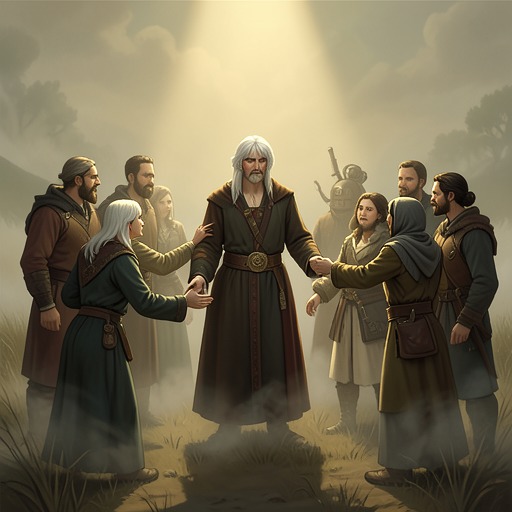
Eshara
New Life as a Max Level ArchmageEshara emerges in recollection as one of Vanguard’s most consequential surviving figures: once the organization’s elvish blacksmith, she has transformed its broken legacy into a wandering campaign against evil. Although she does not call her new organization a guild, her work is described as Vanguard’s spiritual successor, making her less a former member than the person who has carried its purpose into a changed world.
Identity and Reputation
Eshara travels across the continent with a band of heroes, seeking out and slaughtering formidable foes wherever they appear. Her title, the Roving Justicar, captures both halves of her identity: she is a roaming knight devoted to judgment, but also a figure who must remain concealed rather than operate openly. Rafael describes her as a predator’s predator, emphasizing her role as a hunter of intelligent and dangerous monsters, especially those capable of wearing human faces.
Her moral character is presented as intensely principled and unyielding. Rafael’s sardonic tone suggests that these virtues can make her difficult as well as admirable; Eshara does not compromise easily, and her sense of justice governs both her methods and her movements. Her secrecy is therefore practical rather than evidence of estrangement. Rafael states that they are not on bad terms, but that Eshara hides herself out of necessity and often obscures her intentions, making her whereabouts uncertain even to him.
Vanguard’s Spiritual Successor
After Vanguard’s fall and the loss of members of its party, Eshara picks up the fallen swords of Vivi’s former companions and goes to war against all evil. The image makes her continuation of Vanguard literal as well as ideological: she inherits the weapons and unfinished purpose of the dead, then carries them into a solitary, continent-spanning struggle.
Her successor movement is deliberately informal. Eshara has started something that functions as a guild without accepting that name, suggesting an organization defined by action and shared mission rather than established institutions or public administration. Its band of heroes follows her through repeated confrontations with great foes, preserving the adventuring and protective role associated with Vanguard while placing it under a more personal, uncompromising form of justice.
Power and Status
Eshara is not merely an idealistic survivor. Rafael considers her possibly the most accomplished of the surviving figures when measured by sheer levels. She is Titled and, importantly, not newly elevated: he estimates her rank to be in the thirteen hundreds. That status places her among the most revered knights in the Kingdoms and gives material weight to the reputation surrounding the Roving Justicar.
The contrast between her former trade and her later renown sharpens the character’s trajectory. Eshara was once known within Vanguard as its blacksmith, a role associated with sustaining other heroes by making and maintaining their equipment. In the aftermath, she becomes a frontline champion in her own right, yet her new mission remains shaped by that earlier connection to the party’s weapons. The blacksmith who supported the heroic enterprise becomes the knight who preserves it after its original members have fallen.
Connections and Possible Return
Vivi learns about Eshara through Rafael’s account and immediately recognizes her as Vanguard’s former elvish blacksmith. She asks whether Eshara will rejoin them, but Rafael answers only by pointing to Eshara’s character: the question cannot be separated from the fact that she is Eshara, secretive, self-directed, and resistant to predictable commitments. Vivi interprets this guarded answer as implying that Eshara may return, though no reunion is confirmed.
That uncertainty is central to Eshara’s narrative function. She remains alive or at least possibly alive, active somewhere beyond the group’s immediate reach, and powerful enough to alter the balance of any future gathering. Her absence is not emptiness: it is the condition under which her legend grows. She continues Vanguard’s purpose while refusing the ordinary visibility of a restored institution, leaving the possibility of return suspended between promise and warning.
Narrative Significance
Eshara represents a version of heroic continuity that does not depend on restoring the old order. Vanguard may be remembered through its fallen swords, but Eshara turns remembrance into ongoing violence against the forces she judges evil. Her story also complicates the idea of a clean return: rather than coming back to the former party, she has created a new, mobile form of fellowship and chosen concealment as part of its survival.
Through Eshara, the narrative presents justice as both protection and burden. Her principles make her revered, her level makes her formidable, and her secrecy keeps her alive and effective; the same qualities also make her difficult to contact and impossible to command. She is therefore framed not as a passive remnant of Vanguard, but as its most independent continuation—a hidden knight whose future reappearance could reconnect the old heroes’ legacy with the conflicts still unfolding across the continent.