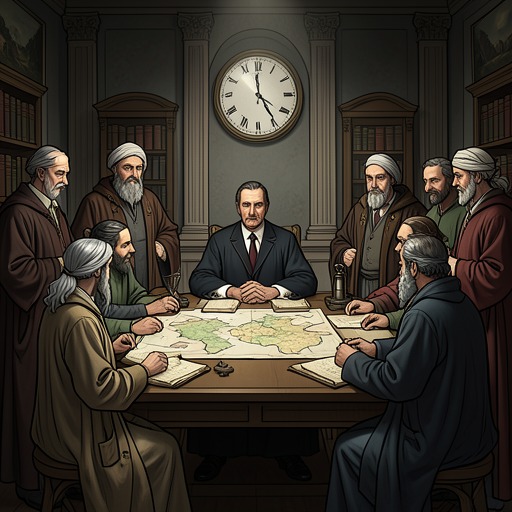
House Keresi
New Life as a Max Level ArchmageHouse Keresi is a demonic noble house of the First Blood, a status treated as comparable to ducal rank and recognized across the political order. Its importance is not merely ceremonial: the house possesses the authority to validate identities, open restricted institutional doors, and compel powerful rivals to reconsider how they handle even an apparently minor confrontation involving one of its members. Its influence is most clearly revealed when Nysari Keresi’s appearance in Meridian forces Duke Caldimore to seek confirmation from the family’s head and when the house responds by placing its full collective strength behind her.
Status and Institutional Recognition
House Keresi’s First Blood standing grants its members unusual privileges within the Thaumaturgical Institute. When Vivi entered the Institute’s Library without an ordinary badge, the receptionist explained that any member of the First Blood could use all but the highest level of the Library, while the Deep Archives remained restricted to Grand Magi and officials with the required clearance. The privilege depended on identity rather than convenience: the receptionist was visibly nervous about admitting a strange demonic mage and requested documents to verify Vivi’s claim. Vivi established the connection through a signet ring and a letter of credence signed by the patriarch of House Keresi. The receptionist examined the seal with an enchanted magnifying glass before returning both items and addressing Vivi as Lady Keresi. The exchange demonstrates that House Keresi’s authority is materially legible. Its seal functions as a recognized instrument of authentication, while its patriarch’s written endorsement can convert a potentially suspect outsider into a person entitled to aristocratic access.
Demonic Aristocracy and the Family Head
The house belongs to a demonic high nobility whose members are often powerful adventurers. Damon Caldimore regards Mizar Keresi as representative of a broader problem within demonic society: high nobles frequently abandon their responsibilities for weeks or months to pursue level advancement in the wilderness. Damon distinguishes between martial strength and the administrative abilities required of a genuine ruler, arguing that exceptional combat power does not automatically confer judgment, competence in delegation, or the ability to manage an estate, levy taxes, and organize society. Despite that disdain, Damon acknowledges the strength of Mizar and his people. Demons possess the highest average level among the common races, and their population is much smaller than humanity’s while still producing comparable numbers of Titled individuals. House Keresi therefore occupies an ambiguous position in Damon’s thinking. He considers demonic nobility politically crude and excessively warlike, yet he recognizes that its military capacity is formidable enough to demand respect. Mizar’s authority is also connected to his absence. Because the head of House Keresi is often away pursuing advancement, the family’s aristocratic identity exists alongside a culture in which personal power and lineage are difficult to separate. The house can be administratively distant while remaining politically immediate: even when Mizar is not present, his name, seal, and potential retaliation continue to shape how others act.
The Meridian Dispute
A member of House Keresi appeared in Meridian and became involved in a minor conflict connected to the Caldimore family. Damon presented the incident to Mizar as a diplomatic inquiry. He claimed that he wanted to confirm whether the woman was truly a member of House Keresi, noting that she had carried a seal that did not appear forged, and to assure the head of the house that he was taking steps toward an amicable resolution. He framed the outreach as an effort to avoid offending a First Blood house with which he had previously maintained cordial dealings. Damon’s stated motives were incomplete. His real purpose was to obtain information about a matter that had aroused his suspicion, not simply to perform courtesy between noble families. The exchange therefore exposes the political function of House Keresi’s reputation: even a powerful duke must cloak investigation in the language of respect and reconciliation when the person involved belongs to the house. The dispute became sharper because the woman was described as an orphaned commoner who had assaulted Damon’s daughter. Mizar reacted with open bewilderment at the combination of those facts, then declared that House Keresi stood behind Nysari Keresi in every matter. He demanded that Damon accommodate her or face the full might of the family’s collective anger, sealing the warning with an oath on his honor. The response was harsher than Damon expected and disproportionate, in his view, to the apparent offense. Yet that disproportion is precisely what makes the house’s protection effective: Nysari’s individual status is transformed into a collective claim that Damon cannot safely dismiss.
Relations with the Caldimores
The confrontation places House Keresi in direct diplomatic tension with House Caldimore. Damon attempts to preserve the appearance of an amicable settlement, telling Mizar that matters are nearly resolved and that the scrying contact was made only to confirm Nysari’s identity and keep her family informed in good faith. His choice to rely on a falsehood shows that House Keresi’s reaction has altered his position. He is no longer dealing only with an alleged assault or an uncertain young woman; he is managing the expectations of a First Blood house whose honor has been formally engaged. The wider Caldimore response also develops through negotiation. Vivi later learns from Rafael that Duke Caldimore appears receptive to a token of apology, although the proposed payment is initially called a bribe before being recast as a token of gratitude. Rafael explains that the duke will not accept it without first meeting Nysari Keresi. The demand makes House Keresi central to the next diplomatic step: the settlement cannot proceed through compensation alone because the duke requires contact with the family whose member has become the source of the dispute. This political pressure gives House Keresi a reach beyond its visible appearances. Its influence operates through documents, family reputation, threats of retaliation, and the need for rival nobles to secure its consent. The house does not need to control the entire situation directly to determine its shape; its recognition or displeasure becomes one of the conditions under which other powers must act.
Narrative Significance
House Keresi joins two forms of power that the surrounding narrative repeatedly contrasts: the bureaucratic power of names, seals, permissions, and official standing, and the raw power of demonic bloodlines and collective retaliation. At the Library, the house is a credential that opens doors while the Deep Archives remain closed. In the dispute with Damon Caldimore, it becomes a shield around Nysari and a threat capable of forcing a duke into diplomatic caution. Its significance also lies in the tension between aristocratic legitimacy and personal capability. Damon’s criticism of demonic nobles attacks the assumption that strength makes a person fit to rule, but Mizar’s response shows that political power does not depend on administrative elegance alone. A family capable of acting as one, defending its member without hesitation, and making that defense credible possesses a form of authority that cannot be reduced to individual level or battlefield prowess. The house’s appearance is therefore brief but structurally important. It authenticates identity, determines access, complicates the Caldimore conflict, and turns Nysari’s uncertain social position into a protected aristocratic one. House Keresi represents a lineage whose members may be distant, unconventional, or difficult to classify, yet whose collective name remains powerful enough to redraw the boundaries of a dispute.