Information is power
New Life as a Max Level Archmage“Information is power” functions as the governing expression of Rafael’s public career and private ambition. It begins as a practical belief in the value of intelligence, but the narrative sharpens it into a theory of political authority: knowledge grants leverage, the appearance of knowledge can preserve that leverage, and even the illusion of possessing information may become power in its own right.
Rafael’s Network and the Search for Purpose
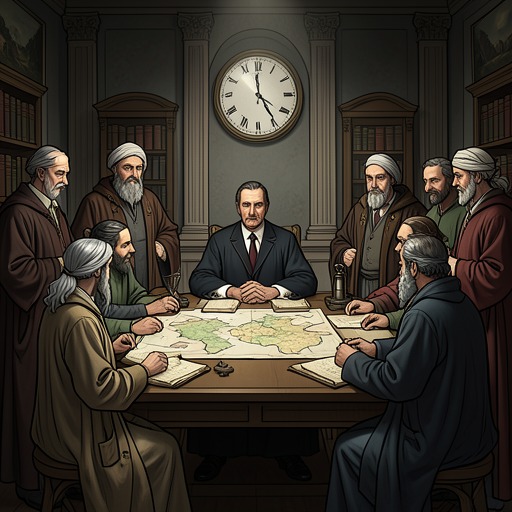
Rafael’s authority is grounded in information rather than battlefield prowess. As Steward of Vanguard, he served as the point of contact for the legendary Party of Heroes, while refusing to claim any honor for personally slaying the Cataclysms. The Heroes were the visible grandeur of that achievement; Rafael understood himself as the foundation beneath them. In the present, he runs the most comprehensive information network in the human kingdoms and captains the Adventurer’s Guild, giving the expression a concrete institutional form rather than leaving it as an abstract proverb.
That achievement has not satisfied him. Rafael made the Adventurer’s Guild into an efficient, comprehensive machine, solving its practical problems within a decade and spending the following nine years refining details that he considered increasingly routine. The work once offered pleasure through its scale, but after a century he finds that even a perfectly functioning institution cannot replace the danger and significance of the Cataclysms. His network was therefore assembled as a reserve of possibility: he planted its power during his time in Vanguard so that it might one day be brought to bear on a task worthy of it. Information matters to Rafael most when it can be converted into decisive action.
From Knowledge to Political Appearance
The expression becomes more sophisticated when Rafael confronts the return of Vivisari Vexaria, the Sorceress. He has no clear explanation for her reappearance and wonders whether it signals a new threat, perhaps even an approaching Eighth Cataclysm. The nearness of the hundredth Peace Day becomes one more piece in an accumulating body of evidence, theory, and context, but the available information does not yet yield certainty.
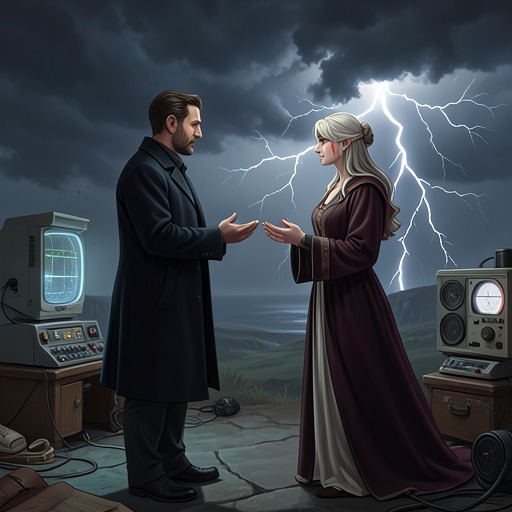
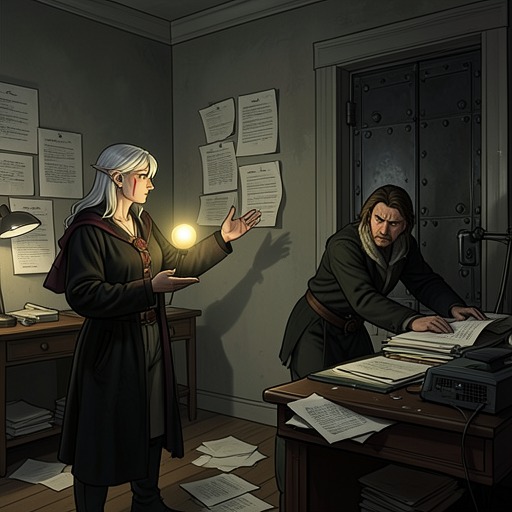
Rafael’s response is not to admit that uncertainty. He reasons that information is power, that the illusion of power is also power, and that such illusions form part of the foundation of politics and help keep kings on their thrones. From there he reaches the expression’s most unsettling extension: if the appearance of power has force, then the illusion of information must possess force as well. His smooth greeting to Vivisari, delivered almost immediately after recognizing that the Sorceress is sitting in his office, is an attempt to manufacture the impression that her visit was expected. The performance is strategic precisely because he has been caught off guard; his authority depends not only on what he knows, but on controlling what others believe he knows.
Information as a Material System
The narrative repeatedly shows that information is carried and authorized by systems, objects, and institutions, not only by individual minds. The Convoy is an armored train built to cross thousands of miles of monster-infested territory, with mana-powered gun turrets stationed along its length. Its armor, artillery, rail lines, and operational infrastructure turn knowledge of dangerous routes into organized movement and survival. Likewise, the Convoy’s power compartment contains eight slots traced with artificing lines. When Saffra brings two inert power cores near it, an invisible force draws them into place; pulling the lever converts them into humming sources of mana that send energy through the train. The machine makes stored knowledge of magical engineering materially consequential.
The same principle governs the reopened Vanguard guildhall. Its interior is larger than its exterior because the System has translated the guild’s tier structure into spatial expansion: upgrading a guild enlarges its interior while preserving a reasonably sized building and plot. What once belonged to the architecture of Seven Cataclysms appears to have crossed into the world through the System, transforming a game-like rule into a functioning institution. The guildhall’s capacity, its tier, and its potential resources are therefore forms of encoded information that determine what actions are possible.
Rafael’s guild administration provides another example of knowledge becoming action through procedure. After Mae and Vivi sign the necessary forms, the System recognizes Vivi’s signature as valid. The quest on Rafael’s desk then ignites in golden fire, consumes itself without leaving ash or scorch marks, and confirms that Vanguard has become a tier-one guild. The consequence is immediate access to the craftsmen’s quarters and at least part of the vault, including the restoration of Mae’s laboratory. A signature, a charter, and a quest condition do not merely describe institutional status; they produce it.
Inspection, Approximation, and the Limits of Knowing
The expression also has an epistemic limit. When Vivi attempts to inspect one of the strange violet-and-black plated creatures emerging through the dimensional breach, the inspection fails. Instead of yielding a complete identification, it provides only an approximation: Greater Voidling. The failure matters because the creatures’ alien carapaces appear to be the source material for the Red Tithe’s voidglass dagger and armor. Information remains powerful even when incomplete, but its authority is no longer absolute. The system can classify the unknown without fully mastering it, offering a provisional label where certainty is unavailable.
This moment contrasts with Rafael’s deliberate use of incomplete knowledge. Vivi receives an explicit approximation because the system cannot inspect the creature normally; Rafael, by contrast, turns uncertainty into a controlled social impression. In one case, the limits of knowledge are exposed. In the other, the appearance of knowledge is deployed as an instrument of power. Together, these scenes make the expression more than a celebration of intelligence: they show how classification, infrastructure, bureaucracy, and performance all determine who can act, who must wait, and who is believed.