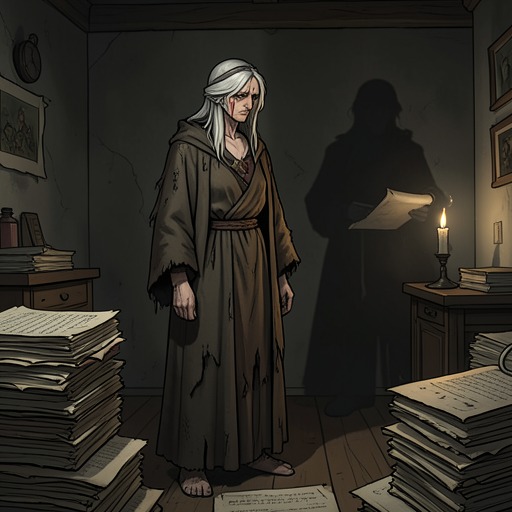
Isabella
New Life as a Max Level ArchmageIsabella is the Caldimore daughter at the center of Saffra’s deepest personal grievance. The available narrative presents her less through sustained direct action than through the emotional afterlife of what she did: eight months after Saffra’s expulsion from the Institute, Saffra still wonders whether Isabella cared, whether the betrayal had been a joke, and whether Isabella laughed before forgetting her entirely. That absence becomes part of Isabella’s significance. She remains present as an unresolved question in Saffra’s mind, while Saffra suspects that she has already become irrelevant to Isabella.
Identity and Social Position
Isabella belongs to the Caldimore family, and her family name carries enough social weight to make her association with Saffra politically and emotionally consequential. Saffra is a silver-rank adventurer with limited formal education, while Isabella is connected to the aristocratic world represented by Lord Barnaby Caldimore. The contrast is visible in public etiquette: when a nobleman sees Saffra and Vivi together in a carriage, he disguises his disapproval beneath polished courtesy and probes how two adventurers could have afforded their tickets. That scene establishes the social environment in which Isabella’s relationship with Saffra must be understood. Saffra’s practical gear and badge announce her position openly; Isabella’s family name functions as a different kind of badge, carrying inherited authority and protection.
The narrative also places Isabella within a family structure that does not erase conflict between rank and personal obligation. During the later crisis in which Isabella’s life is endangered, Saffra confronts the family’s response with furious disbelief, insisting that Isabella is Damon Caldimore’s daughter and demanding to know what is wrong with him. The accusation exposes the moral pressure created by Isabella’s status: her identity should make her especially difficult to abandon, yet the emergency has become so severe that even her rescue is uncertain.
Betrayal and Saffra’s Memory
Isabella’s defining plot function is her betrayal of Saffra and the expulsion that followed. Saffra no longer attends the Institute because of that episode, which makes Isabella’s name inseparable from a concrete institutional consequence. When Saffra notices Lord Barnaby Caldimore aboard the Convoy, she is irrationally afraid that he will recognize her, but he does not. The realization is humiliating in a different way: Saffra concludes that her expulsion was unimportant to everyone, including the family most involved in it.
The thought immediately turns toward Isabella. Saffra asks herself whether Isabella even cares what she did and whether the entire affair had merely been a joke. She then forces the thoughts away, declaring that she is finished thinking about her. The declaration does not resolve the attachment; it proves its persistence. Saffra’s later boast about channeling at fifth-tier, approaching sixth, despite not having reached the fourth-tier benchmark and possessing half the education of most casters, is partly a defense against that spiral. She feels embarrassed as soon as she speaks, recognizing that her pride is being used to cover an older injury.
The passage of eight months intensifies rather than reduces the wound. Saffra is furious that she still cares so much, while imagining that Isabella laughed for days and then forgot her. Isabella therefore controls the scene without appearing in it. Saffra’s interpretation may be uncertain, but the emotional fact is clear: Isabella’s betrayal continues to shape Saffra’s self-image, her resentment toward the Caldimores, and her need to prove her own competence.
Encounters, Absence, and Recognition
Isabella’s presence is repeatedly displaced into acts of concealment and recognition. Vivi initially uses an Illusion to hide the red tear trails beneath her eyes, hoping to remain incognito while gathering information about the world. Later, after facing Winston, she dispels the Illusion concealing her face and accepts the consequences of being recognized. These moments do not directly depict Isabella, but they illuminate the broader narrative system in which identity is managed through appearance, names, and family affiliation. Saffra’s fear that Barnaby might identify her shows how thoroughly Isabella’s family remains attached to the danger of public recognition.
Isabella is also connected to the story through Mae, whose earlier identity is revealed when she meets Vivi again. Mae identifies herself as the alchemist from Jasper’s team and says that she has been using that name for some time. Her hesitant approach, her withdrawn hand, and her admission that she thought she would never see Vivi again contrast sharply with Saffra’s imagined picture of Isabella as someone who laughed and forgot. The contrast does not redeem Isabella, but it clarifies why Saffra experiences the Caldimore relationship as uniquely painful: other lost connections can return with vulnerability and regret, while Isabella’s motives remain inaccessible to her.
Crisis and Possible Death
By the final supplied scene, Isabella is no longer merely the source of a past grievance; she is a person whose survival has become uncertain. Saffra struggles against Rafael as he tries to restrain her, then cries out that Isabella is Damon Caldimore’s daughter and condemns his apparent failure to respond as a father. Rafael agrees with the principle of Saffra’s outrage, but views her emotional intervention as a dangerous delay in a time-sensitive disaster. He considers Isabella’s survival unlikely.
This crisis changes the moral temperature of Isabella’s role. Earlier, Saffra’s question was whether Isabella had cared about the harm she caused. Now the question is whether Isabella is alive at all, and whether her family will act before it is too late. The movement from remembered betrayal to threatened death does not erase the old conflict. Instead, it forces Saffra to act for someone she believes may have wronged her, making the unresolved relationship a test of whether resentment can coexist with rescue.
Narrative Role and Significance
Isabella is a character of powerful indirectness. The evidence gives no extended account of her own voice or motives, so her characterization is mediated through Saffra’s recollection, Vivi’s awareness of the Caldimore name, and the emergency surrounding her possible death. That limited access is narratively important: Isabella functions as both a person and a blank space onto which Saffra projects uncertainty, humiliation, and anger.
Her role also exposes the unequal distribution of social and emotional power in the setting. Saffra bears the lasting consequences of the Institute expulsion, doubts whether the Caldimores remember it, and compensates for her pain by boasting about her magical ability. Isabella, by contrast, is protected by the symbolic force of her family name even when she is absent from the narrative. The later rescue crisis complicates that privilege by placing her in a position of extreme vulnerability.
Isabella’s decisive significance lies in this unresolved contradiction. She is at once the aristocratic figure who helped destroy Saffra’s place at the Institute and the endangered daughter whose possible death provokes Saffra’s immediate outrage. Whether Isabella ever understood the damage she caused remains unanswered, but the story demonstrates that her actions have not been forgotten. They continue to organize Saffra’s memories, pride, hostility toward the Caldimores, and ultimately her willingness to confront the family on Isabella’s behalf.