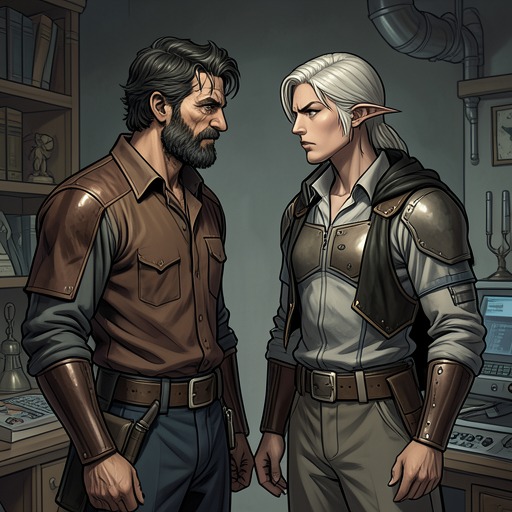
Jasper—Mae
New Life as a Max Level ArchmageJasper—Mae is an emotionally charged relationship that remains suspended between friendship, partnership, and romance. Mae and Jasper share a home, a team, practical obligations, and unmistakable mutual desire, yet Mae refuses to convert that desire into a short-lived affair. The central obstacle is not lack of attraction but the unequal longevity of their species: Mae is an elf, while Jasper is human, and she fears that a serious bond would end with her outliving him. Their connection therefore becomes a test of whether devotion can be made durable rather than merely intense.
Shared Life and Everyday Intimacy
Mae’s alchemy lab serves as the Iron Vipers’ informal guildhall, with living quarters added around the workspace. The place belongs to Mae, but she allows her teammates to stay there, giving Jasper access to a domestic environment that is also unmistakably hers. When he returns from his northern expedition, he calls into the building that he is home, and Mae answers from the laboratory with an immediate rebuke to his familiar endearment. The exchange is comic on its surface, but its ease depends on a settled intimacy: Jasper expects to be welcomed, Mae knows his habits, and both are comfortable enough to argue before the day has properly begun.
Their closeness is expressed through observation as much as affection. Mae notices that Jasper has been drinking without looking directly at him, recognizes the signs despite his hesitation, and criticizes him for damaging a body that already functions poorly even when sober. Jasper, in turn, understands that her concern is not casual nagging. He knows that her objections arise from a serious view of health, longevity, and the consequences of habits that cannot be erased by a single health potion.
The Lifespan Barrier
Mae’s warning about alcohol develops into the relationship’s deepest conflict. Health potions cannot reliably repair immediate trauma, and they cannot prevent the long-term organ deterioration associated with substance abuse. For long-lived people, Mae argues, accumulated damage eventually matters; a human may survive reckless habits across a comparatively brief life, but someone who lives for centuries must treat the future body as a continuing responsibility. Her position is both medical and relational, because Jasper’s health determines whether a possible future together could last.
The text makes the species difference explicit rather than treating it as a decorative obstacle. It is reasonable for an elf to reject romantic involvement with a human when the likely result is a profound mismatch in remaining years. Mae has admitted that she and Jasper want each other, but she does not pursue temporary relationships and refuses to accept a fling as a substitute for commitment. Early in their association, she tells him that she would consider the possibility only if he reaches Titled, so that a serious relationship would not end with her suddenly losing him. The condition transforms advancement from a purely personal ambition into a possible answer to an intimate fear.
Mutual Desire and Deliberate Refusal
Mae’s behavior creates a persistent pursuit-and-withdrawal pattern. She gives Jasper obvious, apparently accidental indications of interest, then refuses to act on them. That contradiction frustrates him because it prevents him from moving on while also denying him the relationship he wants. Her restraint is not presented as indifference; it is the method by which she protects a standard she considers necessary. She does not want an attachment whose ending is built into its beginning.
Jasper responds with equal stubbornness. There are easier ways to find sexual companionship than earning a Title, but he does not choose those easier ways. Instead, he remains fixated on Mae, to the point that his inability to pursue anyone else becomes a source of embarrassed self-mockery. His celibacy is not the result of an explicit promise between them. It is the consequence of desire so focused that Mae’s refusal has not freed him from her influence. The relationship’s tension comes from that asymmetry: Mae controls the boundary, but Jasper voluntarily continues to orient his life toward the possibility beyond it.
Jealousy, Curiosity, and Partnership
Jasper’s return from the Northern Kingdom brings the relationship’s emotional undercurrents into sharper view. He has obtained the Arctic Essence Gland that sent him on the expedition, and he tells Mae that he nearly froze himself hunting or recovering it. When he mentions owing a female figure twice over, Mae immediately asks who she is. Her initial jealousy shifts into interest when Jasper explains that the woman was a dragon, and her questions become more specific about the encounter’s location outside the Sky-Pillar Range.
Mae’s reaction exposes feelings that her stated refusal cannot fully contain. Her jealousy is not theatrical or openly possessive; it appears as an involuntary response before curiosity takes over. The dragon matters because she may be a rival, a danger, or simply an unknown influence on Jasper, but the larger significance is that Mae reacts as someone emotionally invested in where his attention goes. Jasper attempts to dismiss the subject as nothing more than a dragon he met, preserving the teasing evasiveness that characterizes their conversations while also revealing how carefully he manages Mae’s attention.
Their practical partnership remains intact despite the romantic stalemate. Mae makes potions for the whole Iron Vipers team rather than for herself alone, and she treats that shared production as Jasper’s reward for securing the gland. Care and obligation are therefore built into the same exchange as flirtation and jealousy. Their bond is neither purely domestic nor purely erotic: it is also an adventuring alliance sustained through resources, risk, craft, and mutual dependence.
Unresolved Future and Narrative Meaning
Jasper—Mae has no confirmed romantic resolution in the supplied material. Mae has not abandoned her demand for a durable future, and Jasper has not abandoned the effort that might satisfy it. Their relationship consequently remains an open promise rather than a completed romance. The condition of reaching Titled gives the tension a concrete threshold, while the continuing mismatch between human and elven longevity prevents the threshold from becoming a simple courtship device.
The relationship’s distinctive force lies in its refusal to equate mutual desire with immediate fulfillment. Mae’s care is expressed through reprimand, health advice, and refusal; Jasper’s devotion appears through persistence, embarrassment, and willingness to pursue an extraordinary personal goal. Their banter keeps the connection alive, but the serious issue beneath it is whether love can overcome the limits imposed by bodies, time, and unequal lifespans. Until that question is answered, the Iron Vipers’ shared home remains both a place of ordinary companionship and the setting of a romance deliberately held at the edge of possibility.