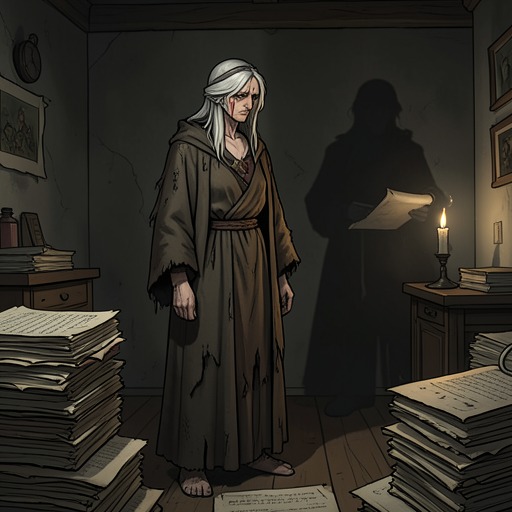
Library Encounter with Isabella Caldimore
New Life as a Max Level ArchmageLibrary Encounter with Isabella Caldimore is a brief but decisive confrontation in the Thaumaturgical Institute Library. What begins as a quiet research outing for Vivisari Vexaria and her apprentice Saffra turns into an involuntary reunion with Isabella Caldimore, Saffra’s former friend and the daughter of Duke Caldimore. Saffra’s terror, Isabella’s own shock, and the absence of any simple accusation transform the scene from an awkward meeting into evidence that the history between them may contain two victims rather than one clear aggressor and one clear target.
Setting and Immediate Circumstances
The encounter takes place on the first level of the Institute’s restricted archives. Vivisari Vexaria has been allowed to bring Saffra inside because of her credentials and because she has formally named the cat beastkin her apprentice. The floor is less imposing than the Institute’s main, arena-like library: its shelves are smaller and fewer, and the room resembles an ordinary library despite its restricted status. Saffra is much more interested in the books than Vivisari Vexaria, while Vivisari Vexaria judges the Institute’s hidden spell designs to be crude by her own standards.
The peaceful exploration ends when Saffra rushes around a corner in a panic and begs to be hidden. Vivisari Vexaria reacts immediately rather than freezing: she draws and shapes mana, silently casts Invisibility, and causes Saffra to disappear behind her. The spell is a practical response to an immediate threat, but it also establishes the unequal emotional positions of the two characters. Saffra is reduced to trembling concealment, while Vivisari Vexaria becomes the controlled barrier between her apprentice and the approaching person.
The Reunion
The person who appears is a tall teenage student in uniform, with long straight blonde hair, regal but gaunt features, and blue eyes marked by frantic panic. She looks physically unwell, as though she has not been eating properly for months, and her expression recalls to Vivisari Vexaria the horror she had seen in Archmage Aeris when he first encountered her. The girl searches the hallway and demands to know where the missing person has gone. Vivisari Vexaria answers evenly and denies knowing whom she means.
The concealment is successful. After the student apologizes and flees, silence settles over the shelves, while Saffra remains behind Vivisari Vexaria for several long moments, gripping the back of her robes. Vivisari Vexaria then dispels Invisibility and tries to treat the incident as a problem of inadequate disguise. The attempt at lightness fails because Saffra is not merely embarrassed at being recognized. She finally mutters that the girl was the only person who would recognize her, revealing how completely the encounter has narrowed her emotional world to this one former relationship.
Vivisari Vexaria identifies the student as Isabella Caldimore, daughter of Duke Caldimore. The identification is initially an inference, but the scene’s emotional evidence makes it compelling: Saffra’s reaction is far more severe than ordinary fear of being caught by a former classmate, and Isabella’s appearance is not triumphant or hostile. She seems horrified and desperate, then leaves without discovering Saffra’s hiding place. The reunion therefore contains no reconciliation and no open accusation. Its force comes from recognition interrupted before either girl can speak honestly.
Saffra’s Reaction and Vivisari’s Reassessment
The encounter leaves Saffra miserable and distracted. When Vivisari Vexaria asks what happened, Saffra gives only the narrow explanation that Isabella saw her and she ran away. She then insists that Isabella does not matter and should be forgotten, but the claim lacks conviction. Her squared shoulders attempt to project resolve, while her drooping cat tail reveals the feelings she cannot suppress. When she walks away, Vivisari Vexaria follows, uncertain whether a responsible mentor should demand an explanation or allow the wound to remain closed.
Saffra’s partial outburst indicates that Isabella was connected to the event that destroyed her trust: Saffra refers to Isabella as the person who got her, but does not explain what that means. The wording leaves the precise circumstances undisclosed while making the betrayal unmistakable. Vivisari Vexaria already knows that Saffra considers Isabella a former friend who betrayed her, yet Isabella’s behavior complicates that judgment. A two-faced bully would not obviously respond with the same panic and horror as the person she supposedly victimized.
Vivisari Vexaria consequently begins to suspect that the accepted account is incomplete. She does not excuse Isabella or deny Saffra’s suffering; instead, she recognizes that the evidence does not fit a simple bully-and-target arrangement. The scene’s central revelation is therefore not a newly explained backstory but a changed interpretation of the existing one: there may be two victims in the debacle. That suspicion becomes more important than any immediate explanation, because it prevents Saffra’s anger from closing the matter permanently.
Consequences and Narrative Significance
The library trip ends early. Although Saffra tries to wear an indifferent mask, the encounter has ruined the rest of the outing, leaving her visibly distracted. Vivisari Vexaria decides that the two of them can return another time, preserving the practical possibility of continued research while acknowledging that the emotional crisis cannot be solved by pretending nothing happened.
The event also develops the relationship between Vivisari Vexaria and Saffra. Vivisari Vexaria’s first instinct is protective action: she hides Saffra, stands between her and Isabella, and remains calm while Saffra trembles behind her. Yet she is not given the easy role of omniscient mentor. She does not know how to handle the situation, does not know the full history, and cannot force Saffra into an explanation. Her mentorship therefore operates through presence and protection rather than immediate interpretation or control.
The meeting further establishes Isabella Caldimore as a morally ambiguous figure rather than a fully explained antagonist. Her gaunt appearance, physical sickness, and panic do not erase the betrayal remembered by Saffra, but they make Isabella’s own distress impossible to ignore. The scene deliberately withholds the missing causal account, using the failed reunion to create a durable question about coercion, responsibility, and the difference between causing harm and being trapped within the circumstances that produced it.
Wider Historical Contrast
The encounter occurs against a world that constantly turns trauma into public memory. In Prismarche Temple, images of the Party of Heroes appear among stained-glass saints and heroes, including an image of Vivisari Vexaria herself. A priest explains that the Party of Heroes defeated the seventh and final Cataclysm a hundred years earlier, though all but the Sorceress perished. The city’s Peace Day Festival then celebrates a century free from the Cataclysms, even as the newer generation knows the horrors of the Rampant Genesis, the Crimson Blight, and the Great Conflagrations mainly through inherited stories and representations.
That public treatment of catastrophe contrasts with the private, unresolved disaster between Saffra and Isabella. The city can give its historical violence a clear ending, honor its heroes, and commemorate survival through a festival. Saffra and Isabella possess no such settled ritual. Their past returns in a library corridor, through a panicked demand and a vanishing body, and remains legible only through gestures, illness, silence, and avoidance. The event thus places personal betrayal beside the world’s larger history of Cataclysms: both are shaped by aftermath, but only one has been granted a triumphant public narrative.
The broader story also repeatedly questions whether apparent salvation can be understood correctly. Archmage Aeris fears that another Eighth Cataclysm may always be waiting beyond the horizon, while Vivisari Vexaria’s overwhelming defeat of the Greater Voidbeast is interpreted by witnesses as the intervention of a god rather than merely the return of a legendary sorceress. In the library encounter, the same interpretive instability operates on an intimate scale. Saffra appears to be the injured party and Isabella the betrayer, but the visible evidence demands caution. The meeting’s significance lies in reopening that uncertainty and making the unresolved past an active force in both women’s present.