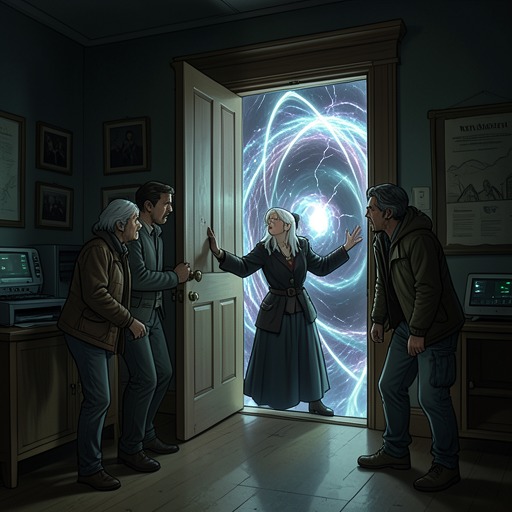
Meeting between Nysari Keresi and Duke Caldimore
New Life as a Max Level ArchmageThe Meeting between Nysari Keresi and Duke Caldimore is significant because it transforms a seemingly manageable dispute into evidence of a larger threat. Vivisari Vexaria enters the Wardens’ Guildhall intending to settle the conflict through apology, money, and political courtesy, particularly to secure William Trent’s release from prison. Duke Caldimore refuses the expected compromise, treats the offense against his daughter as a matter of honor rather than price, and behaves with an inexplicable recklessness that alarms both Vivisari Vexaria and Rafael.
Causes and Diplomatic Purpose
Vivisari Vexaria arranges the meeting after an incident involving her apprentice, Saffra, William Trent, and Duke Caldimore’s daughter. Her stated objective is not to force the Duke to forgive Saffra or to erase what happened between the two young women. Instead, she wants to bring the imprisonment of William Trent to an end and prevent the quarrel from developing into a feud between powerful houses. Rafael prepares her for the negotiation and advises her on the Duke’s likely conduct, leading her to expect that a substantial payment and a carefully worded apology might be enough to restore practical relations.
Vivisari Vexaria therefore adopts language designed by Rafael rather than language that comes naturally to her. She apologizes on behalf of both Saffra and William Trent and proposes that the two houses set aside the unfortunate events in favor of a mutually beneficial settlement. The effort reflects her priorities at this stage: she is willing to suppress personal irritation and abandon vindictive satisfaction if doing so can resolve the conflict with minimal fallout. Her immediate concern is William Trent’s freedom, while Saffra’s position remains entangled with the Duke’s belief that she attacked his daughter.
The Negotiation and Its Reversal
Duke Caldimore frames the meeting as brief and formal, acknowledging that both he and Vivisari Vexaria are occupied with more important demands on their time. He presents himself as willing to discuss an amicable conclusion, but his controlled manner soon gives way to a pointed defense of family honor. He declares that he will not tolerate disrespect or meekly ignore an assault on his own flesh and blood, while allowing that youth may produce mistakes and that hardship may sometimes improve a person’s character.
His central argument is that Saffra’s offense cannot be dismissed through a token apology. In his account, Saffra had received an extraordinary privilege at the Institute: tuition, supplies, and an education beyond the reach of most students. By attacking his daughter, she allegedly repaid that generosity with grave disrespect. Duke Caldimore concedes that Saffra might have changed after her expulsion and the hardships that followed, but insists that personal growth does not cancel the original offense. His position makes clear that the dispute is not merely a financial claim. It is a contest over status, obligation, and the right of House Caldimore to demand recognition of its injured honor.
Vivisari Vexaria responds that she is not asking for forgiveness. She is extending an apology and seeking to end a particular imprisonment. When the Duke continues to resist, she offers to double the proposed payment and then triple it. The offer is deliberately practical: she believes that nearly any sum can be earned back quickly, and that paying to remove an obstacle is preferable to allowing a political quarrel to grow. The Duke’s reaction confirms that Rafael’s original sum was already substantial. His refusal is not an attempt to extract more money; the offer instead reveals that money is not the true issue, and that his earlier resistance was partly intended to provoke or test her.
The Duke finally grants himself two days to deliberate and claims that he wishes the houses to remain on friendly terms. His words are formally conciliatory, but his tone and manner undercut them. He gestures toward the door rather than escorting Vivisari Vexaria out, turning the conclusion into a restrained snub. The meeting ends without William Trent’s release, without a settlement over Saffra, and without any reliable explanation for why Duke Caldimore has chosen such an openly antagonistic posture.
The Hidden Danger
The failed negotiation becomes more disturbing because Duke Caldimore is not ordinarily portrayed as careless. Rafael points out that the Duke has spent his life as a cautious and politically astute man. He recognized that Vivisari Vexaria might have returned as a fresh Titled figure after a long training sabbatical, yet he still insulted her almost directly, despite having no accurate knowledge of her temperament or likely response. To Rafael, that conduct exceeds ordinary arrogance and approaches deliberate self-endangerment. Duke Caldimore is not an idiot, so his behavior must be read as a sign that the normal political calculations have ceased to matter to him.
Rafael identifies two possible explanations. The first is that Saffra’s and William Trent’s offense was genuinely so severe that the Duke’s honor would not permit even the smallest necessary concession. Rafael’s tone indicates that he considers this unlikely. The second, more troubling possibility is that Duke Caldimore no longer cares about the consequences of his actions and has abandoned the diplomatic pretense that governed his public life. Such a change would mean that the negotiation is not the center of the crisis but merely its visible edge.
The meeting also introduces Tobin as another missing piece. Vivisari Vexaria is distracted by the strange man and, more particularly, by his dagger during the encounter. Afterward, Rafael identifies Tobin as a killer who takes pride and pleasure in his work, while admitting that he does not recognize him and cannot yet determine whether he is an assassin. The presence of someone with that profile near the Duke makes the political exchange more ominous. Rafael leaves the meeting intending to contact his associates because the available information is insufficient and because he is convinced that something important has been concealed.
Context of a Returning Legend
The negotiation takes place against the broader historical and religious atmosphere of Vivisari Vexaria’s return. In Prismarche’s Temple, she sees herself and the Party of Heroes displayed among saints and heroes, an image that makes her own legendary status uncomfortably public. A priest explains that the Party of Heroes defeated the seventh and final Cataclysm a century earlier, at the cost of every member except the Sorceress. The century-long distance between that victory and the present explains both Prismarche’s technological transformation and the way the population has converted catastrophe into civic memory.
The Peace Day Festival intensifies that contrast. Citizens celebrate a hundred years of freedom from the Cataclysms, even though later generations have no firsthand experience of the Flesh-Weaver’s Rampant Genesis, the Reaper of the Lost Harvest’s Crimson Blight, or the Ashen Hierophant’s Great Conflagrations. The city reveres the Party of Heroes because those figures saved the world from terrors that remain difficult to imagine. Vivisari Vexaria’s meeting with Duke Caldimore consequently occurs within a society that interprets extraordinary power through heroic and religious symbolism, while its ruling families continue to conduct conflicts through honor, patronage, and controlled insult.
That tension becomes explicit when Master Aeris considers the possibility of another Cataclysm. He observes that the Dragon King might descend from the Sky-Pillar Range, that an ancient horror might awaken, and that another Shattered Oracle could emerge from reckless ambition; in his view, an Eighth Cataclysm is always possible. Later, after Vivisari Vexaria tears a Greater Voidbeast apart with overwhelming ease, observers are more likely to interpret her as a god than as the returning Sorceress. The meeting’s political stakes are therefore magnified by the unstable meaning of Vivisari Vexaria’s identity: she is a legendary figure, a powerful noblewoman, and a force capable of changing the balance between houses without needing to raise her voice.
Consequences and Significance
The immediate result is diplomatic failure. Duke Caldimore has not agreed to free William Trent, has not accepted the offered settlement, and has not reconciled himself to Saffra’s involvement. Vivisari Vexaria leaves before her irritation turns into an open confrontation, recognizing that retreat and reformulation are wiser than continuing to offer money from an unstable position. Her willingness to buy a solution has reached its limit, not because she lacks the funds, but because the Duke’s refusal demonstrates that the dispute is being driven by motives money cannot touch.
The more important consequence is investigative. Rafael’s alarm redirects attention away from the original quarrel and toward the Duke’s altered behavior, Tobin’s identity, and the information missing from the official account. The event shifts the value at stake from simple reconciliation to security and knowledge: Vivisari Vexaria entered seeking an amicable settlement, but leaves with reason to suspect that the apparent feud may be connected to a concealed operation or a deeper collapse in Duke Caldimore’s political judgment.
The meeting also establishes a recurring contrast in the story. Vivisari Vexaria possesses enough power to be mistaken for a divine being, yet she initially approaches House Caldimore through apology, payment, and institutional courtesy. Duke Caldimore, by contrast, has the political experience to understand the danger of provoking her, but acts as though ordinary consequences no longer bind him. That reversal makes the failed negotiation more than a disagreement between nobles. It is the scene in which a practical dispute becomes a warning: beneath the language of houses, honor, and compensation, an unknown force is already shaping the conflict.