Morningstar Ambush
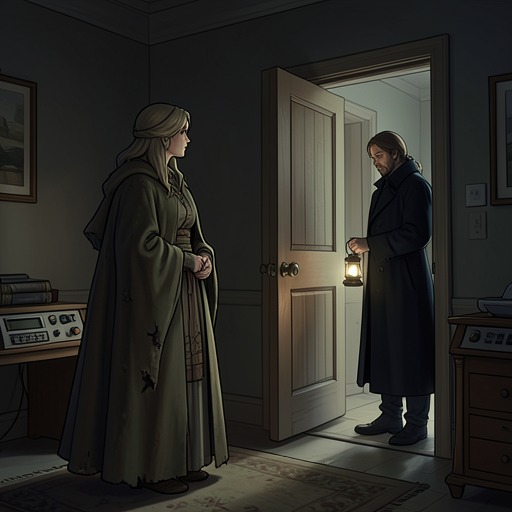
New Life as a Max Level ArchmageMorningstar Ambush is the concealed betrayal that transforms a routine expedition into a life-threatening seizure of Saffra and Allen. Lailah and Dominic exploit the party’s working assumptions, disable Saffra with rune-engraved restraints that consume her mana, and debate whether Allen should be sold alive or killed. The ambush is decisive not only because it places two adventurers in captivity, but because it turns Saffra’s already uneasy suspicion into a real failure of judgment and later forces Vivi to confront the limits of her own vigilance and power.
The Expedition and the Hidden Threat
The ambush begins after the expedition has apparently yielded little beyond the discovery of a Constrictor Creeper. Dominic abruptly stops and raises a fist, the universal sign of danger, immediately bringing Saffra to readiness with her wand raised and a Flame Bolt forming in her thoughts. Lailah identifies the creature, and the moment initially resembles ordinary adventuring procedure: Dominic searches for more Creepers, asks about their weakness to fire, and leaves Saffra to handle the task as the team’s mage.
That apparent normality is the trap. Saffra has been watching Dominic and Lailah throughout the expedition, but Dominic’s behavior gives her no obvious reason to maintain full defensive readiness. His request that she deal with a fire-weak monster makes the division of labor seem logical, while his attention appears directed toward the ground and the surrounding vegetation. The party’s familiar routine therefore becomes the mechanism of its defeat. Saffra’s suspicion is not absent; it is simply made irrelevant by a carefully staged opportunity.
Capture of Saffra and Allen
As Saffra begins gathering the spell near the pulsating Creeper clump, a cold, heavy device closes around her neck. The rune-engraved metal does more than restrain her physically: when she reflexively draws on her mana, the energy vanishes into the metal, which greedily absorbs it. Her magical response, normally her principal means of defense, is converted into another source of helplessness.
Lailah then abandons the pretense of cooperation. She remarks that she had been considering whether the group would need to use brute force and acknowledges that Saffra had watched her closely. Dominic is instructed to deal with Allen while Lailah handles Saffra. Dominic pulls Saffra’s arms behind her and locks manacles around her wrists; when she fights, he tells her that resistance is only hurting her. Allen is thrown beside her, bound and gagged, and left visibly shocked.
The captors’ intention to keep them alive makes the situation more horrifying to Saffra than an ordinary robbery or killing. Death, however violent, would have ended the danger; captivity implies continued use, sale, and loss of control. Lailah’s cheerful, almost friendly manner intensifies the betrayal, because the same conversational ease that had made her seem approachable now accompanies the act of taking Saffra’s freedom.
The Captors’ Stakes and Allen’s Fate
The attackers do not treat the prisoners as merely defeated adventurers. They immediately assess their economic and strategic value. When Dominic suggests that killing Allen would be easiest and that the Cult could pay a good price for his corpse, Lailah counters that an acolyte, especially a promising one, might fetch more alive. The disagreement reveals two competing calculations: Allen is valuable as a living religious initiate, but his continued existence could expose the captors to divination from the temple.
That calculation makes Allen’s identity especially dangerous. His connection to the temple gives him potential institutional protection, but it also makes him a liability for those holding him. The possibility of killing him is discussed as a practical security measure rather than an emotional decision. Saffra is forced to hear the terms of this decision while unable to look at Allen, and her silence and hyperventilation register the moral shock of realizing that both prisoners have become commodities whose lives are being priced.
The encounter also overturns Saffra’s belief that she could rely on her own suspicion to keep herself safe. She had recognized something wrong in Lailah and had monitored the group, yet the attackers still created the precise conditions needed to isolate her. Her realization that she had known, and still failed to act effectively, turns the ambush into an episode of self-reproach as well as external danger.
Vivi’s Delayed Intervention
Vivi had initially dismissed Saffra’s paranoia and returned to Prismarche, but she continued checking the expedition with Farsight. After an hour in which nothing happened, she headed back toward town. When the situation finally deteriorated, she realized that Saffra needed help, yet awareness did not produce instantaneous rescue. Vivi could repeatedly use Blink to cross enormous distances, but she first had to recognize that a crisis existed, and rapid movement still required time.
Vivi eventually saved Saffra and Allen, but the rescue did not erase the consequences of the delay. The event grounded her in the reality of her new life. She had imagined, with increasing detachment, that this world might be an idealized fantasy in which generosity and extraordinary ability prevented serious harm. The ambush disproved that assumption. A teenager and a young man had been traumatized, and Vivi understood that her information and reasonable suspicion might have allowed her to prevent the escalation. Her power was immense without being omnipotent, and the difference mattered.
That realization reaches beyond personal regret. Before arriving in this world, Vivi had lived as an antisocial shut-in who spent most days playing video games and earned enough from online gaming videos to pay for a one-bedroom apartment. Responsibility had been limited and largely avoidable. The ambush forces her to recognize responsibility as an active burden: possessing superior ability does not guarantee timely intervention, and failing to use available knowledge can become part of the harm suffered by others.
Consequences and Narrative Significance
The ambush changes the meaning of vigilance throughout the surrounding story. Suspicion alone is insufficient when enemies can perform cooperation, invoke ordinary procedure, and wait for a target to lower her guard. The event also establishes a recurring tension between magical capability and practical limits. Saffra’s mana is neutralized by the restraints, while Vivi’s mobility is constrained by delayed knowledge and non-instantaneous travel; neither mage can simply treat magic as an absolute answer.
Its consequences continue through Saffra’s later guilt and through the strained moral atmosphere of her relationship with Vivi. When Saffra later worries about the value of a healing potion Vivi gave her and wants the matter brought into the open, her willingness to confess reflects the same burden created by the capture: she is preoccupied with actions whose consequences might have been avoided and with accepting whatever judgment follows. The ambush therefore functions as more than an isolated attack. It is a turning point from adventurous uncertainty to durable accountability, teaching both Saffra and Vivi that the world’s dangers are not merely monsters to defeat but betrayals, institutions, and choices that can make a person responsible even when the original harm was inflicted by someone else.