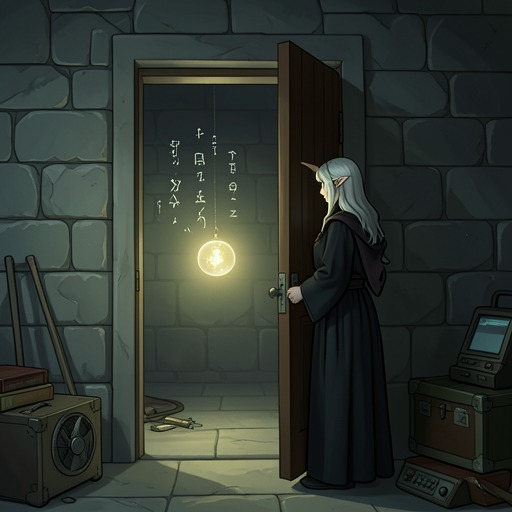
Opening of Osmian’s Door
New Life as a Max Level ArchmageOpening of Osmian’s Door begins when Vivisari Vexaria encounters a seemingly ordinary door hidden between bookshelves in the Thaumaturgical Institute Library and recognizes that its defenses are anything but ordinary. The event converts an unexplained architectural obstruction into a threshold between the Institute’s public scholarship and the buried legacy of its founder. By solving the door’s unfinished magical design, Vivisari does more than gain entry: she activates a succession process that has apparently waited for a worthy inheritor for a thousand years.
Discovery in the Library
The door is set into the library wall without a sign or placard, making its purpose impossible to determine from its appearance alone. Its enchantments are so powerful that Vivisari estimates they may be sixteenth tier or higher, and their force surpasses even the defenses of the convoy. The contrast between the unassuming wooden slab and the overwhelming magic surrounding it gives the object its first importance: it is concealed in an ordinary scholarly environment while guarding something of extraordinary value.
The markings on the rich teak surface provide the decisive clue. Vivisari identifies them as a half-finished spell design, probably the beginnings of a gravity spell. The design is not a simple lock with a visible keyhole; it is an incomplete magical argument that requires interpretation and modification. She can construct a comparable spell circle from nothing with relative ease, but understanding another mage’s unfinished work and changing it correctly is more difficult. The door therefore tests not brute force but literacy in advanced magic.
Vivisari becomes absorbed in the puzzle and traces the runes with quick brushes of mana. Her judgment falters because the intellectual challenge is so satisfying: she inscribes the missing symbols without considering why such a heavily guarded door has been placed in a secluded part of the Institute. The result is deliberately quiet. No alarm sounds, no destructive magic erupts, and no guardian appears. A click is followed by the fading of the defensive enchantments, and the door opens only about two inches. The small movement is nevertheless a major reversal, transforming an impenetrable barrier into an invitation.
The Door’s Hidden Reputation
Saffra’s reaction reveals that Vivisari has not opened an obscure student exercise. Saffra recognizes it as Osmian’s Door and treats the discovery as dangerous as well as momentous. According to the knowledge surrounding the door, it is supposed to contain Archmage Osmian’s legacy, inheritance, or treasure, although the exact contents are unknown and the story has become almost a folk tale. The uncertainty is part of the door’s power: it has preserved a reputation without yielding a stable public explanation.
Saffra further explains that Archmage Lysander is the only person known to have opened it before Vivisari. Even Archmage Aeris, whom Vivisari had assumed might be the more talented mage, is not known to have received such an opportunity. The comparison places Vivisari’s achievement within the highest level of the Institute’s magical history. Her casual description of the puzzle as moderately difficult is also revealing. What she experiences as an enjoyable intellectual exercise would be outrageously challenging, perhaps effectively impossible, for most magic users, especially because gravity magic is not familiar to them.
Saffra initially believes that the two of them should leave before anyone sees them, but she immediately recognizes that Vivisari cannot reasonably ignore the opened door. Vivisari agrees to investigate because the discovery is too intriguing to abandon, even though she has other responsibilities and regards the excursion as a diversion. Saffra protests that she is not permitted to enter, establishing that the door’s inheritance is governed by rules not yet fully understood and that Vivisari’s opening of it has created a problem for her apprentice as well as an opportunity for herself.
Osmian’s Succession Design
Inside, the event reveals that Archmage Osmian’s legacy is not merely a cache of books or treasure. Osmian appears as a ghostly figure whose form has an expiration. He explains that he was responsible for lifting the grounds on which the Thaumaturgical Institute stands, confirming that the Institute’s founder was also the architect of its floating campus. The revelation enlarges the meaning of the door: it is a surviving mechanism of the institution’s founding generation, preserved across a millennium rather than an isolated magical curiosity.
Osmian states that he must find his inheritor before his current form expires. His search has lasted across a thousand years and has produced no candidate he considers acceptable. The possibility that he may have to settle visibly disgusts him, suggesting that his standards are not merely demanding but nearly unattainable. The history of Archmage Lysander’s failure reinforces this impression. Even the only previously recognized opener of the door did not satisfy Osmian’s requirements for succession.
The legacy is consequently defined as a post-mortem apprenticeship. Osmian offers to present three trials, after which he will decide whether Vivisari is suitable to inherit his personal grimoires and be named his apprentice after his death. The room’s purpose becomes clear only when the ghost declares the terms: the door is a delayed examination, and its reward is not passive ownership but entry into an intellectual lineage controlled by the founder’s surviving will.
Vivisari and the First Trial
Vivisari does not approach Osmian as a deferential petitioner. She presents herself as his peer and alludes to esoteric magics, a claim that provokes the ghost’s annoyance but also his interest. Osmian recognizes that her arrogance may not be empty. As an academic, he is drawn toward the possibility that she possesses knowledge capable of meeting his standards, so he accepts the terms and agrees to test whether her confidence is founded.
The agreement also establishes a boundary around Saffra. Osmian explicitly says that Vivisari’s apprentice will not be coming because she does not belong. The exclusion is important even though the supplied account ends as the first trial begins: the inheritance process is personal, selective, and governed by Osmian’s judgment rather than by Vivisari’s authority alone. Vivisari can open the door, but she cannot automatically bring her apprentice into the succession.
Osmian then snaps his ghostly fingers, announces the first trial, and fills the room with magic. The event therefore ends at a threshold within the threshold. The library door has opened, the founder’s identity and purpose have been exposed, and the examination has begun, but the evidence does not disclose the outcome of the three trials or whether Vivisari ultimately inherits the grimoires.
Significance and Knowledge Conflict
The event dramatizes a recurring contrast between Vivisari’s instinctive command of unfamiliar magic and the Institute’s established limits of knowledge. Elsewhere, Marcus initially rejects the idea that dimensions exist or that magic could interact with dimensional boundaries because he has no supporting evidence; in the prison, another mage can only partially interpret the runes controlling a spatial lock; and Archmage Aeris later accepts that dimensional magic exists and asks Vivisari to help study it. Osmian’s Door belongs to the same pattern. Its defenses and unfinished gravity design are not simply difficult mechanisms; they are evidence that the Institute’s current understanding does not exhaust the magical world.
Vivisari’s opening of the door also continues her tendency to cross boundaries before fully considering the consequences. Her fascination with a puzzle overrides caution, just as her ability to read magical designs far beyond ordinary practitioners makes dangerous situations appear deceptively manageable. Yet the event is not presented as a meaningless mistake. Her curiosity produces genuine access to knowledge, and her success identifies her as a candidate whom even Osmian finds worth testing.
The door’s inheritance trials thus connect three scales of time. The Institute preserves the achievement of its founder; Osmian’s ghost carries a thousand-year search into the present; and Vivisari, returned to a world that has changed since the Party of Heroes defeated the final Cataclysm, becomes the possible inheritor of knowledge intended to outlast its creator. Opening the door does not resolve the mystery of Osmian’s legacy. It makes the mystery active, personal, and consequential by placing Vivisari inside the examination.