Party of Heroes
New Life as a Max Level ArchmageThe Party of Heroes is the legendary five-member adventuring group whose victory over the Seventh Cataclysm ended the Age of Cataclysms and inaugurated a century of peace. The group’s public image presents its members as champions of virtue, saints, and even godlike figures, while Vivisari Vexaria remembers them as her friends and regular party members from the game they cleared together. That contrast between living memory and historical worship defines the group’s significance: its triumph saved the world, but its survival as a legend depends on the disappearance of the people who actually lived it.
Formation and Identity
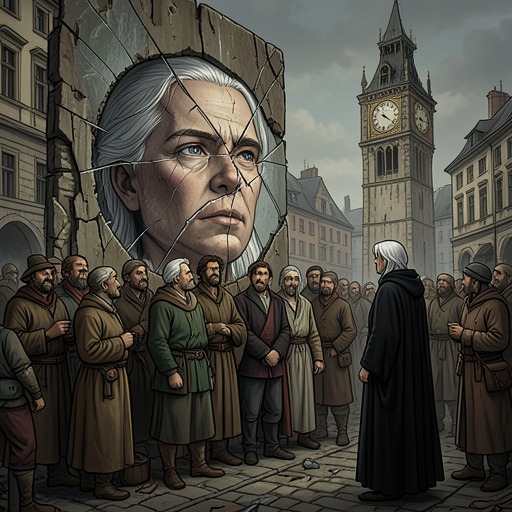
The Party of Heroes consisted of five central figures, all known personally to Vivisari Vexaria. When she encounters their statues in the elevated centerpiece of a town square, recognition comes before interpretation: the figures are not merely famous heroes but the companions with whom she cleared most of the game. A bronze plaque gives the group its official historical name, converting an intimate party into a public institution of memory.
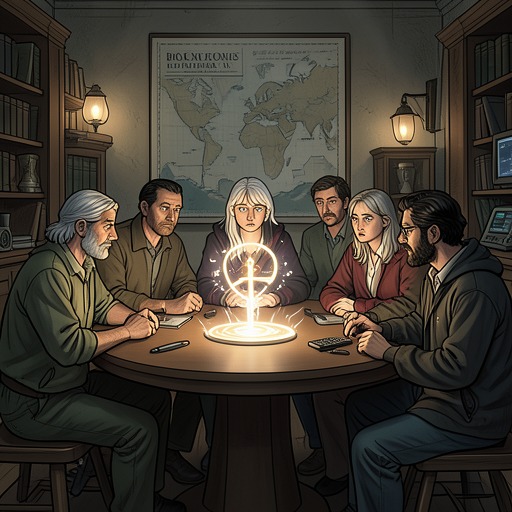
The group was closely associated with Vanguard, which in both the game and the transformed world began as a small private organization composed of Vivisari Vexaria and her friends. Although the five members ranked among the top players of Seven Cataclysms and possessed considerable influence, they designed Vanguard’s guildhall as a small, cozy interior rather than an imposing headquarters. The modest scale of that space preserves the group’s original character as a private fellowship, even after history enlarged it into a world-shaping legend.
The Party of Heroes was not simply a band of fighters. Its support network included craftsmen and other staff, while former members of that wider organization later scattered. An alchemist who brewed potions for the group is remembered specifically through that practical contribution, showing that its victories depended on a community larger than the five celebrated heroes. In the present, however, the public name primarily signifies the five adventurers, while the labor that sustained them has largely vanished from common recognition.
Victory over the Cataclysms
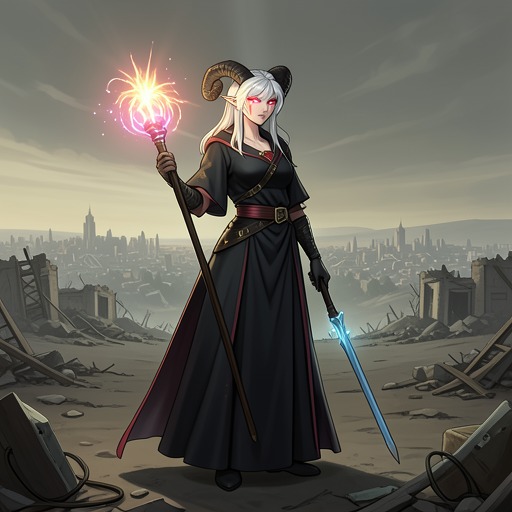
The decisive achievement of the Party of Heroes was its defeat of the seventh and final Cataclysm a hundred years before the main present-day action. The victory came at great cost: all but the Sorceress perished in the fight. The surviving Sorceress was identified as Vivisari Vexaria, making her absence from the intervening century as important to the legend as the group’s victory itself.
The result was not merely the destruction of one enemy. The Party of Heroes ended the age of chaos and created the historical foundation for a kinder age. In the century that followed, the people of Prismarche marked the anniversary through Peace Day, a week-long celebration devoted to remembrance, gratitude, and the end of the Cataclysms. The festival’s public language treats the group’s victory as the boundary between two different eras, giving the party the role of founders of peace rather than merely successful adventurers.
The scale of the group’s accomplishments expanded further in later recollection. The Party of Heroes killed the Colossus and, in only ten years, reshaped the world by purging monsters of incomprehensible power. Some people therefore interpreted the five as gods and goddesses who had descended into familiar forms to correct the injustice represented by the Cataclysms. Tatiana rejects that explanation, but the belief remains understandable within the world’s hierarchy of power: Vivisari Vexaria was rumored to have exceeded level eighteen hundred, a height associated otherwise with the Dragon King and the most exceptional beings in existence.
Public Memory and Ritual
The Party of Heroes survives in civic and religious imagery as much as in historical account. Prismarche’s Temple is built of polished white stone and filled with stained-glass images of saints and heroes; among the prominently displayed figures is an image of Vivisari Vexaria and her party. The temple therefore folds the group into a sacred visual tradition, even though Vivisari experiences the display with dismay rather than reverence. Her reaction exposes the distance between an ordinary person’s remembered relationships and the institutional machinery of worship.
Peace Day turns that memory into public ritual. As the festival intensifies, Prismarche’s citizens flood the streets to celebrate a hundred years free from the Cataclysms. A late-night parade in the town square presents the Cataclysms in order, from beginning to end as Vivisari remembers clearing them. The procession transforms the group’s dangerous chronology into a spectacle that can be watched, repeated, and celebrated by people who did not experience the original battles. The heroes become the implied answer to every threat represented by the parade, while the violence that made peace possible is safely contained within ceremonial form.
This ritualized memory also produces an irony. The city celebrates the Party of Heroes as a completed story at the very moment Vivisari is forced to understand that the story’s human participants are gone. She recognizes the statues, temple images, and public commemorations as evidence of her own past, but the evidence offers no path back to the friends she knew. The world has preserved their names by losing their lives.
Loss, Return, and Vanguard
After a century, Vivisari concludes that death is permanent, that her old party is dead, and that she is famous to the populace without belonging to the society that remembers her. Her return is consequently not a simple homecoming. It is the reappearance of the last surviving member of a supposedly finished legend, bringing personal continuity into a world that has converted the past into history, religion, and celebration.
Her reappearance prompts immediate speculation. Rafael identifies the unmistakable form of Vivisari Vexaria as the lost Sorceress of the Party of Heroes and asks, in effect, why such a figure has returned. The proximity of the hundredth Peace Day becomes part of the accumulating evidence and theories. Her return might signal a renewed commitment to the world’s good, or it might indicate that an eighth Cataclysm is approaching. Even the possibility that nothing immediate is wrong cannot erase the pattern established by the group’s history: extraordinary danger and extraordinary heroes are expected to arrive together.
The Party of Heroes also becomes the measure against which Vanguard’s restoration is judged. For nearly a hundred years, the guild that shepherded the world through seven earth-rending Cataclysms has lain dormant, its treasures lost with it. The first restoration of Vanguard returns only a subset of its vault, chiefly crafting materials rather than artifacts, gear, or consumables. That incomplete recovery mirrors the larger problem: the organization can be reopened, but the original conditions that made it legendary cannot simply be retrieved from storage.
Vivisari wants to reach out to previous members and former associates, yet she acknowledges that the original party cannot be restored. Rafael emphasizes the uniqueness of the five once-in-a-millennium, perhaps once-in-ten-millennia talents who formed it. Vanguard must therefore become something other than a repetition of the past. Its first new members include former craftsmen turned adventurers, and Vivisari’s recruitment of people such as Mae and Jasper breaks the old exclusivity of a guild once reserved for the Party of Heroes.
Historical and Narrative Significance
The Party of Heroes embodies the tension between communal myth and private truth. Publicly, the group represents virtue, divine intervention, and the clean beginning of a peaceful age. Privately, its surviving member remembers a small party of friends, supported by craftsmen and staff, who fought through a game together and paid for victory with the deaths of nearly all its central figures. Neither version wholly cancels the other: the myth is justified by what the group accomplished, but it is also incapable of preserving who those people were.
Its legacy further exposes the instability of heroic return. Vivisari can return to Vanguard, recover fragments of its material inheritance, and recruit a new generation, but she cannot recreate the five-person convergence that made the original Party of Heroes possible. The restored guild is therefore both continuation and rupture. It carries the old name, vault, and mission into a world that has changed, while accepting that the original party belongs to a closed historical moment.
The group’s legend reaches its limit when a later display of power is witnessed. Vivisari is already a figure of impossible renown, yet even she could not casually rip a Cataclysm in half; observers instead assume that a god has appeared and that the heavens themselves have descended. This reaction places the Party of Heroes at the threshold between the humanly heroic and the supernatural. Its members were treated as gods because their deeds exceeded ordinary history, but the narrative preserves a distinction between their legendary achievement and power so overwhelming that it appears to come from beyond the world itself.