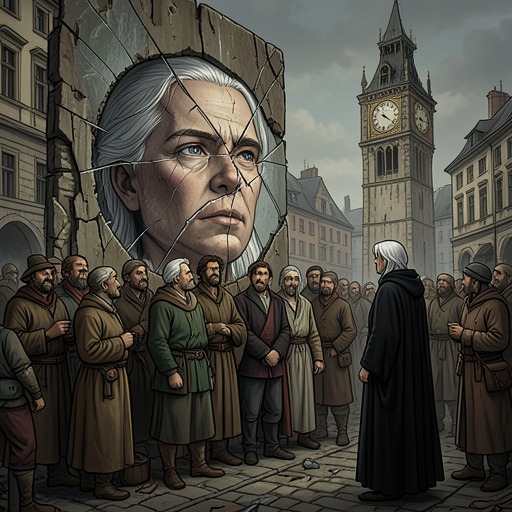
Peace Day Festival Parade
New Life as a Max Level ArchmageThe Peace Day Festival Parade is the most theatrical expression of Prismarche’s centennial Peace Day celebrations. Staged one hundred years after the Party of Heroes defeated the seventh and final Cataclysm, it converts a history of mass destruction into a procession that the city can watch, cheer, and eventually leave behind. For Vivi, whose memory reaches back to the campaigns themselves, the parade carries a double meaning: it is evidence that the world survived, but also a distorted replay of horrors that she remembers as real.
Historical and Civic Setting
The parade belongs to a week-long festival marking the end of the Age of Chaos and the beginning of a kinder age. The occasion commemorates the fortune of the survivors rather than merely celebrating a calendar anniversary, and Prismarche extends the festivities beyond the usual single day because the hundred-year milestone warrants an exceptional public observance. By the time the celebrations intensify, the city’s citizens have completed their daily duties and flooded the streets, setting aside ordinary restraint in favor of communal celebration.
The event therefore occupies an unusual place between remembrance and entertainment. The newer generation has not personally witnessed the monsters that once ravaged the world, and the festival gives them a shared historical image in place of direct experience. The parade makes the old wars visible without requiring the crowd to inhabit their suffering. Its public function is to affirm that the Cataclysms belong to the past and that ordinary life can safely gather in the streets again.
Course of the Procession
Around ten at night, the parade begins in the town square, with floats moving past cheering spectators gathered behind guardrails. Its subject is not an abstract account of the old disasters but a sequential representation of the Cataclysms, arranged from beginning to end in the order Vivi remembers confronting them. The procession thus gives the city a simplified historical narrative: each threat appears, is recognized, and is implicitly placed among the defeated enemies of a completed age.
The first float depicts the Umbral Regent, bringer of the Cataclysm of Eternal Twilight, as a hunched lich jerking forward on a withered black staff. Actors wearing masks, including figures presented as warriors, rogues, and mages, oppose his minions. Vivi recognizes the intended episode even though the representation does not match the campaigns’ reality. The float’s theatrical clarity matters more to the crowd than historical accuracy; it supplies a legible emblem of evil and a readily understood image of heroic resistance.
The second Cataclysm appears through the Crimson Blight wrought by the Reaper of the Lost Harvest. The float evokes plague and starvation and places at its center a human husk dressed in red robes. As with the first display, the devastation is compressed into costume, movement, and symbol, allowing spectators to cheer a catastrophe that once meant disease, hunger, and death. The parade continues this pattern by presenting the old enemies as scenes in a victorious civic pageant rather than as threats still capable of returning.
The final major representation is the Ashen Hierophant, shown as a twelve-foot-tall titan in black plate armor. This figure is the most accurate of the Cataclysm Monarchs, partly because Prismarche knew the Ashen Hierophant’s presence intimately. His fires destroyed more lives than disease, age, and famine combined, and entire regions of the continent still bear scars a century later. The float consequently carries more historical weight than the earlier caricatures, even within the festival’s celebratory form.
Memory, Spectacle, and Departure
Vivi experiences the parade with interest, amusement, and horror at once. The crowd cheers and jeers at representations of monsters that, to her, are not remote legends but enemies from campaigns she remembers clearing. The absence of solemnity initially feels strange: the spectators do not display genuine relief because few of them understand what the Cataclysms had actually been like. Yet Vivi also recognizes the positive implication. The lack of fear suggests that the parade has succeeded in making the disasters into relics rather than living threats.
This contrast between personal memory and public ritual defines the event’s emotional charge. For the citizens, the parade renews a collective myth of deliverance. For Vivi, it is a distorted encounter with her own past, one in which the people celebrate victories without knowing the cost paid for them. The distance between those perspectives does not invalidate the celebration. Instead, it shows how a society survives catastrophe: the original terror fades, the heroes become revered figures, and the wounds are recast as stories that can be staged in the street.
Eventually, the procession winds down and the crowd disperses toward the festival’s other attractions. The ending is deliberately ordinary. Nothing in the parade reopens the Cataclysms, and no revelation changes the public mood; the spectacle simply concludes, leaving the citizens free to continue celebrating. Its significance lies in that calm transition. A world once shaped by incomprehensible destruction can now move from a representation of its deadliest enemies to the next item on a week of festivities.