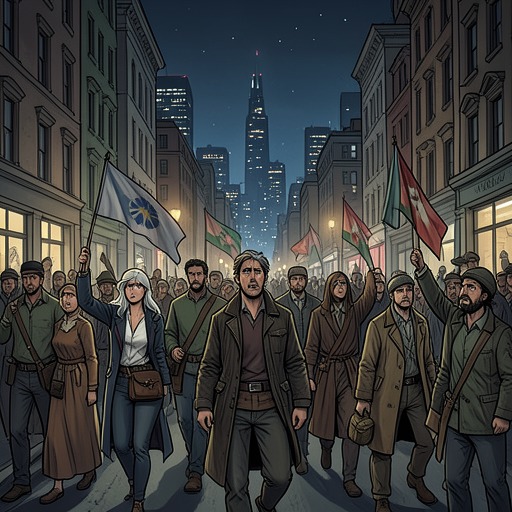
Post-Cataclysm Peace
New Life as a Max Level ArchmagePost-Cataclysm Peace is the fragile historical condition in which the human kingdoms have ceased open warfare after the Cataclysms. It permits ordinary movement, commerce, and civic life, but its apparent stability is repeatedly tested by memories of catastrophe and by signs that a new threat may be approaching.
Political and Civic Condition
Post-Cataclysm Peace is visible in the practical functioning of the kingdoms rather than in a claim that danger has disappeared. At the gates of Meridian, guards inspect wagons while allowing people on foot to pass without obstruction. Because no wars embroil the human kingdoms and Meridian receives too many daily visitors to examine everyone individually, the city operates according to peacetime assumptions: travelers can enter, roads remain open, and the capital accommodates a constant flow of movement.
That ordinary access also reveals the limits of the peace. Security is selective rather than absolute, and the system is designed for a busy, stable society rather than for a world expecting immediate invasion. The city’s crowded roads, inns, stables, stalls, general stores, and wagon-repair shops are therefore signs of recovery and confidence. Meridian’s infrastructure is busy, loud, and imperfect, yet its cobblestone streets remain relatively clean and well maintained, suggesting that peace has allowed civic organization and useful magic to become part of daily life.
Peace Day and Historical Memory
The peace is marked by Peace Day, whose centennial observance gives the condition a ceremonial and temporal weight. The Centennial Peace Day is not merely a date on the calendar; it represents a hundred years of distance from the catastrophes and provides the political culture with a recurring measure of survival. Its anniversary creates an expectation of continuity, making any disturbance during the celebration especially ominous.
The centennial also exposes the anxiety beneath the commemoration. Winston considers the timing of Vivisari Vexaria’s reemergence on the centennial Peace Day suspicious and asks whether something is afoot. The question joins personal return to historical recurrence: the return of a legendary figure at the exact moment when society celebrates a century without catastrophe appears too coincidental to dismiss. Peace Day thus functions both as a public ritual of reassurance and as a marker against which signs of renewed danger are measured.
The Threat Beneath Stability
The condition of peace does not erase the Cataclysms from political thought. When Rafael examines Vivisari Vexaria’s return, the possibility that the Sorceress has ended her retirement because an eighth Cataclysm is looming becomes part of his reasoning. The thought is not presented as proof, but it demonstrates how thoroughly catastrophe remains embedded in the imagination of the postwar world: even a personal reappearance can be interpreted as a response to an approaching disaster.
That suspicion gains force when the events surrounding the centennial are connected to a massive dimensional spell. On the same night as the Centennial Peace Day, a spell beyond tier twenty apparently attempted to puncture a gateway into the world. Vivisari Vexaria is uncertain about what occurred, while the Thaumaturgical Institute is expected to study the phenomenon. The uncertainty matters. The peace has produced an orderly surface, but the world cannot yet explain the force that disturbed it, and the unexplained gateway makes the historical settlement feel provisional rather than secure.
Narrative Significance
Post-Cataclysm Peace creates a contrast between visible normality and invisible possibility. Travelers enter Meridian freely, commerce fills the roads, and the city’s cleanliness and organization imply that civilization has endured. At the same time, the centennial anniversary, Vivisari Vexaria’s return from the Ashen Hierophant’s domain, and the dimensional incident all turn the language of peace into foreshadowing. The more confidently the society celebrates its hundred years without war, the more sharply a new anomaly threatens to redefine that achievement.
The state therefore represents neither complete safety nor mere interlude. It is a hard-won order whose institutions and habits have become ordinary, while its historical memory keeps asking whether catastrophe is truly finished. Peace permits the world to function, but the possibility of an eighth Cataclysm ensures that every celebration, border crossing, and unexpected return can also be read as evidence gathered before the next crisis.