Prismarche
New Life as a Max Level ArchmagePrismarche is a fortified city in the Northern Kingdom and one of the most important locations in the narrative’s transition between legendary history and an unstable present. Its walls, civic buildings, temple, train station, festivals, and mixed population make it a functioning modern settlement, yet its identity remains anchored to the victory over the Seven Cataclysms a hundred years earlier. When Vivisari Vexaria returns there, the city changes from a destination associated with history and celebration into the center of a dimensional crisis whose consequences reach far beyond its walls.
Setting and Civic Character
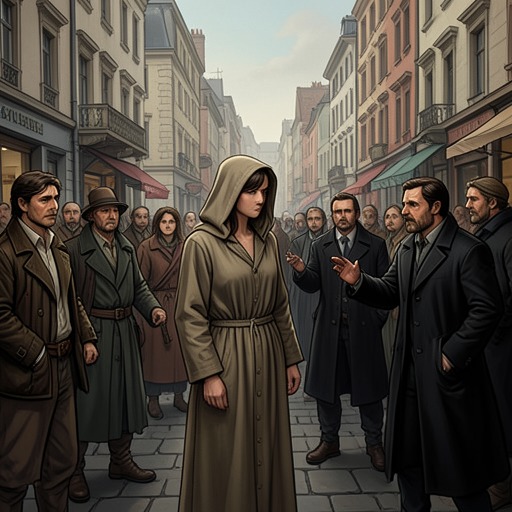
Prismarche first appears as the place where Vivisari Vexaria reemerges after crossing vast distances by magic. She stumbles back into existence in the town square, finding a busy civic center rather than a ruined or isolated frontier settlement. Officials hurry into the town hall carrying scrolls, citizens gather around notice boards, and travelers consult maps on benches. Humans form the majority of the crowd, but elves and demons are also visibly present, establishing Prismarche as a populated, multi-species northern city rather than a purely human stronghold.
The city’s northern position explains its defensive architecture. From above, Vivisari Vexaria sees Prismarche spreading beneath her inside a continuous wall. The settlement has grown, but it remains small by the standards of the modern cities she remembers, a limitation imposed by the dangers of the region. Safer territories can allow cities to expand without such barriers; Prismarche cannot. Its wall therefore functions both as practical protection and as a visible reminder that the Age of Cataclysms has not entirely vanished from ordinary life.
The urban landscape includes a town hall, a bank, a temple, and a train station whose tracks run southward toward the horizon. The station is especially startling to Vivisari Vexaria because trains did not exist during the era of the Seven Cataclysms. Their presence gives the city a concrete marker of historical change: Prismarche is built on the ground of an older heroic age, but it belongs to a society that has developed technologies and institutions its legendary defenders never knew.
Temple, Heroes, and Historical Memory
Prismarche’s temple dominates the skyline, rising above even the town hall and bank. It is built from polished white stone and has tall arched stained-glass windows depicting saints and heroes unfamiliar to Vivisari Vexaria. Inside, sunlight passes through the glass onto rows of wooden pews and a long aisle leading to a grand altar, making the temple a deliberately monumental space in which civic history and religious reverence overlap.
The temple’s imagery also turns Vivisari Vexaria herself into an object of public memory. To her dismay, one of the most prominent stained-glass figures represents her and her Party of Heroes. The representation creates an immediate contrast between the living person and the sanctified legend. The city remembers the heroes as distant figures from a completed age, while Vivisari Vexaria experiences that history from within and knows the cost hidden by the heroic image.
That cost is repeated in the city’s account of the final victory. The people are told that, at great cost, all but the Sorceress perished while the Party of Heroes triumphed over the seventh and final Cataclysm nearly a hundred years earlier. Prismarche’s public culture therefore rests on a paradox: the festival celebrates freedom and survival, but the story being celebrated is also a story of mass death. The city’s temple and commemorative traditions transform catastrophe into an enduring civic inheritance.
Festival and Everyday Life
Prismarche becomes especially vivid during the Peace Day Festival. A distant clock tower marks five o’clock as evening arrives, and the streets fill with citizens leaving their daily duties behind to mingle throughout the city. The celebration reaches its greatest intensity as the sun rises and washes the world in orange, when the townspeople flood the streets and abandon ordinary restraint.
The festival marks a hundred years of freedom from the Cataclysms that once ravaged the world. Its public energy is not merely entertainment; it is a collective ritual of historical reassurance. The residents repeatedly affirm that the city survived, that the old devastation belongs to the past, and that communal celebration can give shape to a century of peace. Yet the narrative places that confidence beside later evidence that the past is not safely closed. Prismarche’s festival makes the city’s later crisis more disruptive because the anomaly breaks into a place that has been publicly organized around the belief that catastrophe has ended.
For Vivisari Vexaria, the festival also creates a practical interval between responsibilities. She intends to continue toward Meridian, but first must confirm the train schedule, collect a bounty, and reinforce the enchantments of a cell. Tickets can be purchased when needed, so the train station offers her a straightforward route onward. This mundane arrangement—an adventurer preparing transportation, completing official errands, and choosing a hunting trip to test her abilities while pursuing a bounty—places extraordinary magic within the city’s ordinary administrative rhythms.
The Dimensional Anomaly
Prismarche’s decisive transformation begins with the dimensional anomaly above the city. Vivisari Vexaria experiences the boundary between realities cracking there, an event terrifying even for a mage of her power. She later judges that experience to have been only a prelude, a preliminary taste of what a true shattering feels like. The city consequently serves as the first location where the narrative makes the instability between worlds physically and emotionally undeniable.
The anomaly is extensive rather than localized. Its shattering spans the entirety of Prismarche, forcing the question of what has happened to the city and its surrounding reality. Although the breach initially appears stable and slowly self-repairing, Vivisari Vexaria refuses to treat that apparent healing as permission to leave the matter unattended. She plans to investigate it from Meridian and to check on Prismarche with Greater Warp, but the danger keeps drawing her back.
Her relationship with the city therefore changes sharply. At first she wants to wash her hands of Prismarche as quickly as possible. The dimensional breach makes that impossible. Because people’s lives may be at stake, she expects to return frequently over the following weeks, turning the city into an obligation rather than a temporary stop. Her movement between Prismarche and other locations also demonstrates the scale of the setting: Greater Warp can place her and Saffra atop the city’s wall almost instantaneously, while the train system provides the slower, institutional network linking Prismarche to the wider world.
The anomaly’s significance extends beyond Vivisari Vexaria’s own investigations. A demon reports witnessing a major dimensional anomaly in Prismarche and helping the local guard send a report to the Thaumaturgical Institute. Other powerful observers become concerned while looking toward the sky above the city, sensing disturbances in the mana currents even when the source cannot be identified. Prismarche thus becomes a point where local officials, adventurers, apprentices, archmages, and beings of extraordinary power confront the same unknown threat from different levels of understanding.
People, Encounters, and Consequences
Prismarche is the place where several important relationships begin or acquire their defining circumstances. The demon who becomes connected to Vivisari Vexaria’s apprentice meets her there under unfortunate circumstances and is impressed by her integrity when she later asks to be taught. That meeting turns the city into the origin of an apprenticeship whose consequences involve Saffra, the Thaumaturgical Institute, and the Caldimore family.
The city also serves as the meeting place through which outside observers learn about those relationships. The demon explicitly identifies Prismarche as the place where he met the apprentice, and later explains that his decision to teach her followed the integrity she displayed during their encounter. Tilly Tanswell asks him to investigate the dispute involving Saffra, the Institute, and the Caldimore family, so Prismarche’s local incident becomes connected to a wider network of institutional and noble conflict.
Vivisari Vexaria’s activities around Prismarche repeatedly reveal the contrast between overwhelming power and the need for caution. She flies over the city, considers whether detection spells might alert the City Guard to an invisible flying archmage, and worries that powerful individuals at the Thaumaturgical Institute could notice even lesser magical signatures. When she returns with Saffra through Greater Warp, the apprentice suffers spatial nausea despite having developed some resilience to ordinary Blink travel. The city is therefore not simply a backdrop for effortless magical movement; it is a place with defenses, witnesses, authorities, and consequences for being seen.
Prismarche also becomes linked to the Red Tithe and the breach’s alien material. Vivisari Vexaria concludes that the dagger and armor used by the Red Tithe were made from alien carapace belonging to monsters beyond the dimensional horizon. She believes the equipment is tied somehow to the anomaly above Prismarche and reports that, during an attack on Saffra, she removed a piece of the spatial fabric surrounding the Red Tithe. The action made the attacker disappear along with the weapon and armor, leaving Vivisari Vexaria uncertain whether the equipment can be repaired and believing that the Red Tithe was probably dead.
Narrative Significance
Prismarche is a threshold location in both geographical and historical terms. Vivisari Vexaria arrives there in an instant after traveling thousands of miles, and the city stands between the older world of Cataclysm legends and the newer world of trains, organized guilds, civic reports, and public festivals. Its fortified boundaries contain a society that has advanced beyond the age of the Party of Heroes without escaping the dangers that made those heroes necessary.
The city’s strongest narrative tension comes from the collision between commemoration and recurrence. Prismarche celebrates a century without Cataclysms, displays Vivisari Vexaria as a heroic image in its temple, and fills its streets for Peace Day. At the same time, the dimensional anomaly reveals that the boundary between realities can crack above the very city that treats the old catastrophe as history. The public belief in completed victory is therefore placed under pressure by an event that may announce a new kind of danger.
Prismarche also provides the scale against which Vivisari Vexaria’s power is measured. Her return, flight, teleportation, and intervention make her appear almost divine to those who witness what follows, but the city remains large enough to contain institutions, crowds, defenses, and competing interpretations of the unknown. Even the later spectacle of power is not casually attributed to her; observers may instead assume that a god has appeared to aid a battle of otherworldly origin. In that sense, Prismarche is more than the place where the crisis occurs. It is the civic and symbolic ground on which legend, technology, religion, personal responsibility, and dimensional terror collide.