Rafael
New Life as a Max Level ArchmageRafael is Vivisari Vexaria’s steward and one of the clearest surviving links between the legendary Party of Heroes and the transformed world that receives Vivisari after a century of absence. His importance lies not in spectacular combat but in administration, memory, political judgment, and the disciplined handling of information. Through Rafael, Vivisari learns what became of Vanguard, while he in turn recognizes that her return could destabilize the mortal kingdoms as surely as any Cataclysm.
Identity and Position
Rafael is introduced as the Guild Steward associated with Vanguard, the person Vivisari remembers dealing with whenever she needed to upgrade or manage the guild. His role has expanded dramatically since the game’s recorded history ended: Vanguard has fractured because it lost its officers, while Rafael has risen to become Chief Guildmaster of the Adventurer’s Guild. The change gives him institutional reach far beyond that of a household servant or ordinary guild clerk, yet his position remains connected to his original loyalty to Vivisari and to the organization she once led.
His authority is paired with a strong conception of information as power. He treats conversation as a contest in which judgment, concealment, and timing matter as much as formal rank. When he drinks alone, he does so precisely because he dislikes clouding his mind in company; social encounters are not leisure for him but strategic exercises. That habit explains both his composure and his effectiveness when the impossible returns to his office.
Recognition and Reunion
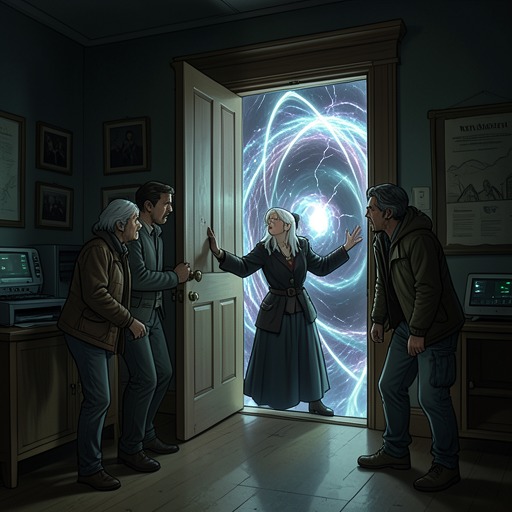
Rafael’s reunion with Vivisari begins with a revelation rather than a sentimental welcome. He is alone in his office when the disguised woman before him reveals the unmistakable form of Vivisari Vexaria, the lost Sorceress of the Party of Heroes. The recognition freezes him in place, whiskey glass in hand, but his outward response arrives almost immediately. He addresses her as Lady Vivisari and claims that he has been expecting a visit, attributing the expectation to the incident in the north.
The exchange shows Rafael’s ability to recover from shock without surrendering control of the scene. He does not expose his astonishment, demand proof, or allow the revelation to dictate his behavior. Instead, he establishes a working relationship at once, declaring that now her identity is proven, he is her loyal steward as always. His slightly sarcastic bow carries both ceremony and familiarity, while his visible excitement confirms that the return is personally meaningful as well as politically consequential.
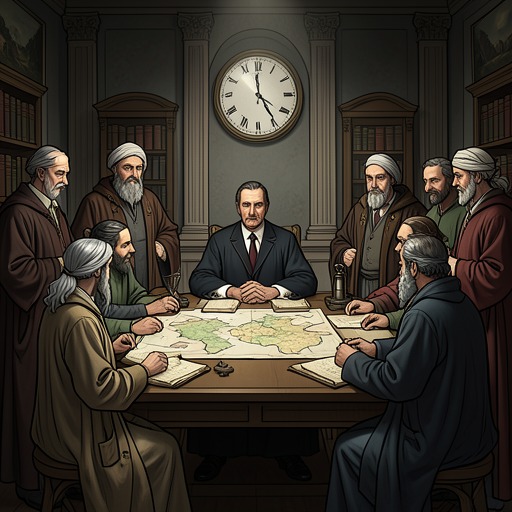
He then leads Vivisari to the steward’s office and searches through the guild’s charter and records. The gesture is practical: the documents may illuminate what happened to Vanguard and provide a reliable starting point for rebuilding it. Rafael therefore serves as a living archive, but not a passive one. He interprets institutional evidence, identifies missing information, and turns the reunion into an immediate investigation.
Political Judgment and Methods
Rafael understands that Vivisari’s restoration project cannot be treated as a private return to old comrades. He warns that she must tread carefully if she does not want the mortal kingdoms to unite against a perceived world-ending threat. In political terms, her reappearance could be presented as an Eighth Cataclysm. Rafael does not accuse her of destructive intent; instead, he distinguishes between her purpose and the public interpretation of her power, insisting that political considerations will shape every action she takes.
His caution is matched by respect for Vivisari’s agency. When she says that she wants to restore Vanguard and do what good she can, he accepts the intention while stressing the danger of acting without regard for law or diplomacy. He is neither a simple restraining influence nor an unquestioning subordinate. His loyalty gives him permission to warn her, and his warnings are grounded in a detailed understanding of how rulers manufacture threats from uncertainty.
That understanding becomes especially important in the dealings with Duke Caldimore. After Vivisari’s encounter with Isabella Caldimore and the worsening uncertainty around the Caldimore family, Rafael reports that the duke appears receptive to their token of apology. He immediately distinguishes between conciliatory language and the practical possibility that the payment is a bribe. Later, he argues that the meeting requires direct observation and asks to accompany Vivisari while masquerading as her attendant. When she points out the danger of being discovered under an illusion, he proposes transmogrification instead, considering it a more reliable deception.
Rafael’s request is not theatrical devotion. He wants to watch Duke Caldimore in person because a meeting can yield information even if it fails to produce an amicable solution. His method is investigative and incremental: observe the subject, gather details, and postpone escalation until the pattern becomes clearer. After the meeting goes badly, he judges the duke’s conduct as deeply abnormal. Duke Caldimore is normally cautious and politically keen, yet he nearly insults Vivisari despite having no accurate profile of her character or any certainty about how she might react. Rafael concludes that such behavior approaches idiocy, and because the duke is not an idiot, it signals concealed danger.
Rafael’s suspicion extends to Tobin, whom he identifies as a killer who takes pride and pleasure in his work. He considers whether Tobin is an assassin but refuses to settle the question without more evidence. His repeated emphasis on missing pieces and inadequate information reveals the limits he places on his own conclusions: Rafael is perceptive, but he does not confuse suspicion with proof. That restraint makes his warnings more credible and turns uncertainty itself into one of the plot’s central threats.
Loyalty, Care, and Alliance
Rafael’s loyalty is professional, personal, and strategic at once. Once Vivisari’s identity is established, he resumes the role he held before her disappearance, but the old relationship must function within a world that has changed. He has become a senior guild authority, Vanguard has fractured, and Vivisari’s power now exceeds what the political order can comfortably classify. Their alliance consequently depends on translating her extraordinary force into actions that institutions and kingdoms can survive.
He also supports Vivisari’s care for Saffra, even when the apprentice’s presence draws the powerful Caldimore household into their affairs. Vivisari uses a private teleport to bring herself and Saffra to the safety of her manor, where privacy wards may conceal the spell’s signature. Rafael later notes that Vivisari has placed herself in the midst of intrigue with a major ducal household through an apprentice she claimed suddenly. His concern is not contempt for Saffra; it is recognition that personal protection, apprenticeship, guild restoration, and noble politics have become inseparable.
When Miraelle, now going by Mae, reunites with Vivisari, Rafael stands nearby and silently confirms the meeting. Mae explains that he had caught her up and admits that she had thought she would never see Vivisari again. Rafael’s presence in this reunion reinforces his function as a keeper of continuity: he carries news between separated survivors, preserves old affiliations, and helps former companions orient themselves around Vivisari’s return.
Change and Narrative Role
Rafael’s century-long development contrasts with Vivisari’s abrupt reentry. He has aged, accumulated authority, and adapted to the collapse of Vanguard, while she must reconstruct the world from fragments of memory. His advancement from guild steward to Chief Guildmaster demonstrates that loyalty has not required stagnation. He has remained useful by becoming institutionally powerful and politically literate.
At the same time, Rafael’s role changes from administrator to intelligence coordinator. After the encounter with Duke Caldimore, he leaves the Wardens’ Guildhall with Vivisari and immediately states that the situation is extremely concerning. He plans to contact associates, investigate Tobin, and determine what information is missing. Even when Vivisari later unleashes power so overwhelming that observers may interpret it as divine intervention rather than the work of the Sorceress, Rafael returns his attention to the mission of finding out what has happened. His response to supernatural spectacle is therefore characteristic: wonder may occur, but the work of gathering information continues.
Rafael embodies the political intelligence required to live after legendary victory. The Party of Heroes defeated the seventh and final Cataclysm at immense cost, with all but the Sorceress perishing, and the world now celebrates that triumph a hundred years later. Yet the peace built on that victory remains vulnerable to fear of another catastrophe. Rafael understands that Vivisari’s return is both a possible salvation and a destabilizing public event. His loyalty does not erase the danger she represents; it gives her the counsel needed to move through it without becoming the threat others may imagine.
Significance
As Vivisari’s steward, Rafael is the narrative bridge between private identity and public consequence. He connects the vanished Party of Heroes to current guild institutions, links personal reunions to political intelligence, and turns the passage of a century into actionable knowledge. His defining skill is not merely knowing facts but judging what can safely be inferred from them.
Rafael also provides a counterweight to Vivisari’s immense power. She can teleport, conceal identities, and confront forces that may exceed the old hierarchy of strength; Rafael cannot solve those problems through force. His contribution is the slower discipline of observation, diplomacy, records, contacts, and controlled disclosure. In a story where the return of one legendary figure could be mistaken for the arrival of a god or an Eighth Cataclysm, Rafael’s stewardship makes survival depend on interpretation as much as power.