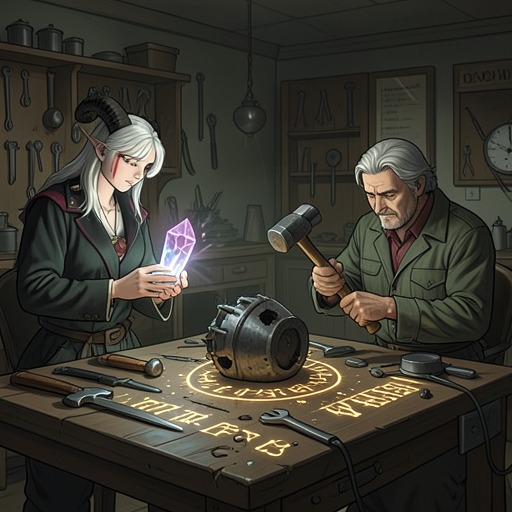
Rhek Verontell
New Life as a Max Level ArchmageRhek Verontell is a four-century-old Master Leatherworker whose importance lies in the collision between hard-earned craftsmanship and the supernatural scale of Vivisari Vexaria’s hidden life. Introduced as a retired artisan with a damaged knee, a sour temper, and an apparently abandoned career, he is drawn back by a commission that becomes the greatest technical and emotional challenge of his life. His work on the Heartguard of the Fleeting Shade turns retirement into a brief return to ambition and reveals that even a craftsman who believes he has already reached the summit can still be forced into a new understanding of excellence.
Identity and Background
Rhek lives in a private cabin home overlooking Meridian, a location whose view would attract even the upper nobility. His mornings are shaped by physical limitation and habitual discipline: he rises from his cot with a knee that must not be aggravated, prepares a hot drink from dark leaves, and settles on his balcony before beginning the day. The routine presents him as an old man whose body has accumulated the cost of centuries, but it also shows that retirement has not severed him from the habits of a working craftsman.
His professional standing is unusually high. He is one of only three Master Leatherworkers in the human kingdoms, and the title is not ornamental: it represents centuries of work and the physical sacrifice of using his hands until they were worn down. He distinguishes sharply between being pleasant and being effective, admitting that he is not good company while insisting that he remains a good, or at least effective, teacher. The distinction captures his governing self-image. Rhek does not seek affection; he seeks proof that his methods produce results.
Retirement has therefore always been unstable for him. He maintains the workshop in the Crafter’s District through weekly visits from another person, a practical admission that he never truly intended to abandon his life’s work. His irritation is partly performance and partly defense. When Stellan arrives on behalf of the Leatherworking Guild, Rhek insists that retirement means no more jobs, yet his actions quickly contradict his words: he opens the door, invites Stellan inside, and demands the details.
The Commission and Its Revelation
The Guild’s offer concerns a wealthy client who has requested Rhek by name. At first he assumes the work may be for an indulged noble heir, but the combination of wealth, secrecy, and practical design changes his assessment. The gear is intended for an apprentice of a Titled-rank adventurer, with defense as a priority and an appearance subtle enough not to attract attention. Rhek recognizes that such a client may be adventuring incognito, may be an exceptionally high-level figure unknown to the mortal kingdoms, or may belong to the stranger population drawn to Meridian.
The client is Nysari Keresi, a demonic noblewoman whose family name Rhek only vaguely recognizes. His first meeting with her is deliberately abrasive. Seeing her outside the workshop, he calls her a runt, despite knowing that her perceptiveness marks her as Titled and that insulting such a person could be fatal. Nysari identifies herself plainly and asks whether he is Rhek Verontell, the leatherworker. He corrects her with the title he has earned: Master Leatherworker. His demand for recognition is not mere vanity. In Rhek’s mind, respect for the title acknowledges the centuries of labor that made the commission possible.
The materials quickly make the client’s identity impossible to ignore. Nysari has supplied three fresh pelts and numerous other rare components, all harvested within the preceding hours. Rhek’s skills confirm that the materials are genuine and recently obtained; the collection is so extraordinary that he cannot imagine anyone below an upper-Titled rank acquiring it. The materials promise perhaps an entire rank increase if the project succeeds, transforming the commission from a lucrative job into a once-in-a-lifetime professional opportunity.
His suspicions become certainty when Nysari’s resemblance to the Sorceress grows impossible to dismiss. Rhek had seen the legendary figure in the flesh when she was still making her name, although only from a distance and while he himself had barely reached Expert rank. Nysari denies the identification, but the fresh, impossibly rare materials answer more convincingly than her words. The supposed daughter is, in fact, Vivisari Vexaria herself, and Rhek realizes that he is not merely serving an important client: he is working beside the Sorceress.
Craftsmanship and the Transcendent Result
The project begins with Rhek issuing commands, to his surprise finding that Vivisari obeys without argument. Years at the upper levels of his profession have accustomed him to clients and collaborators with enormous egos. Her willingness to listen raises his estimation of her, even before her technical abilities become clear. As the hides are prepared for stitching, she places enchantments into them, using magic at a level that makes her a genuine collaborator rather than a patron standing outside the work.
Rhek’s objective is not merely a durable set of equipment. He wants a masterwork. For a Master-tier craftsman, ordinary quality is a professional failure, good is only a tolerable baseline, superior is satisfying, and extraordinary is a rare achievement usually associated with orichalcum clients who provide materials they harvested themselves. Rhek has produced extraordinary work in collaborations with four Titled figures, but he has never created a masterwork. That absence has become a private measure of incompletion, and this project awakens the ambition he had tried to bury beneath retirement.
The first completed piece is the cuirass Heartguard of the Fleeting Shade. When Rhek finally uses Inspect, the item is identified as transcendent and level 385. The result shocks him because he has not merely surpassed his hoped-for masterwork; he has skipped over it entirely. Even Grandmasters are understood to achieve only a few masterworks in a lifetime, while Rhek has reached a quality beyond the summit he had imagined for himself. He refuses to attribute the miracle entirely to his own skill, recognizing that the rare materials and Vivisari’s enchantments have made the collaboration something no solitary craftsman could reproduce.
The remaining work consists of vambraces, greaves, and boots. Vivisari explains that she could retrieve equipment from a vault filled with treasures, but circumstances prevent that solution. Traditional mage equipment emphasizes sorcerous bonuses at the expense of physical protection, while she specifically wants defense-focused gear. The equipment is also a gift, and she wants it made from scratch. This decision gives Rhek’s labor a personal purpose beyond commerce: the armor is not simply acquired power but an intentionally created offering.
The completed four-piece set overturns Rhek’s expectations again during testing. He normally expects his work to withstand attacks and spells fifty levels above an item’s listed requirement, perhaps as much as a hundred. The armor resists tests at levels 450, 500, and 600, showing stress only at 650, the mithril threshold. The result is silver-rank armor with the durability of mithril-rank equipment. Vivisari judges its appearance slightly more distinctive than intended because of the Reaping Shade pelts, but credits Rhek with keeping the unusual materials from becoming too conspicuous.
Relationships and Professional Conflict
Rhek’s most important relationship is his collaboration with Vivisari Vexaria. Their dynamic begins in mutual testing: he challenges her with bluntness, while she answers with composure, resources, and practical competence. She is powerful enough to make his insolence dangerous, yet she does not punish his rough manners. He, in turn, does not flatter her once he understands who she is. His respect is expressed through concentration, technical honesty, and the refusal to accept mediocre work.
The collaboration also creates a reversal in authority. Rhek is the senior specialist in leatherworking and directs the physical construction, but Vivisari is the higher-ranked magical partner whose enchantments alter the potential of the materials. Neither simply dominates the process. His commands are accepted, her enchantments reshape the hides, and the result emerges from the interaction between their distinct forms of mastery. The transcendent armor is therefore a product of cooperation rather than a conventional commission in which a wealthy patron merely purchases a finished object.
His connection with Stellan and the Leatherworking Guild reveals a different form of pressure. Stellan’s cheerful persistence cuts through Rhek’s declared retirement, while the Guild’s decision to approach him demonstrates that his reputation still carries institutional weight. Rhek resents being drawn back into work, but his resentment cannot conceal his interest in the offer or his attachment to the workshop. The Guild’s intervention does not create his desire to craft; it exposes that the desire never disappeared.
Change, Ending, and Narrative Role
Before the commission, Rhek’s anger is intensified by rejection. Four apprentices have turned him down, and a curt, unsigned response from Leif confirms his suspicion that he is the problem. He knows he is unpleasant, but he clings to the belief that effectiveness should compensate for temperament. The commission gives him an arena in which personality matters less than execution, allowing his buried excitement to return without requiring him to become agreeable.
The work changes his understanding of his own career. Rhek begins as a craftsman who treats retirement as a settled fact and ends having produced an item beyond the masterwork he had spent his life seeking. The achievement does not make him suddenly gentle or socially open; his defining abrasiveness remains intact. What changes is the scale of his certainty. His worldview is repeatedly shattered by Vivisari, the materials, the item’s quality, and the armor’s durability, and each shock forces him to acknowledge possibilities he had previously regarded as impossible.
Vivisari pays him nine orichalcum, a sum associated with rare Titled-rank materials, and asks him to keep silent about his theories concerning her identity. Rhek gives a weak reassurance, aware that others might not believe him even if he told them. After she leaves, he stands staring at the closed doors, then at the valuable materials remaining in the workshop. Those physical remnants confirm that the encounter was real. His final mutter about the Sorceress is both incredulous and admiring, a compact expression of the professional astonishment that defines his role.
Rhek functions as a grounded witness to the magnitude of Vivisari’s world. The armored Convoy, its eight-slot power-core compartment, the guildhall expanded inward by the System, and the failed Inspection of a Greater Voidling all show a setting in which machines, institutions, magic, and monsters participate in the production of power. Rhek’s workshop offers a parallel scale: rare materials enter as uncertain potential, skilled hands and enchantments transform them, and the finished object becomes evidence that the impossible can be made tangible. His story is not a heroic ascent through battle, but a craftsman’s threshold crossing, in which returning to work briefly restores ambition, recognition, and wonder.