Ritualism
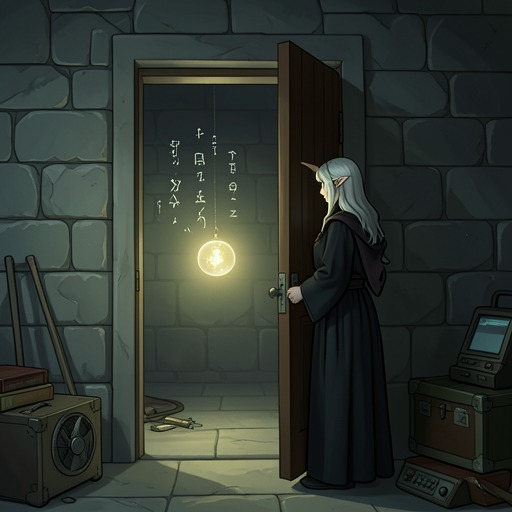
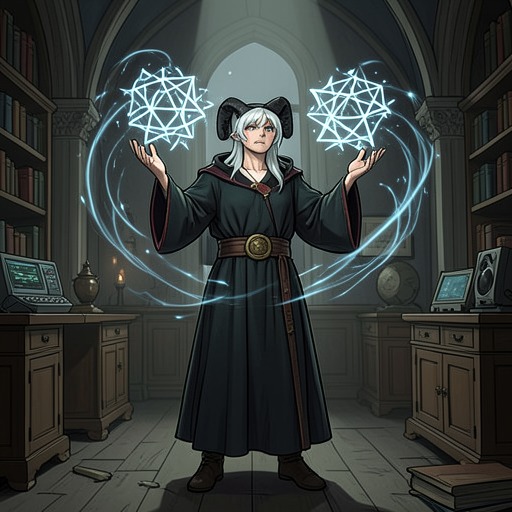
New Life as a Max Level ArchmageRitualism is the least orderly and most potentially catastrophic branch of magic in the world of the Cataclysms. Unlike a conventional spell, whose result can be stabilized through a mage’s self-formed mana and a defined magical pattern, a ritual combines an ordered framework with conceptual forces, a meaningful sacrifice, and dominion over the source or target involved. Its power can produce wonders on an institutional scale, but its imprecision means that even a low-level mage with basic knowledge might call down ruin. For Vivisari Vexaria, Ritualism is also a revealing limit: despite her mastery of spellcasting and enchanting, it remains the discipline in which she is least experienced and most vulnerable to failure.
Definition and Danger
Ritualism is distinguished from enchantments and spell circles by its relative lack of order. Archmage Osmian explains that a ritual may be written in High Arcana, but its conceptual elements guide the effect at least as strongly as its formal design. The written structure is therefore not an absolute command. At best, it acts as a suggestion that directs wild magical energy toward an intended result.
That freedom makes Ritualism both hazardous and unusually powerful. A conventional spell such as a Fireball produces a broadly predictable form with a reasonably stable size, velocity, and strength. A ritual, by contrast, can align itself with the caster’s mental intent while still taking an uncertain form. Osmian characterizes magic itself as neither evil nor good, but as wondrous, with wonders that can become horrible beyond comprehension. The danger is not merely moral misuse; it is the instability of the medium and the gap between what the caster means and what the ritual is capable of doing.
Sacrifice and Conceptual Dominion
Every ritual requires a sacrifice with weight. The sacrifice supplies energy, but it also influences how the ritual manifests. Blood sacrifices are common among cultists because life carries substantial weight and provides abundant fuel, making blood an effective though crude shortcut. The decisive principle is conceptual dominion: the ritualist must possess a recognizable form of control or dominance over whatever is being sacrificed or drawn upon.
Osmian uses a person restrained at an altar as the clearest example. A knife at the victim’s throat establishes an undeniable relationship of control, so the sacrifice can be accepted without ambiguity. Yet dominion is not restricted to violence. Vivisari Vexaria realizes that the founder of an institution may hold a form of conceptual dominion over the institution and the mages who have sworn themselves to it. Osmian accepts this as a valid kind of dominion, widening Ritualism beyond the bloody practices associated with cults.
The less distinct the ritualist’s control, the greater the likelihood of failure. A sacrifice may be physically available while remaining conceptually uncertain, and that uncertainty gives the ritual more room to distort. Osmian reduces the operative structure to a simple sequence: invoke the desired working, provide enough power, make a proper sacrifice, and allow the ritual to follow the caster’s intent. The result may succeed, but its precise manifestation remains difficult to predict.
Sources of Energy and the Institute
Ritualism can draw energy from the environment rather than from a living victim. One of Osmian’s trials requires energy to be taken from the island itself, with Vivisari Vexaria considering whether the island’s flora can fuel enchantments without killing anything. Plant life is less volatile than a sentient being because it lacks a mind, but its vital energy is still far less tractable than a mage’s deliberately shaped mana.
This distinction helps explain the Thaumaturgical Institute’s floating campus. Osmian states that no mage could lift an island and keep it suspended for more than a millennium using only personal mana. The Institute’s survival therefore demonstrates Ritualism’s capacity to sustain an enormous, long-term working by using a carefully designed ritual and an intentional mana source. Its continued suspension is a wonder of ordered ritual magic, but it also stands as evidence of the scale that the discipline can reach when its framework, fuel, and conceptual purpose align.
History of Catastrophe
Ritualism is associated with several of the world’s most destructive transformations. Vivisari Vexaria has more experience dealing with the aftermath of failed or successful rituals than with creating rituals herself. The Umbral Regent’s ascension into lichhood is presented as one possible ritual outcome, while some of the Flesh-Weaver’s grotesque creations may also have emerged from ritual work. The Shattered Oracle’s glimpse into the unknowable and the madness that followed provides another example of a magical act whose consequences exceed ordinary spellcraft. Vivisari even suspects that the Colossus and the Maw may have resulted from rituals, although their origins remain undefined.
This history gives Ritualism a double identity. It is a discipline capable of noble and constructive achievements, such as maintaining the Institute, yet it is also a plausible engine behind monstrosities, apotheosis, madness, and other Cataclysm-level events. The same openness that permits a working of wonder permits a working to escape the boundaries its maker intended.
Vivisari Vexaria’s Trial and Significance
Ritualism is Vivisari Vexaria’s weakest major magical discipline. Her decade of campaigns against the Cataclysms made her an accomplished spellcaster, while her constant need to create legendary equipment for herself and her teammates gave her extensive experience with rare materials and enchanting. Rituals offered no comparable foundation. She had spent years confronting their catastrophic fallout, not learning how to construct them.
Under Osmian’s instruction, she must draw energy from an island without destroying its life, confront the role of sacrifice, and understand why conceptual dominion matters more than a merely technical design. The trial exposes a rare asymmetry in her otherwise overwhelming abilities: raw strength and experience against Cataclysm threats do not automatically confer mastery over the most unpredictable form of magic. Her questioning also shows that she can reason toward Ritualism’s principles, recognizing institutional allegiance as a possible sacrifice and form of dominion even when the discipline itself remains unfamiliar.
Ritualism therefore functions as both a magical system and a theory of causation in the narrative. It connects personal intention to environmental power, institutional identity to sacrifice, and formal design to uncontrollable consequence. The floating Institute, the world’s old Cataclysms, Archmage Osmian’s decaying soul-fragment vessel, and Vivisari Vexaria’s apprenticeship trial all meet within the same principle: magic becomes most transformative precisely where structure ceases to guarantee obedience.