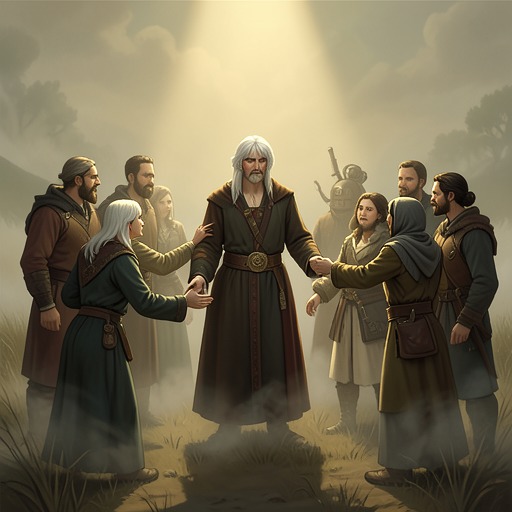
Rowena
New Life as a Max Level ArchmageRowena is remembered not through a direct appearance but through the delayed news of her death. Once associated with Vanguard as a craftsperson, she later became an adventurer after the organization’s disbandment and died in an adventuring incident. Her fate gives concrete, tragic form to the way Vanguard’s collapse disrupted the lives and identities of those who had lived beneath its immense reputation.
Identity and Background
Rowena belonged to the generation shaped by Vanguard’s presence and was known as a good woman by those who had worked beside her. The available account does not specify her exact craft, family, or personal history, but it establishes that she was not originally defined by adventuring. Her later choice to enter that dangerous profession therefore represents a departure from the life she had previously built within Vanguard’s wider world.
The timing of her death is significant. Rowena died roughly eight decades before the conversation in which Vivisari Vexaria hears the news, and the interval places her among the people lost during the long history that Vivisari Vexaria cannot personally remember after her disappearance. Her absence is not recent, yet it remains newly painful because the information is new to her.
Life After Vanguard
After Vanguard’s disbandment, Rowena was one of several former associates who turned to adventuring. The reason is left deliberately open: the explanation offered is that they may have been trying to fill a void, seeking greatness beyond their craft careers, or responding to the question of why anyone pursues adventuring at all. None of these possibilities is confirmed as Rowena’s private motive, but together they frame her decision as part of a broader crisis produced by Vanguard’s disappearance.
Her transition from craftsperson to adventurer carries an implied contrast. Vanguard had provided a powerful collective identity, and its disbandment removed the structure beneath which people like Rowena had worked. Adventuring could be read as an attempt to replace that lost purpose, but the same choice exposed her to risks that her earlier career may not have carried. The narrative connects her death directly to this post-Vanguard change: she died in an adventuring incident rather than peacefully in old age.
Death and Remembrance
Rowena’s death is presented as notably harsher than Bram’s. Bram passed away in his sleep surrounded by family, a death described as close to what anyone would want. Rowena, by contrast, died in an adventuring incident, and the speaker’s grim reaction marks the difference between a peaceful end and a sudden death caused by the dangers of her chosen path.
Even while delivering the news, the speaker corrects his own flippancy. He acknowledges that Rowena was a good woman and that he had grieved her when she died, despite the passage of eighty years. This small act of self-reproach prevents her from becoming mere historical data. The conversation initially treats the former Vanguard members as part of a vanished past, but his apology restores Rowena’s moral and emotional weight.
The news also raises the question of whether Rowena’s family was cared for after her death. That concern suggests that her responsibilities extended beyond Vanguard and adventuring, even though the evidence does not state the answer. For Vivisari Vexaria, the question matters because death is not only the end of an individual life; it also leaves obligations among the living.
Narrative Significance
Rowena functions as an unseen casualty of institutional collapse and dangerous reinvention. She has no recorded scene of her own, yet the brief account of her life links three timescales: Vanguard’s former greatness, its disbandment, and the distant present in which Vivisari Vexaria receives belated news of what followed. Her death demonstrates that the consequences of Vanguard’s disappearance were neither immediate nor uniform. Some survivors continued their crafts, while others sought a substitute for the lost organization in adventuring, with fatal results.
Her role is therefore less that of an active quest participant than of a remembered absence. Vivisari Vexaria does not respond with straightforward grief because she is encountering the loss decades after it occurred and without the memories that would ordinarily accompany mourning. The uncertainty of her response—feeling something, but not grief exactly—turns Rowena into a measure of the damage caused by disappearance itself. Rowena is dead, but the emotional event occurs later, when the living finally learn what history took from them.