Saffra and Isabella Caldimore friendship and rupture
New Life as a Max Level ArchmageSaffra and Isabella Caldimore friendship and rupture is one of the story’s most deliberately unresolved relationships. Its visible history is simple enough: Saffra once knew Isabella, was later expelled from the Thaumaturgical Institute after allegedly attacking her, and came to regard her former companion as the person responsible for destroying her future. Yet every subsequent encounter complicates that judgment. Saffra’s panic, Isabella’s visibly unhealthy condition, and their mutually distressed reactions suggest that the rupture was not a straightforward case of a bully defeating a victim, but a damaged bond caught inside the power of House Caldimore.
Friendship Before the Rupture
The evidence does not provide a complete account of how Saffra and Isabella first became close, but it establishes that their connection preceded the expulsion and still carries emotional force afterward. Saffra is not merely irritated by a former classmate; Isabella is the one person at the Institute whom she believes would recognize her, a detail that makes the reunion frightening precisely because it comes from shared history. Saffra’s reaction also reveals how much of that history remains active beneath her hostility: she cannot simply encounter Isabella as an ordinary student and continue with the planned visit.
The social circumstances surrounding Saffra’s education sharpen the imbalance within the relationship. Saffra is an orphaned commoner whose magical talent is only mildly impressive by elite standards, and she lacks the family inheritance, guild standing, noble title, or influential Institute patron that could open access to more complex magic. Her difficult attitude has further alienated the families and institutions whose favor might have compensated for that disadvantage. Isabella, by contrast, is a member of House Caldimore, a politically formidable noble family. Their friendship therefore existed across a structural divide that became decisive once accusations were made.
Accusation, Expulsion, and the New Hostility
Saffra was expelled from the Thaumaturgical Institute after House Caldimore became involved. The allegation was that she had attacked Isabella, alongside other charges whose exact details remain unclear. Vivi understands that Saffra may not be entirely free of guilt, but she suspects that most or all of the accusations were fabricated. The legal matter was treated as settled through expulsion, leaving Saffra without an institutional remedy and making the relationship’s breakdown inseparable from class power.
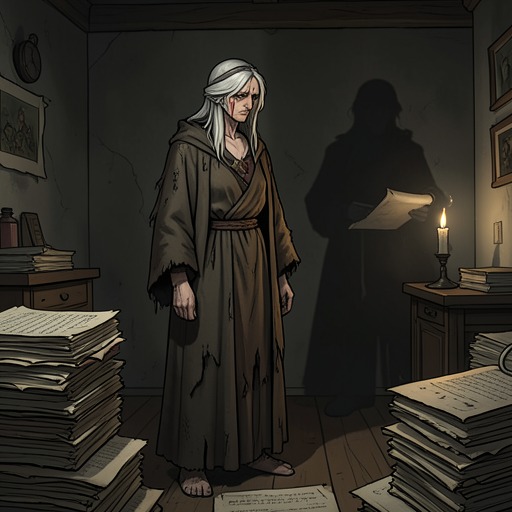
Saffra’s own compressed explanation conveys the wound more clearly than any formal account. After seeing Isabella, she mutters that Isabella is the one who “got me,” then forces herself to declare that Isabella does not matter and should be forgotten. The attempted dismissal is unconvincing. Her squared jaw and drooping tail separate the words from the feeling beneath them: she is trying to impose a final interpretation on a relationship that still has the power to hurt her.
The rupture also draws in a gold-rank adventurer who objected to what happened to Saffra. He insulted Duke Caldimore and was imprisoned for six months, demonstrating that Saffra’s conflict with Isabella has consequences beyond the two girls. The Caldimore family can convert a personal accusation into expulsion, legal closure, and punishment for anyone who challenges the family’s authority. Saffra’s grievance is consequently treated not as a private dispute requiring reconciliation, but as a settled matter backed by noble power.
The Institute Reunion
The relationship resurfaces when Saffra accompanies Vivi into the restricted archives of the Thaumaturgical Institute. Vivi is examining an inferior journal on the seventh-tier spell Earthrend when Saffra rushes around a corner, visibly panicked, and begs to be hidden. Vivi immediately casts Invisibility, allowing Saffra to disappear behind her robes before a student reaches the corridor.
That student is Isabella Caldimore. She is a tall teenager in a student uniform, with long straight blonde hair, blue eyes, and a thin, gaunt appearance that makes her look sick rather than regal. Her expression is one of panic and horror, and she searches the hallway as though pursuing or fleeing from something. When she fails to find Saffra, she turns her frightened attention to Vivi, apologizes for bothering her, and runs away.
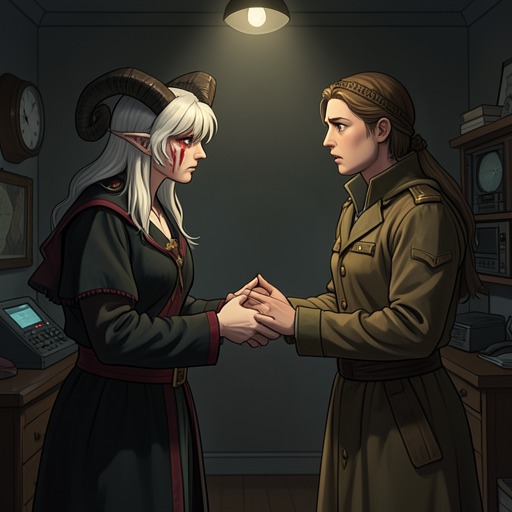
The encounter leaves both girls exposed without either speaking openly. Saffra remains cowering behind Vivi for several moments after Isabella has fled, then whispers that Isabella is the only person who would recognize her. Later, she complains about the way Isabella looked at her and abruptly insists that Isabella does not matter. Vivi observes that Isabella’s unhealthy gauntness and terror do not fit the image of a triumphant two-faced bully. The scene therefore transforms the conflict from an accusation with an obvious victim and perpetrator into a mystery involving two visibly damaged young women.
Mutual Victimhood and Unresolved Meaning
Vivi’s central conclusion is that there may be two victims in the debacle. Isabella’s condition does not prove Saffra’s innocence, nor does Saffra’s distress establish what Isabella did or failed to do. It does, however, undermine the simplest version of the story. A person who had successfully destroyed her target would not obviously be expected to appear sick, frightened, and unable to face the returning student. Isabella’s response implies that the Caldimore family’s actions may have harmed her as well, whether through coercion, fear, guilt, or circumstances the narrative has not yet disclosed.
Saffra’s pattern is correspondingly divided between pursuit and withdrawal. She wants the past recognized enough to name Isabella as the person who ruined her, yet she tries to end the conversation by saying that Isabella is irrelevant. She hides behind Vivi, clutches at the back of Vivi’s robes, and then attempts to recover control by squaring her jaw and marching away. The body repeatedly contradicts the defensive story. Her hostility is not emotional indifference; it is the protective form taken by attachment after trust has become dangerous.
The relationship also illuminates the moral contrast between institutional procedure and personal care. The Institute has expelled Saffra and treated the matter as closed, while Vivi refuses to accept closure without understanding what happened. She does not immediately declare Saffra blameless, but she continues investigating because the observed behavior does not match the official account. Her response gives Saffra a form of support that is neither sentimental absolution nor passive belief: Vivi takes the girl’s pain seriously while preserving uncertainty about the facts.
Consequences and Continuing Conflict
The reunion ruins Saffra’s visit to the Institute. Although she tries to appear unaffected, she remains distracted for the rest of the exploration, and Vivi ends the trip early. A supposedly ordinary return to the Institute becomes a psychological confrontation in which neither former friend can speak honestly. The institution’s shelves, restricted archives, and hidden spell knowledge thus frame a conflict whose most important information remains inaccessible.
The rupture continues to shape later political and rescue decisions. Vivi seeks the release of the imprisoned gold-rank adventurer who protested Saffra’s expulsion, while Rafael warns that Duke Caldimore has the legal advantage and is unlikely to overlook insults against his family. Later, when Saffra confronts Rafael over Isabella’s danger, she screams that Isabella is the Duke’s daughter and demands to know what is wrong with him. Her outrage shows that hatred has not erased responsibility. Whatever Isabella did, or whatever Saffra believes she did, Saffra still insists that Isabella must be saved.
That contradiction is the relationship’s decisive feature. Saffra can condemn Isabella as the source of her ruin, recoil from her presence, and still react with immediate fury when Isabella’s life is endangered. The story leaves the original betrayal unresolved, but it makes the emotional truth unmistakable: the friendship has not vanished so much as become inaccessible beneath fear, accusation, unequal power, and possible shared victimhood. Its eventual meaning depends on whether the hidden circumstances can be brought into language before the Caldimore family’s version of events becomes permanent.