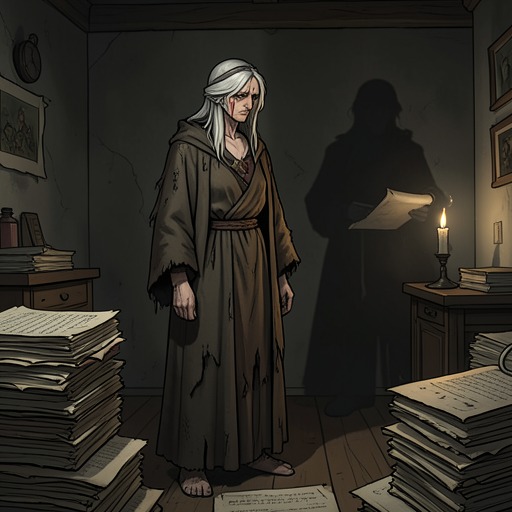
Saffra–Isabella rivalry
New Life as a Max Level ArchmageThe Saffra–Isabella rivalry is one of the most persistent emotional conflicts in Saffra’s life. What first appears to be a simple accusation that Saffra attacked Isabella Caldimore is gradually revealed as a more complicated relationship in which friendship, perceived betrayal, institutional power, and family manipulation remain inseparable. Saffra’s anger survives because the injury was never merely academic: she lost her place at the Thaumaturgical Institute, was made to carry blame for events she did not cause, and was left uncertain whether Isabella had ever valued their connection.
Origin in the Institute
Saffra’s history with Isabella is inseparable from the incident that ended her education at the Thaumaturgical Institute. Saffra remembers Isabella as the major exception to her otherwise strong ability to judge character, and even brushing against the memory makes her flinch. The text does not present Saffra’s expulsion as a settled moral judgment. Vivi knows that Saffra has a good heart and suspects that the accusations against her were largely fabricated, although Vivi lacks proof. The allegation that Saffra attacked Isabella is accompanied by other unspecified charges, allowing the official version of events to remain both authoritative and doubtful.
The social consequences are nevertheless concrete. Saffra no longer attends the Institute, and the event still governs how she understands herself eight months later. When she notices Barnaby Caldimore aboard the Convoy, she becomes irrationally afraid that he might recognize her, even though he plainly does not. That indifference wounds in its own way: Saffra concludes that her expulsion was unimportant to the family most involved in it, perhaps not even important to Isabella. The contrast between the magnitude of Saffra’s pain and the apparent normality of the Caldimores makes the rivalry feel profoundly unequal.
A Wound Sustained Through Uncertainty
Saffra cannot determine what Isabella felt about the betrayal. She wonders whether Isabella cared about what she had done or whether the entire affair had been a joke to her. She imagines Isabella laughing for days before forgetting her altogether, then becomes furious that she still cares so much. The uncertainty is as damaging as the accusation itself. Saffra has no clear confession, apology, or explanation to place at the center of the memory, so the past returns as speculation and self-directed humiliation.
Her response is often defensive performance. After thinking about Isabella, Saffra begins boasting about her own magical ability, declaring that channeling at fifth tier and approaching sixth is impressive even though she has not reached the benchmark for fourth-tier magic and possesses only half the education of most casters. The boast is not presented as genuine confidence. She feels embarrassed as soon as the words leave her mouth, yet bluster temporarily steadies her. The rivalry therefore shapes Saffra’s self-presentation: achievement becomes a shield against the fear that Isabella’s version of her remains the one others believe.
The Rivalry Under Pressure
The relationship becomes more complicated when Saffra is caught in the Convoy crisis. After Vivi realizes that the healing potion Saffra used was extraordinarily valuable, Saffra’s guilt becomes unbearable. She holds Vivi’s locket, asks how valuable the potion had been, and prepares herself to accept punishment. Her fear is not only about wasting an artifact; it reflects a learned expectation that helping someone can be treated as wrongdoing when powerful people control the rules.
Vivi rejects that logic. She tells Saffra that using the potion to help someone is acceptable, even though it was meant for Saffra herself. The response directly counters the pattern established by the Caldimores, where Saffra’s motives and actions were allegedly transformed into grounds for condemnation. Saffra’s instinct is to conceal the act and await judgment, while Vivi treats the life saved as the decisive fact. This difference begins to separate Saffra’s new mentorship from the old rivalry: Vivi’s trust is based on conduct, whereas Saffra’s previous experience taught her to expect accusation.
Vivi also decides to help Saffra recover a measure of dignity after the crisis by finding a missing pet and arranging circumstances so that Saffra can receive the credit. The gesture is small compared with the dangers surrounding them, but it responds precisely to the structure of Saffra’s injury. Saffra has repeatedly been denied control over the story of what she did; Vivi therefore tries to give her an uncomplicated victory that cannot be taken away by an institution or noble household.
Isabella as Victim and Instrument
The later revelation changes the moral shape of the rivalry. Isabella explains, haltingly and incoherently, that Saffra had not actually done anything to provoke Duke Caldimore’s anger. The Duke wanted to punish Isabella or remove a distraction and test her, although the exact purpose remains unclear. Saffra was simply an available target. She had been caught in the Caldimore family’s internal drama rather than punished for her own conduct.
This discovery does not erase the damage between the two women, but it redistributes responsibility. Saffra is furious on Isabella’s behalf as well as her own because Isabella too has been controlled by the Duke’s actions. Saffra insists aloud that Isabella should not feel guilty, and Isabella’s eyes fill with tears, suggesting that the younger woman cannot yet accept her innocence. Their conflict consequently moves beyond a straightforward victim-and-perpetrator structure. Isabella participated in the chain of harm, or at least became its immediate instrument, but she was also subjected to a family authority that used both women against each other.
Vivi’s political response reinforces the scale of the power imbalance. She explains to Rafael that the Caldimore family secured Saffra’s expulsion and that a gold-rank adventurer who objected to what happened insulted the Duke and was imprisoned for six months. Vivi wants him freed, even though the legal settlement appears to favor Duke Caldimore. The imprisonment demonstrates that the rivalry is not confined to private resentment: the Caldimores possess enough authority to turn a personal dispute into institutional punishment and to retaliate against anyone who challenges their account.
Persistence and Significance
The Saffra–Isabella rivalry persists because it combines personal attachment with an unresolved political injury. Saffra is not simply angry at an enemy; she is grieving a relationship whose meaning she cannot securely recover. Her continued fixation after eight months reveals that the rivalry has become a recurring test of her judgment, her worth, and her capacity to trust. She believes she can see beyond surface appearances and judge character well, yet Isabella remains the decisive exception that makes that confidence unstable.
The relationship also gives Saffra’s later actions an ethical counterpoint. When she uses an expensive potion to save others, she fears that generosity will once again be converted into guilt. Vivi’s refusal to punish her, her effort to create a success for Saffra, and her decision to investigate the Caldimores offer alternatives to the old pattern of accusation and silence. Even Vivi’s own self-reproach after arriving too slowly to prevent danger echoes the rivalry’s moral structure: people are haunted not only by the harm they cause, but by the harm they believe they could have prevented.
By the time the truth emerges, Saffra and Isabella are no longer best understood as simple rivals. Saffra remains the person expelled and publicly discredited, while Isabella remains the person whose family made that expulsion possible, but both have been damaged by the same household’s manipulation. Their relationship’s significance lies in that unstable overlap. It shows how a private bond can be broken by unequal power, how uncertainty prolongs resentment, and how later recognition of shared victimhood can complicate blame without restoring what was lost.