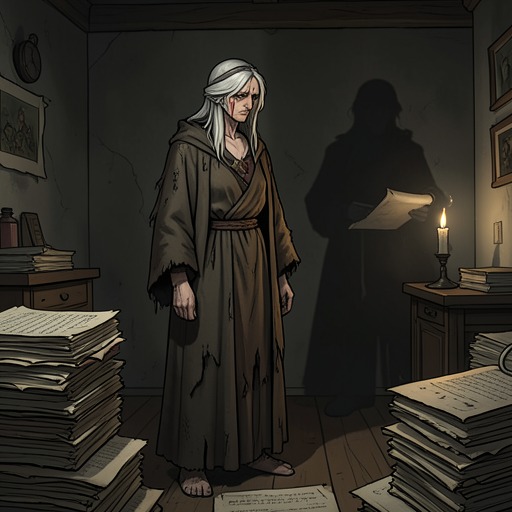
Saffra’s Expulsion from the Institute
New Life as a Max Level ArchmageSaffra’s Expulsion from the Institute is not presented as a completed disciplinary episode but as an absence that governs Saffra’s life after it. The Institute has taken away her formal education and access to its library, while the narrative withholds the precise cause until Saffra’s later dealings with Isabella Caldimore and Damon Caldimore expose the conflict behind the punishment. The expulsion therefore functions simultaneously as social exclusion, an educational deprivation, a wound in Saffra’s friendship with Isabella, and the point at which a talented but isolated commoner becomes vulnerable to the authority of a noble family.
Background and Hidden Cause
Saffra’s removal from the Institute is repeatedly identified as the reason she no longer attends, yet its details remain concealed for much of the surrounding narrative. When the subject first enters her thoughts, it is attached to a major exception in her otherwise strong ability to judge character: Saffra can see beneath people’s surfaces, but she failed disastrously in at least one important case. Her glance toward Lord Barnaby Caldimore reveals the social dimension of the injury. She worries that he will recognize her, then realizes that her expulsion has apparently mattered to no one, not even the family most directly involved. The punishment has thus produced both fear of recognition and the humiliating suspicion that the people who caused it have already forgotten her.
The withheld explanation becomes a source of continuing pressure because Saffra still cares about Isabella Caldimore eight months later. She imagines that Isabella may have laughed at what happened and then forgotten Saffra altogether, while Saffra remains angry that the episode can still send her spiraling. Her boast that she can channel fifth-tier magic and is approaching sixth-tier channeling, despite not yet reaching the benchmark for fourth-tier magic and having received only half the education of most casters, is partly an attempt to recover pride after thinking about Isabella. The expulsion has therefore changed the meaning of achievement: magical progress becomes evidence that exclusion did not make Saffra worthless.
Educational and Social Consequences
The Institute’s loss is especially severe because Saffra is an orphaned commoner whose access to advanced magic is already constrained by social hierarchy. She has spent years pursuing the Elementalist class partly because it is practical and attainable, not because elemental spells are her deepest preference. More complex fields, including divination, illusions, and druidism, are controlled through family inheritance, guild connections, noble titles, or personal favor with Institute mages. Her attitude has also alienated the families and institutions whose approval might have opened those paths. Expulsion compounds this structural disadvantage by removing the institution that could have supplied training, books, and professional legitimacy.
Saffra’s later theory about Vivi’s gaps in knowledge makes the contrast sharper. Saffra suspects that Vivi’s ability to know immense amounts about magic while lacking basic information comes from memory loss, perhaps magical or perhaps caused by a combat injury. Saffra herself, however, is not deficient in the same way: her knowledge has been interrupted by circumstance and policy. The Institute has denied her ordinary educational continuity, while her talent continues to develop beyond the formal benchmarks available to her. Her expulsion makes her expertise look anomalous because it has been forced to grow without the institutional support normally used to measure and validate it.
The restriction also affects her access to books. Saffra admits that the library is one of the things she has missed most, and she wants to accompany Vivi because the return of its resources would be practically valuable. She knows she is technically banned and worries that her presence might cause trouble, even while arguing that her shortened hair and increased age make recognition unlikely. Her hope is not simply to revisit a familiar building; it is to recover a means of learning that the expulsion removed from her life.
Return to the Institute with Vivi
Vivi’s apprenticeship changes the practical force of Saffra’s exile. When Saffra asks whether she may accompany Vivi to the library, Vivi offers protection through her status and, if necessary, an illusion. Saffra accepts only after acknowledging the legal and social risk: she is still banned, and she does not want to become a source of trouble. Vivi answers that the responsibility will be hers. This exchange reverses one central condition of the expulsion. Saffra once had to face the Institute alone as an excluded student; now she enters under the protection of a powerful mage who publicly names her as an apprentice.
The librarian does not object when Vivi brings Saffra into the restricted archives. Vivi’s credentials and the declaration that Saffra is her apprentice are sufficient for access to the first restricted level, which is reserved for full Institute Magi and important or well-connected guests. The permission does not erase the expulsion, but it demonstrates that institutional boundaries are unevenly enforced. Saffra cannot enter by virtue of her own student standing, which has been revoked, yet she can enter through the authority of a stronger patron. Her renewed access exposes both the value of Vivi’s protection and the dependence created by the social system that had previously excluded her.
The library itself offers a qualified restoration. Saffra is much more interested in the shelves than Vivi, while Vivi judges even the Institute’s concealed spell designs to be crude. A journal describing an inferior implementation of the seventh-tier spell Earthrend confirms that the books are useful but beneath Vivi’s standards. Saffra nevertheless receives something the expulsion denied her: the chance to examine institutional knowledge directly, rather than relying solely on incomplete education and improvisation. The return is therefore materially beneficial without becoming a full reinstatement.
Isabella Caldimore and the Caldimore Challenge
Saffra’s first return to the Institute reopens the emotional cause of her exile. While exploring the archives, she encounters Isabella Caldimore or is seen by her, then rushes away in panic. Her reaction is far more intense than the unease of meeting former classmates. Vivi understands that Isabella, the Duke’s daughter and Saffra’s former friend, must be involved; the encounter carries the force of betrayal rather than ordinary embarrassment. Saffra eventually states only that Isabella saw her and that she ran away, but the physical retreat makes visible what the withheld history has done to her. The Institute is not merely a place from which she was expelled. It is the place where the old relationship remains capable of controlling her body and choices.
The conflict becomes public when Vivi meets Damon Caldimore. Damon describes Saffra as a young woman expelled for assaulting his daughter, explaining that she and Isabella met in the north and later traveled to Meridian together. The accusation supplies the first explicit account of the disciplinary offense, but it does not settle its moral meaning. Damon frames Saffra’s action as an assault against his daughter and emphasizes the privilege Saffra had received: tuition, supplies, and an education unavailable to many children. In his interpretation, Saffra repaid generosity by attacking a fellow student, making the expulsion a justified response to ingratitude as well as violence.
Damon also refuses to let the issue end with an apology. He acknowledges that youth can produce folly and even allows that Saffra may have changed during her time away, but he insists that some mistakes cannot be forgiven. His position turns the expulsion into an active threat: even after Saffra has become Vivi’s apprentice and offered an apology, the Caldimore family can continue to treat her as an offender whose punishment should not be relaxed. Vivi does not demand forgiveness; she seeks to extend an apology and end a particular imprisonment. The distinction matters. She recognizes that the past cannot be rewritten, but rejects the idea that an old disciplinary judgment should permanently determine Saffra’s freedom.
Aftermath and Narrative Significance
The expulsion leaves Saffra caught between exclusion and advancement. She continues to improve her channeling, pursues the Elementalist class, and eventually reaches the level milestones associated with class evolution, even though the education that might have guided her toward more esoteric magic was restricted by social access and her removal from the Institute. Her progress is not a clean triumph over the institution: it is evidence of what she has accomplished while deprived of it, and it also explains why returning to its library matters so much.
Her relationship with Vivi provides a counterstructure to the Institute’s judgment. Vivi does not treat Saffra as permanently defined by the accusation. She makes room for Saffra in restricted archives, accepts responsibility for her presence, and keeps her close when trials and institutional dangers arise. Yet Vivi’s protection does not dissolve Saffra’s memories. Saffra still blusters to regain composure, still worries that Isabella never cared, and still reacts to Isabella’s sight as if the expulsion were happening again. The apprenticeship offers recognition and practical shelter, but emotional recovery remains unfinished.
The event also links private betrayal to aristocratic power. Damon’s account reduces Saffra to an orphaned commoner of moderate talent and an irrelevant family name, while the same fact becomes startling to another powerful figure because Saffra is connected to Vivi and has become her apprentice. The difference between these descriptions reveals how status determines whether an expelled student is treated as disposable or politically significant. Saffra’s exile begins as an institutional punishment, but its consequences spread into noble retaliation, imprisonment, diplomatic negotiation, and the question of who has the authority to define a young mage’s future.
Saffra’s Expulsion from the Institute consequently marks the boundary between the life she was meant to have and the life she constructs afterward. It removes her from the conventional path of education, turns a former friendship into an unresolved source of fear, and forces her magical identity to develop outside approved channels. Her return to the library under Vivi’s name proves that the boundary can be crossed, but Damon’s resistance shows that crossing the threshold is not the same as being welcomed back. The event remains decisive because it is never allowed to become merely past: it continues to shape Saffra’s knowledge, pride, relationships, mobility, and struggle for recognition.