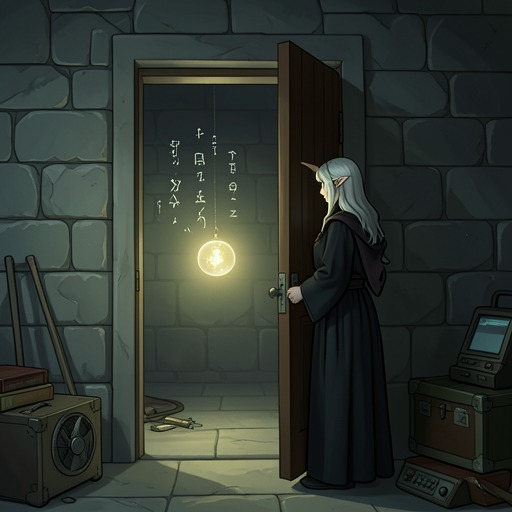
Spatial Magic
New Life as a Max Level ArchmageSpatial Magic is the study and practice of altering space itself: its distances, positions, and dimensional boundaries. It is significant because it turns movement and location into subjects of magical design, allowing practitioners to cross impossible distances, study dimensional anomalies, and imagine enchantments capable of sustaining enormous structures for centuries. The discipline combines spectacular public demonstrations with difficult theoretical work, and its greatest promise lies not merely in travel but in preparation for another calamity.
Definition and Scope
Spatial Magic appears under closely related descriptions including dimensional magic and warp magic. Its range extends from localized movement spells to enchantments that alter the relationship between land and gravity. The Thaumaturgical Institute’s crowning architectural marvel is a quarter-mile-wide mass of earth and stone suspended fifty feet above the ground, held in place by gargantuan chains. The anti-gravity enchantment has no clearly explained creator or method, and the game’s lore never established how it was made, leaving its origin as an unresolved problem within the world’s magical history.
That floating campus demonstrates the discipline’s scale as much as its theatricality. The enchantment may have little practical purpose beyond displaying what mages can accomplish, yet its ability to endure for centuries makes it a serious technical challenge. Even Vivisari Vexaria, described as perhaps the world’s strongest individual mage, doubts whether she possesses enough mana to reproduce an effect of that magnitude. The problem also establishes an important distinction within Spatial Magic: exceptional individual power is not always equivalent to collective capability. The alumni of the Institute, representing nearly all humanity by proxy, can achieve miracles through collaboration that no solitary mage could sustain alone.
Research and Collective Knowledge
Spatial Magic becomes a major research concern when Vivisari Vexaria investigates the dimensional anomaly and decides that the Institute’s scholars are better equipped to decipher it. Her decision is not an admission that she lacks power; rather, it recognizes that knowledge distributed across a community can exceed the capacity of even the strongest practitioner. The anomaly therefore links Spatial Magic to institutional scholarship, experimentation, and the organized accumulation of expertise.
Master Aeris has been developing theories and experimenting with designs of his own. Vivisari Vexaria gives him a notebook containing her diagrams and asks him to assess whether they can help his work. Aeris concludes that dimensional magic certainly exists and argues that it should be studied in order to prepare for the possibility of another calamity. The Institute’s elite researchers are already excited by Vivisari Vexaria’s diagrams, although even Aeris was initially confounded by them before he believed he had understood the concepts being conveyed.
The exchange also defines research as a collaborative conversation rather than a simple transfer of answers. Vivisari Vexaria tells Aeris that any assistance is useful, even if he serves only as someone with whom she can discuss ideas. To make that exchange practical, she places a Warp Anchor outside his door, creating a permanent means for future visits. The anchor turns an abstract promise of cooperation into infrastructure: Spatial Magic does not merely enable isolated feats, but can establish continuing networks between people and places.
Warp and the Experience of Passage
The most direct demonstration of Spatial Magic occurs when Vivisari Vexaria casts Greater Warp for herself, Master Aeris, and Tatiana. She claims that the return journey is merely eighteenth-tier magic, a statement that shocks Tatiana because the spell is treated by Vivisari Vexaria as comparatively minor despite its extraordinary effect. Vivisari Vexaria performs it without her staff, for three people, and without visible fatigue, making the feat an immediate measure of the gap between her mastery and the abilities of ordinary practitioners.
Greater Warp is experienced not as ordinary travel but as the temporary destruction of familiar embodiment. The world folds inward; blackness presses from every direction; sight, hearing, and smell vanish; and Tatiana feels as though she has ceased to exist. Her limbs and body seem to disappear in total disembodiment before a sensation of movement returns, comparable to being hurled by a catapult multiplied a million times over. Space then unfolds and expels her into cold sunlight, where Master Aeris steadies her as she staggers back into reality.
The spell’s violence is balanced by its instructional value. Aeris tells Tatiana that the first experience is overwhelming but becomes easier with adjustment. Although Greater Warp is not Blink, the two spells are closely aligned, and Tatiana deliberately fixes the sensations in her memory. The journey gives her a bodily model for the invocation she has been studying; the terror and wonder of passage become practical knowledge that makes Blink seem genuinely within reach.
Limits, Mastery, and Consequences
The evidence presents Spatial Magic as powerful but not effortless in principle. The floating Institute requires an enchantment capable of holding for centuries, while Vivisari Vexaria questions whether even her vast mana reserves would suffice to recreate it. The contrast between her instantaneous casting of Greater Warp and her hesitation over sustained anti-gravity work shows that spell difficulty is not measured only by dramatic appearance. A fast movement spell and a long-term structural enchantment impose different demands of scale, duration, and mana.
The discipline also depends on preparation and controlled access. Vivisari Vexaria’s Warp Anchor outside Master Aeris’s door promises repeated contact, while her notebook gives researchers a foundation for studying dimensional phenomena. Her request that Aeris help investigate the anomaly is motivated by the need to prepare for another calamity, so Spatial Magic carries a defensive and anticipatory purpose as well as an exploratory one. Its practitioners are not simply seeking impressive transportation; they are trying to understand forces that may threaten the world.
Narrative Significance
Spatial Magic is framed through a tension between spectacle and uncertainty. The floating campus is a public miracle whose original construction remains unexplained, while Greater Warp provides an intimate demonstration whose mechanics are felt more clearly than they are understood. In both cases, the discipline produces awe by exposing characters to a power larger than ordinary physical experience. The floating earth makes the Institute seem almost mythic from the outside; the warp makes Tatiana confront the fragility of personal existence from within.
At the same time, the concept resists being reduced to spectacle. Its unanswered origins, demanding mana requirements, reliance on collaboration, and connection to dimensional anomalies give it a sustained research dimension. Spatial Magic marks the point where individual mastery, institutional knowledge, and the world’s looming dangers meet. Through it, movement becomes theory, architecture becomes experimentation, and a brief journey through darkness becomes a possible lesson in survival.