Thaumaturgical Institute Library
New Life as a Max Level ArchmageThe Thaumaturgical Institute Library is the intellectual heart of the Thaumaturgical Institute and one of the premier collections of knowledge in the world. Spanning the Institute’s full diameter, it confronts Vivisari Vexaria with millions of books, a century-old structure she recognizes, and a concentration of history, culture, magical theory, and institutional authority that makes the place far more than a backdrop for research. It is where Vivisari seeks to supplement Saffra’s apprenticeship, recover knowledge for herself, and test the actual quality of the Institute’s learning.
Purpose and Setting
The library enters the plot when Vivisari Vexaria explains that she can guide Saffra through spell design and mana exercises but cannot provide every part of the girl’s education. The Institute’s collection could fill those gaps, particularly through primers on history and world geography and through material related to dimensional magic and adjacent theory. Vivisari therefore asks Saffra to identify books worth seeking, respecting both her apprentice’s reluctance to return to the Institute and her familiarity with the subjects she needs.
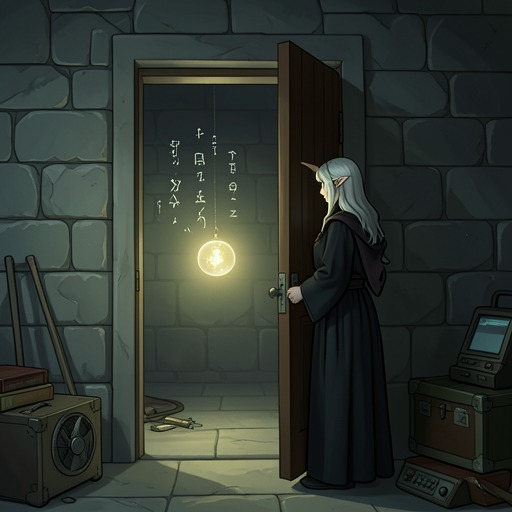
The physical scale of the library makes that educational purpose feel almost overwhelming. After an elevator stops, Vivisari passes through a short hallway and a huge arched doorway into the first floor. The collection occupies the entire diameter of the Institute, which is described as no slender tower, and shelves extend along the circular walls and across the ground floor. Millions of books fill the space, while enchantment-fueled white orbs provide dim atmospheric light and the air carries the scent of paper and vellum. The combination of circular architecture, hovering illumination, and material abundance gives the library an atmosphere of accumulated knowledge rather than a simple room containing books.
Memory and the Weight of Knowledge
The library’s design has changed less than Vivisari expects despite the passage of a century. Its grandeur is therefore doubled: it is both an institution preserved from her remembered past and a functioning center of scholarship in the present. She pauses at the entrance to absorb the sight, recognizing the Institute’s academic ambition in the construction. The mages’ instinct to display their accomplishments has made the library one of their great focuses, so its magnificence embodies both intellectual seriousness and institutional pride.
That recognition does not make the space emotionally simple. When Vivisari finds her first target and opens a random book, the dense lettering on a single page produces a sudden burst of disorientation. The page contains an immense amount of information, and millions of other books wait around it. The library becomes a stark reminder that she has been thrown into a new world: the accumulated history and culture on its shelves make the gap between her former knowledge and her present surroundings materially visible. The collection thus externalizes the problem of orientation. It promises answers while simultaneously demonstrating how much remains unknown.
Vivisari responds by turning the library into a portable archive. After closing the book, she casts Illusory Scan, copying the book’s physical structure into an archive inside her mind so that she can call up a magical copy when needed. Later, after an encounter elsewhere in the Institute, she and Saffra return to the library and gather a small pile of general-information books, which Vivisari copies and stores. The library’s knowledge is consequently both place-bound and transferable: its shelves possess the authority of an institution, but Vivisari’s magic allows her to extract that authority into a private mental collection.
Access and Restricted Knowledge
The library is not wholly open. A receptionist behind a half-moon desk initially blocks deeper passage, and Vivisari must state her identity and explain the situation. Her presence, and the prospect of how the strange demonic mage might react to resistance, visibly unsettles the receptionist. The scene establishes that access is governed as much by status and reputation as by ordinary library procedure.
Vivisari later takes Saffra toward the restricted floors, offering to use Invisibility if the apprentice is not permitted to enter. The offer reveals the practical character of their partnership: institutional barriers are treated as obstacles to solve, while Saffra’s education remains the priority. In practice, the librarian does not object when Vivisari brings another person into the restricted archives and identifies Saffra as her apprentice. The first restricted level is available to full Institute Magi and important, well-connected guests, and its relatively low status means that the most powerful tomes remain elsewhere.
The contrast between the main floor and the first restricted level is deliberate. The public area is spacious and arena-like, with an awe-inspiring atrium and vast numbers of shelves; the restricted area is smaller and more ordinary, with fewer shelves and a conventional library layout. Restricted access therefore does not automatically equal exceptional knowledge. Saffra is fascinated by the material, but Vivisari finds the concealed spell designs crude. Even the Institute’s guarded instructional manuals appear primitive by her standards. The books are not incorrect or dangerous, yet their limitations make possession less valuable than the institution’s secrecy might suggest.
Research, Limits, and Narrative Function
The library serves Saffra’s apprenticeship by giving her resources Vivisari cannot personally provide, but it also becomes a site where Vivisari evaluates the Institute itself. She enters expecting useful information about magic and the wider world; what she encounters is a hierarchy of knowledge whose restricted materials still fail to match her standards. The collection’s prestige and its actual technical quality pull in opposite directions. Its millions of volumes testify to historical depth, while the inferior implementation of a seventh-tier Earthrend spell exposes the narrowness or stagnation of at least some institutional instruction.
The library’s exploration is interrupted when Saffra rushes around a corner in panic and asks Vivisari to hide her. Vivisari does not freeze or hesitate: within less than a tenth of a heartbeat, she draws and shapes mana and silently casts Invisibility, causing the catgirl who has taken cover behind her to vanish from sight. The episode turns the library from a contemplative archive into an active tactical space. Shelves, restricted corridors, librarians, and institutional surveillance become immediate conditions of danger, while Vivisari’s decisive response demonstrates that her role as mentor includes protection as well as teaching.
As a location, the Thaumaturgical Institute Library joins several otherwise separate functions. It is an educational resource for Saffra, a research base for Vivisari, a monument to the Institute’s self-image, a container of memories reaching across a century, and a controlled gateway to knowledge divided by rank. Its sheer abundance produces wonder but also disorientation; its restricted rooms promise superiority but reveal mediocrity; and its quiet scholarly atmosphere can be broken instantly by fear and concealment. The library’s decisive significance lies in that tension: it offers access to the world’s accumulated understanding while reminding Vivisari that knowledge is vast, unevenly guarded, and never automatically equal to wisdom.