The Codex of the Hollowed Sun
New Life as a Max Level ArchmageThe Codex of the Hollowed Sun is the exceptional relic at the heart of the accessible chamber in the Vanguard vault: a legendary level-2000 artifact associated with the Umbral Regent, the first Cataclysm slain by the Party of Heroes. Its practical function is extraordinary. The Codex absorbs magical energy into its pages and releases that energy back to the mage who supplied it, creating a portable secondary mana pool whose usefulness extends even to Vivisari Vexaria. At the same time, its hunger and Cataclysmic provenance make it an ominous object, because the System’s provision of such a tool appears to imply that a future threat may eventually demand it.
Discovery and Provenance
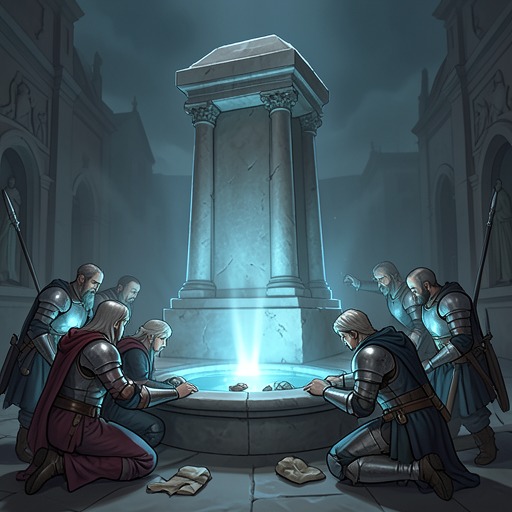
The Codex appears as the singular exception among the crafting materials stored in the first accessible section of the Vanguard vault. The chamber contains resources of nearly incalculable value, including materials gathered from creatures that no mortal group besides the Party of Heroes had been able to harvest in quantity. The Codex, however, rests separately on a pedestal beside the locked door leading toward the vault’s deeper chambers, marking it as something more deliberate than ordinary treasure and identifying it as the reward for the current restoration quest.
Vivisari Vexaria recognizes the book immediately. The Umbral Regent had worn it on his belt, although it had not been his principal spell tome and she had never seen him cast with it. That history gives the artifact a double identity: it is both a recovered reward and a surviving remnant of a defeated Cataclysm. The Umbral Regent had been the world’s most powerful lich, the freshest-born and weakest of the Cataclysms, and the first one killed by the Party of Heroes. The Codex therefore carries the material memory of an enemy whose defeat helped establish the century of peace celebrated in Prismarche.
Appearance and Classification
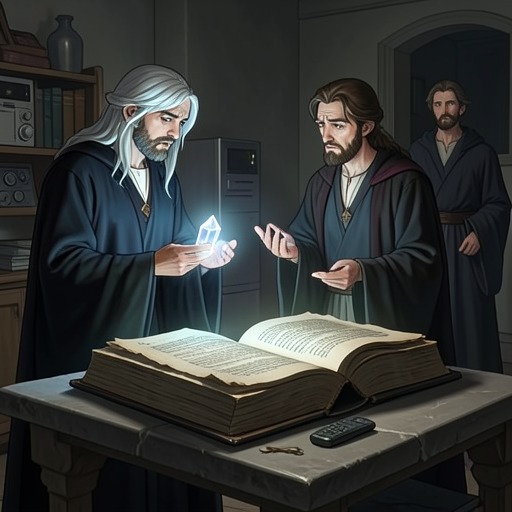
The System identifies the object as The Codex of the Hollowed Sun, classifies it as Legendary, and gives it a level of 2000 while displaying a current level of 0. The book is shockingly heavy, as though carved from a block of lead. Its cover consists of cold, polished black stone, centered by a dull-silver circle from which thin, sharp lines flare like rays of a sun. The imagery makes the title visually paradoxical: a sun is represented, but its radiance is muted and hollowed rather than warm or illuminating.
The interior is made of dark gray pages that initially appear blank, including at the end of the volume. Vivisari’s inspection reveals abilities including True Sight and Soul Sight, but she finds no immediate curse or hostile mechanism. Her caution remains justified because the Codex is a relic repurposed from a Cataclysm. Its blankness is not uselessness; it is a sign that the book’s contents are activated through energy rather than written instruction.
Mana Reservoir and Operation
Vivisari identifies the Codex as a mage’s accessory that absorbs energy. She can feel its pages tugging at the mana core inside her torso and drawing on every nearby power source. The book is not merely capable of storing energy in the abstract; it is hungry for it, and the sensation makes the artifact seem almost alive in its need to be fed. That appetite turns an apparently inert book into an active magical presence and causes Jasper to wonder whether the party is about to create another Cataclysm.
To test the object, Vivisari opens her gates and pours mana into its first page. The Codex drinks in increasingly vast quantities, draining a considerable portion of her pool before a symbol brightens on the page. The symbol is Galdrust, the rune associated with a reservoir, storage, or container. Each page can hold an obscene amount of mana, although the book cannot take more than the supplying mage can provide. Once the first page is full, the flow slows to a trickle and stops, showing that the Codex has reached the capacity of that page rather than simply resisting the experiment.
The stored power can then be drawn back out. Vivisari pulls on the glowing symbol, and mana flows into her, refilling her core with a conversion loss of approximately fifty percent. She estimates that the Codex has at least fifty more pages, meaning that filling the entire book would require even her to feed it continuously for weeks. The number of pages and the scale of the reservoir transform the artifact from a convenient container into a vast strategic reserve.
The Codex does not remove every limitation on magical strength. A larger mana pool is only one component of a mage’s power, and Vivisari remains constrained by other factors. The book nevertheless solves a major practical problem: she knows of no other reliable means of storing mana for later use. A ritual circle can be fed with energy, but that is not a genuinely portable reserve. The Codex can travel with its user, accumulate power in advance, and provide that power when needed.
The stored mana appears to be associated with the mage who supplied it. Vivisari suspects that the pages are either locked to that mage or suffer enormous losses when another person attempts to draw from them, although such transferred use may remain possible. Her conclusion is provisional and based on broad observations of mana flow; further experimentation would be required to establish the exact sharing rules. The uncertainty is important because it limits how freely the party can treat the Codex as a communal resource, even while suggesting that someone such as Saffra might be able to channel at least part of its contents.
Strategic Meaning and Ominous Implications
The Codex is valuable precisely because it is useful even to Vivisari, whose power makes most ordinary equipment irrelevant. The first page alone contains enough mana for her to erase a city, or perhaps only a small village if Saffra were able to draw from the reservoir and channel it herself. That comparison establishes both the scale of the artifact and the distance between Vivisari’s capabilities and those of less powerful mages.
Its usefulness also troubles Vivisari. Earlier, the possibility of an Eighth Cataclysm had been treated as uncertain: the Dragon King might descend from the Sky-Pillar Range, an ancient horror might awaken from a millennium-old crypt, or another Shattered Oracle might emerge from reckless ambition. Yet the world’s history has already taught its inhabitants to fear threats that begin as distant possibilities. A hundred years after the Party of Heroes defeated the seventh and final Cataclysm, Prismarche can celebrate Peace Day because the old terrors have been pushed into history, but the existence of the Codex introduces a quieter counterpoint to that celebration.
Vivisari therefore reads the artifact as possible evidence of future calamity. If the System is helping the party acquire a means of accumulating immense magical reserves, she reasons, perhaps some danger on the horizon will eventually require that preparation. The Codex is consequently more than a reward for restoring Vanguard: it is a resource that may belong to the next crisis before that crisis has visibly arrived. Its blank pages hold mana, but they also hold the narrative pressure of an unannounced threat.
Narrative Significance
The Codex links the world’s heroic past, its peaceful present, and its feared future. Its physical association with the Umbral Regent recalls the Cataclysms that once ravaged the world, while its discovery during Vanguard’s restoration places an artifact of that violent age in the hands of a new generation. The same society that venerates the Party of Heroes in the white-stone temple of Prismarche and celebrates a century free from the Cataclysms now possesses a tool born from one of those defeated enemies.
The object also embodies the story’s tension between reassurance and dread. The Party of Heroes’ victory has made peace possible, and Master Aeris can find relief in the absence of immediate proof that an Eighth Cataclysm is coming. Nevertheless, the Codex makes preparedness materially real. It gives Vivisari a means to preserve power against an unknown future, even as its hunger resembles the appetite of the forces the world once feared. That ambiguity culminates in the later perception of Vivisari herself: after she casually tears a Greater Voidbeast apart, witnesses are more likely to believe that a god has descended than that the Sorceress has returned. Against that backdrop, the Codex functions as a smaller but revealing version of the same problem—the world cannot easily distinguish salvation from the arrival of something beyond its understanding.