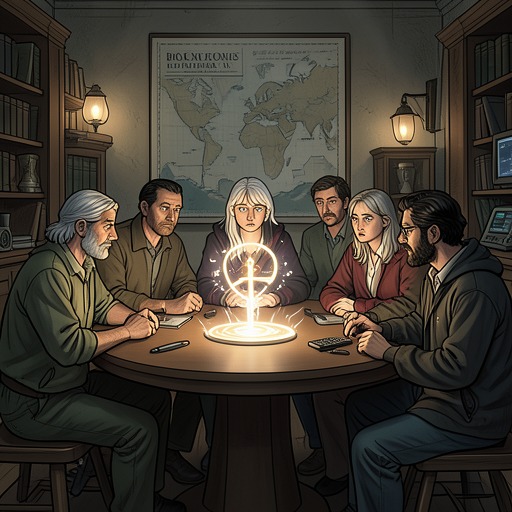
The Eighth Catastrophe
New Life as a Max Level ArchmageThe Eighth Cataclysm names the catastrophe that the world expects to follow the seven disasters already recorded in history. It is not merely another monster or battle, but a horizon of collective fear: a possible event so vast that kingdoms, guilds, and ordinary people must interpret extraordinary power through the language of apocalypse. The concept becomes especially significant when Vivisari Vexaria returns after nearly a century and finds that the world may regard her—not as a savior, but as the disaster it has been waiting to fear.
Historical Meaning
The idea of an Eighth Cataclysm rests on the legacy of the seven catastrophes that preceded it. The Party of Heroes defeated the seventh and final Cataclysm roughly a hundred years before the main events, though the victory cost the lives of every member except the Sorceress. That history has been transformed into public memory: Prismarche’s Temple displays images of saints, heroes, and the Party of Heroes, while the Peace Day Festival celebrates a century of freedom from the forces that once ravaged the world.
The older catastrophes remain concrete rather than abstract in the world’s imagination. The Rampant Genesis unleashed by the Flesh-Weaver, the Crimson Blight brought by the Reaper of the Lost Harvest, and the Great Conflagrations called down by the Ashen Hierophant are remembered as forces that left carnage and destroyed entire cities. The younger generation has not witnessed those horrors directly, but the scale of the inherited memory explains why the population continues to revere the Party of Heroes and why any sign of a new catastrophe carries immediate existential weight.
From Dimensional Breach to Public Fear
The concept first becomes attached to the dimensional anomaly surrounding Vivisari Vexaria’s return. She identifies her arrival point as the Northern Kingdom, the domain of the Ashen Hierophant, and recalls that a massive dimensional breach—or an attempt to create one—occurred in Prismarche on the same night she gated there. The breach failed, but its timing makes coincidence difficult to dismiss. Vivisari therefore intends to investigate it, while others begin to consider whether the event indicates something more dangerous.
Rafael introduces the political dimension of the idea when he tells Vivisari that the leaders of the modern world may perceive the strongest known mortal, returned after almost a hundred years, as a danger on the scale of an Eighth Cataclysm. Her fame does not protect her from suspicion. She had always been the least publicly known member of the Party of Heroes, and even Meridian has so little reliable knowledge of her appearance that people invent details about her. Her absence has allowed legend to grow without a stabilizing human presence.
Rafael therefore warns that Vivisari must tread carefully if she does not want the mortal kingdoms to unite against a perceived world-ending threat. Her stated goal is to restore Vanguard and do what good she can, but political authorities may interpret independent power, unexplained reappearance, and involvement with dimensional phenomena as evidence of an impending catastrophe. In this sense, the Eighth Cataclysm is not only something that might happen; it is also a classification that governments can apply to a person or event when ordinary categories fail.
An Ever-Present Possibility
Master Aeris gives the concept its broadest formulation. He points to threats that remain possible even in an apparently peaceful age: the Dragon King might descend from the Sky-Pillar Range and destroy the mortal lands, an unknown horror might awaken from a crypt that had been sealed for a millennium, and another Shattered Oracle might emerge from a single overambitious glimpse. His conclusion is that there is always an Eighth Cataclysm on the horizon, even when no immediate sign promises that one has begun.
This distinction matters. The Eighth Cataclysm is simultaneously remote and permanent, absent from the present but embedded in the world’s expectations. Master Aeris is relieved when Vivisari says that she sees no promise of one at that instant, because her presence has shocked him into assuming too much. The remark does not reassure Tatiana, who hears only a catalogue of horrors that could surface at any time. The exchange shows how the concept operates psychologically: one character treats the possibility as a reason for vigilance, while another experiences the same reasoning as an expansion of fear.
Vivisari Vexaria as the Suspected Cataclysm
The suspicion surrounding Vivisari intensifies when her power exceeds even the legendary image attached to her. After she effortlessly defeats the Greater Voidbeast, the display is so overwhelming that observers are unlikely to attribute it simply to the returning Sorceress. They may instead assume that a god has appeared and that the heavens themselves have descended to intervene in a battle of otherworldly origin. Even Vivisari’s legendary status cannot explain casually tearing a Cataclysm apart.
That reaction turns the Eighth Cataclysm into a problem of scale and interpretation. Vivisari does not necessarily become a catastrophe by intention, and Rafael explicitly says that he knows her and does not believe she is one. Yet the distinction between what she is and what the world believes her to be becomes politically decisive. The more completely her power escapes familiar measures, the more plausible it becomes for frightened authorities to treat her as an apocalyptic force.
The irony is that Vivisari’s strength may simplify the explanation of later events while simultaneously making her more frightening. If the public sees her as merely the Sorceress, it may connect her to known history; if it sees her as something capable of powers beyond the old Cataclysms, it may elevate her into a divine or catastrophic category. The Eighth Cataclysm thus marks the point at which legend, political fear, and observable force collapse into one another.
Crisis, Governance, and the Limits of the Label
The concept also shapes how authorities respond to other extraordinary dangers. When two living members of Morningstar are captured, the Guard Captain explains that execution is normally the starting and ending point for detaining criminals of such power. Mithril-rank prisoners can teleport, use skills, or deploy spells that make containment extraordinarily dangerous, so ordinary legal assumptions give way to emergency measures. The same logic governs the response to dimensional disasters: the threat is treated as a crisis in which conventional security and responsibility may no longer be sufficient.
Damon Caldimore’s ritual demonstrates the danger of allowing that emergency logic to become self-justifying. After the ritual causes a disaster and threatens to overrun the capital, Rafael demands that Damon explain his actions and reveal how the breach might be contained. Damon claims that his knowledge and the replicable process he created make him too useful to execute, even though he admits that he does not know how to close the gate. His argument turns catastrophic knowledge into a defense against punishment, while Rafael attempts to convert that knowledge into immediate mitigation.
The Eighth Cataclysm therefore remains an unstable term. It can describe a genuine future disaster, a dimensional threat, a political accusation, or the public reaction to a person whose power has become incomprehensible. Vivisari’s later observation that the dimensional boundary is resilient and self-repairing weakens the immediate catastrophe narrative, but it does not eliminate the world’s underlying fear. The possibility remains at the edge of every calculation: an ever-present name for the moment when inherited history, uncontrolled power, and institutional panic become indistinguishable.