The Party of Heroes' Victory
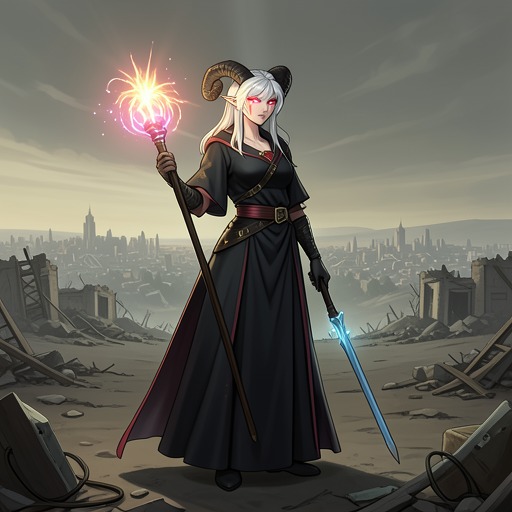
New Life as a Max Level ArchmageThe Party of Heroes' Victory, also remembered as the Conquest of the Seven Cataclysms and the End of the Age of Chaos, is the decisive historical event that separates the world’s age of devastation from its later age of peace. A hundred years before Vivisari Vexaria’s return, the Party of Heroes defeated the seventh and final Cataclysm at a terrible cost: every member except the Sorceress perished in the fight. Their triumph saved the mortal lands from horrors capable of ravaging entire cities, while the survival of the Sorceress turned the victory into both a collective legend and a mystery surrounding the woman the new age believed it understood.
A Victory Bought at Catastrophic Cost
The victory concluded a sequence of world-threatening disasters known collectively as the Seven Cataclysms. The remembered conflict was not a conventional war with a single enemy or battlefield. The Cataclysms included the Rampant Genesis of the Flesh-Weaver, the Crimson Blight brought by the Reaper of the Lost Harvest, and the Great Conflagrations called down by the Ashen Hierophant to scour entire cities. Their aftermath was associated with carnage on a scale that made the older age appear almost incompatible with ordinary life, and the newer generation of Prismarche knew these terrors primarily through inherited memory and public history rather than firsthand experience.
The final victory therefore carried two opposite values at once. It represented the greatest possible liberation, because the Party of Heroes freed the world from the Cataclysms, but it was also a mass sacrifice. The priest who explains the event to Vivi emphasizes that the heroes triumphed only with all but the Sorceress perishing in the fight. The new peace was not presented as a natural progression or an effortless reward; it was founded on the deaths of the people who made it possible.
Public Memory and the Peace Day Festival
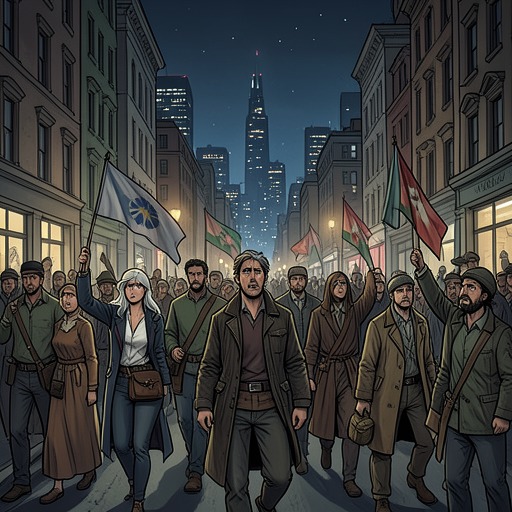
Prismarche preserves the victory through a civic and religious culture that treats the event as the beginning of a kinder historical age. The one-hundred-year anniversary is marked by Peace Day, described as a remembrance of the world’s good fortune, the end of the age of chaos, and the advent of a more merciful era. The celebration lasts an entire week, and the city prepares with colorful banners, decorative lanterns, newly constructed stalls, and crowds that eventually flood the streets as soon as their daily duties are complete.
The festival’s exuberance exists beside an acknowledged distance from the original suffering. The younger generation has not personally witnessed the monstrosities that once crawled across the land, yet the public celebration keeps the old danger present as a moral and historical reference point. The Cataclysms are remembered not as abstract dates but through images of plague, uncontrolled creation, and cities consumed by fire. That contrast explains why the Party of Heroes remains revered a century later: the people may be too young to remember the terror directly, but their society is built upon the consequences of the heroes’ intervention.
The anniversary also turns history into a recurring public ritual. Peace Day does not merely report that the Cataclysms ended; it reenacts the community’s gratitude each year, and the centennial intensifies that act of remembrance. The city’s decorations, crowds, and religious imagery transform a past military achievement into sacred civic time, allowing Prismarche to celebrate its present safety while reaffirming the sacrifice that created it.
Monuments, Religion, and the Sorceress
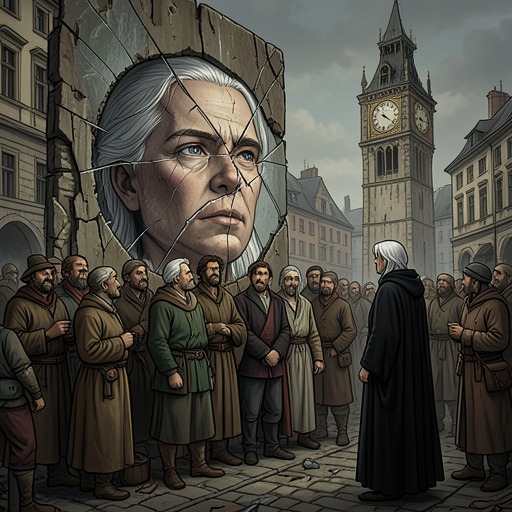
The Party of Heroes has been given a physical presence throughout Prismarche. In the town square, five statues stand together on an elevated platform, identified by a bronze plaque as the Party of Heroes. Vivi recognizes the figures immediately as her former regular party members, the friends with whom she had cleared most of the game, although the world knows them only through the heroic title attached to their historical deeds. The monument thus produces a sharp collision between private memory and public myth: the celebrated figures are simultaneously the companions she knew and the dead founders of a civilization she has entered as a stranger.
The statue of Vivisari is especially revealing because it preserves her identity while distorting her person. It correctly presents her as a female demon mage with curved horns, but it makes her nearly six feet tall instead of four-foot-something and gives her a much more womanly figure than reality. The monument demonstrates how history turns an individual into an image suited to collective expectation. Even the surviving hero is not remembered as she actually was; she has been enlarged, idealized, and made legible as the legendary Sorceress.
Religion reinforces the same transformation. Prismarche’s Temple is a massive building of polished white stone, with tall stained-glass windows depicting saints and heroes, and one prominent image shows the Sorceress together with her party. Inside, the rows of pews and long aisle lead toward a grand altar, placing the Party of Heroes within a devotional space rather than leaving them solely in the realm of civic history. The victory has consequently become more than a successful campaign: it is treated as an event with quasi-sacred significance, and its surviving champion is approached through reverence as much as through historical curiosity.
The Surviving Hero and the Unfinished Future
The victory’s official story says that the Sorceress lived, but it does not make her return simple. When Vivi encounters the monuments, the festival, the temple, and the priest’s account, she is forced to measure the remembered Vivisari against her own experience and against a world that has continued for a century without her. The public knows the title, the sacrifice, and the result; it does not possess the living person behind the legend. Her survival is therefore both the event’s most hopeful detail and the source of its greatest historical discontinuity.
The old victory also fails to guarantee permanent safety. Master Aeris expresses relief when Vivisari’s continued existence does not immediately signal a new disaster, yet he lists dangers that remain beyond the peace: the Dragon King could descend from the Sky-Pillar Range and raze the mortal lands, an unknown horror could awaken from a millennium-old crypt, and another Shattered Oracle could emerge from an over-ambitious glimpse. His conclusion is that there is always an Eighth Cataclysm on the horizon, even if none is occurring at that instant. The phrase turns the Party of Heroes’ achievement into a precarious suspension rather than a final guarantee. Peace is real, but it exists under the pressure of recurrence.
That tension becomes especially stark when Vivisari later displays power beyond what the historical legend can contain. She can rip a Cataclysm apart with casual disrespect, a feat so overwhelming that observers are more likely to assume a god has descended from the heavens than to attribute it to the Sorceress remembered in the old accounts. The event that once established her as the world’s greatest surviving hero is therefore reinterpreted by her return: the legendary scale of the past is shown to have been smaller than the living figure who has come back.
Historical and Narrative Significance
The Party of Heroes' Victory functions as both the world’s foundational liberation and the first major example of history being mistaken for complete knowledge. It explains Prismarche’s prosperity, the Peace Day celebrations, the temple imagery, the statues, and the continuing reverence for the five heroes. At the same time, every public representation leaves something out: the friends behind the title, the deaths beneath the triumph, the distortions in Vivisari’s statue, and the uncertainty surrounding what the surviving Sorceress became after disappearing from the world.
Its significance is therefore deliberately double. The victory truly ended the seventh Cataclysm and opened an age of peace, but its peace is maintained by remembrance rather than secured forever. The people celebrate freedom from the horrors that once ravaged them, while figures such as Master Aeris continue to imagine what might awaken next. Vivisari’s return exposes the distance between a completed historical narrative and the unstable living reality beneath it. The Party of Heroes saved the world, yet the world’s reverence cannot fully contain the survivors, the sacrifices, or the possibility that the next catastrophe may already be forming beyond the horizon.