The Seven Cataclysms
New Life as a Max Level ArchmageThe Seven Cataclysms is the catastrophic historical age that defined the world before the Age of Peace and gave the Party of Heroes its legendary status. Its monsters destroyed cities, spread plague and famine, fractured time, and scarred entire regions; its end came only when the Party of Heroes defeated the seventh and final Cataclysm, with all but the Sorceress perishing in the victory. A century later, the Cataclysms are officially remembered as a closed chapter, yet their memory continues to shape religion, public celebration, power politics, and the fear that another catastrophe may always be approaching.
Definition and Historical Place
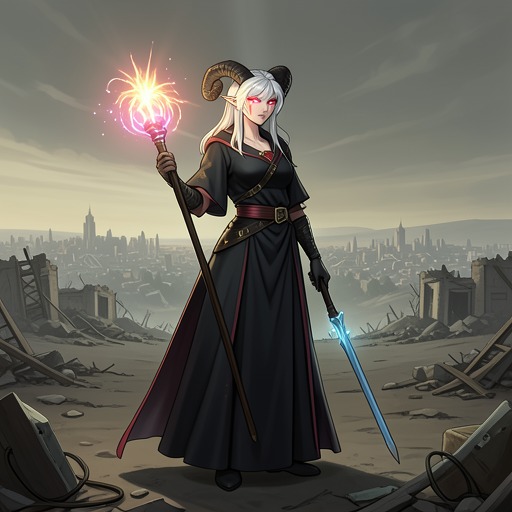
The Age of Cataclysms is also described as the Age of Chaos, the period preceding the Age of Peace, when the Cataclysms still tore through the world. For Vivi, the phrase is not merely historical terminology: it is the setting and central objective of Seven Cataclysms, the skill-based game from which she originated. In that game, she completed the campaigns against all Seven Cataclysms and even cleared the Burial Room of the Ashen Hierophant on mythical difficulty, earning the unique title Usurper of the Ashen Throne. Her knowledge therefore comes from both direct participation in the game’s campaigns and the transformed reality into which she awakens.
The decisive historical transition occurred a hundred years before the main events. The Party of Heroes defeated the seventh and final Cataclysm, though at great cost, because all its members except the Sorceress perished in the fight. The victory ended the Age of Chaos and initiated the Turning, the name used for the day of that defeat. The historical interval explains why the present contains changed cities, technological advances, altered institutions, and a generation that knows the Cataclysms primarily through inherited stories rather than firsthand experience.
The Cataclysm Monarchs and Their Destruction
The Cataclysms were not a single undifferentiated disaster but a sequence of distinct threats, each associated with a particular Cataclysm Monarch and a characteristic form of devastation. The Peace Day parade in Prismarche presents them in the same order in which Vivi remembers clearing them, turning the campaign’s progression into a public historical pageant.
The first float depicts the Umbral Regent, represented as a hunched lich carrying a withered black staff while masked actors portraying warriors, rogues, and mages fight his minions. His catastrophe was the Cataclysm of Eternal Twilight. The second represents the Crimson Blight wrought by the Reaper of the Lost Harvest, with plague and starvation led by a human husk in red robes. These images reduce complex campaigns to recognizable emblems, but they preserve the essential association between each Monarch and the suffering inflicted upon the mortal world.
The later Cataclysms embody increasingly different forms of ruin. Sundered Earth is associated with the Colossus, whose straightforward physical destruction claimed more lives than any Cataclysm except the final one. Fractured Time belongs to the Shattered Oracle, whose experiments with forbidden and esoteric magic drove him mad and transformed him into a Cataclysm. His victims could be trapped for millennia inside alcoves of stuttering time, making his catastrophe less destructive in sheer scale but more horrifying in its manipulation of existence.
The Ashen Hierophant is shown as a twelve-foot-tall titan in black plate armor. His Great Conflagrations cleansed more lives than disease, age, and famine combined, laid entire expanses of the continent to waste, and left scars that remained a century later. Prismarche’s representation of him is considered the most accurate, perhaps because the city still knows his presence intimately. His continuing physical and emotional imprint makes him the clearest example of how the Cataclysms remain present even after their political age has ended.
Memory, Ritual, and Public Meaning
The centennial Peace Day celebrations convert historical survival into a civic ritual. When the festival begins in earnest, Prismarche’s citizens flood the streets to celebrate a hundred years of freedom from the Cataclysms. The newer generation has not personally witnessed the monstrosities that once crawled across the lands, including the Rampant Genesis of the Flesh-Weaver, the Crimson Blight of the Reaper of the Lost Harvest, and the Great Conflagrations called down by the Ashen Hierophant. Their distance from the original suffering allows celebration to replace mourning.
The parade dramatizes that transformation. Around ten at night, floats representing the Cataclysms pass through the town square while crowds cheer behind guardrails. The monsters are cheered and jeered rather than treated with solemn fear, because the people understand them as relics of the past. Vivi finds the spectacle strange, even horrifying, but also recognizes its hopeful implication: the populace can treat the Cataclysms as theatrical figures precisely because the Party of Heroes made their return unnecessary. The pageant therefore does more than commemorate victory; it performs the public belief that history has been secured.
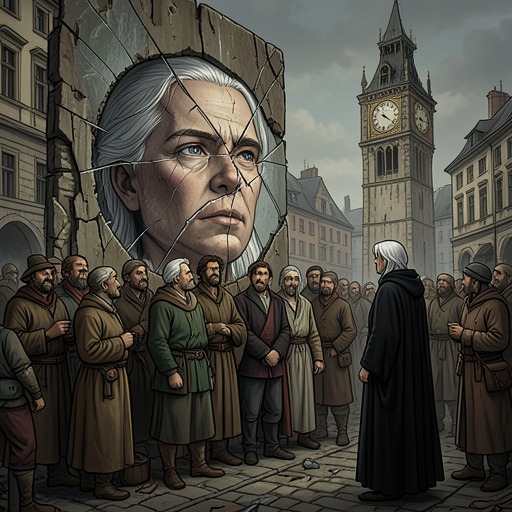
Prismarche’s Temple gives that belief a sacred form. The massive structure of polished white stone contains stained-glass windows depicting saints and heroes, including a prominent image of Vivi and her party. Rows of pews lead toward a grand altar, placing the Party of Heroes within an institutional religious memory. To ordinary citizens, the Sorceress is not simply a powerful adventurer from a game-like past but one of the figures through whom the world understands its deliverance.
That sanctification also creates unease when Vivi returns. Her reappearance after many decades unsettles those who associate her with the Age of Cataclysms. The common folk do not know whether the return of such a relic promises another disaster. Her legend is inseparable from the era she helped end, so her presence threatens to collapse the distinction between sacred history and present reality.
The Cataclysms as a Continuing Political Standard
The defeat of the Cataclysms remains a benchmark for judging power. Saffra understands that Vivi’s apprenticeship status proves her teacher is at least a peer to some Cataclysms and may even be the daughter of the Dragon King, a creature feared as a possible Eighth Cataclysm. This reasoning gives the old catastrophes a practical function: they are not only remembered enemies but the highest known scale of destructive power.
The same standard shapes the fears surrounding Duke Caldimore. Isabella warns that her father has developed something capable of threatening even a Cataclysm, while Saffra reasons that Vivi could still help if the claim is true. The comparison reveals how extraordinary the Cataclysms remain in the political imagination. A project described as dangerous to a Cataclysm is automatically beyond the reach of ordinary mortals and becomes a matter of world-level concern.
Vivi’s plans for Vanguard also emerge against this historical background. She refuses to leave the guild’s treasures locked away and wants Vanguard to rise from its ashes, reclaim its glory in a new form, and become the beacon of virtue that Eshara imagined. The proposed restoration is not a simple return to an earlier institution: the old world was defined by Cataclysm campaigns, while the new one must decide how to use the surviving assets in an era that claims to be peaceful.
The opening of Vanguard’s guildhall after a century makes that tension concrete. Rafael recognizes the moment as momentous because the building has been closed since the age of the Party of Heroes. Its interior, expanded through the System’s translated guild mechanics, shows that the Cataclysm-era institution has not vanished entirely. Its treasures, staff traditions, and political potential remain available, turning the past into an active resource rather than a sealed memorial.
The Threat of Recurrence
The narrative repeatedly refuses to treat the Cataclysms as permanently impossible. Master Aeris finds relief when Vivi says there is no immediate promise of a new catastrophe, but the possibilities remain vast: the Dragon King could descend from the Sky-Pillar Range and raze the mortal lands, an unknown horror could awaken from a millennium-old crypt, and another Shattered Oracle could emerge from one over-ambitious glimpse into forbidden magic. The statement that there is always an Eighth Cataclysm on the horizon expresses the world’s permanent vulnerability.
The dimensional anomaly over Prismarche intensifies that uncertainty. Vivi identifies its mana signature as dimensional in origin and recalls the Shattered Oracle’s experiments, which had driven him mad and transformed him into a Cataclysm. The new phenomenon is larger than even those remembered experiments, spanning the entirety of Prismarche. The festival continues below while reality itself appears to shatter above it, placing carefree public celebration beside the possibility that the supposedly concluded age is beginning again.
The same contrast returns during the defense of Meridian. Heroes of every level swarm to the city against a horde of Voidbeasts, while Vivi tears Greater Voidbeasts apart with a spoken word. The Gale of Blades and The Archbishop also enter the battle, linking new defenders to the heroic tradition established during the Cataclysm Wars. Yet Vivi’s overwhelming power changes the meaning of the old comparison: even the Sorceress may no longer be the proper measure, because observers could interpret her display as the intervention of a god rather than the return of a legendary mortal.
The Seven Cataclysms thus function as both ending and warning. Their defeat created the possibility of peace, and their staged remembrance allows later generations to believe that the danger belongs to history. But the dimensional breach, Duke Caldimore’s project, and the world’s awareness of dormant powers expose the fragility of that belief. The age is over in chronology, not in imagination; every unexplained force is tested against its scale, and every impossible return raises the question of whether the world has truly escaped it.