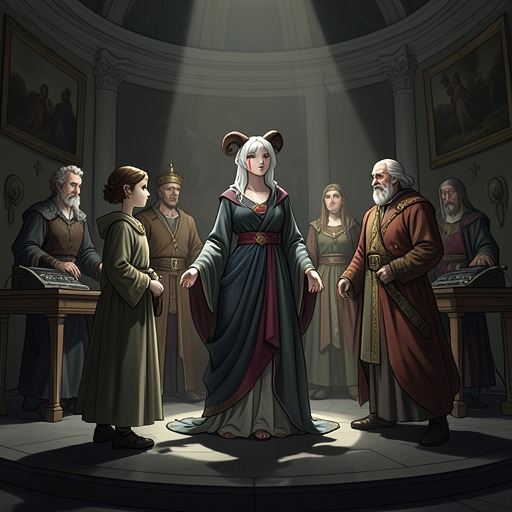
Vivi · Vivisari Vexaria
New Life as a Max Level ArchmageVivi / Vivisari Vexaria is both a person returned from legend and the force that makes the past suddenly active again. Known publicly through the heroic history of the Party of Heroes and more intimately as the Sorceress, she re-enters a world that has spent a century commemorating her victory while trying to understand what her return means. Her decisive importance lies in the tension between those identities: she is treated as a savior, conceals herself behind constructed names, investigates new threats, and acts with such disproportionate power that witnesses begin to mistake her for something more than mortal.
Identity and Historical Position
Vivi’s place in history is inseparable from the Party of Heroes’ victory over the seventh and final Cataclysm. The triumph came at great cost, with every member of the party except the Sorceress perishing in the fight, and occurred almost exactly a hundred years before the events surrounding her return. In Prismarche, that victory has become public memory and civic ritual. The Temple displays images of saints and heroes, including a prominent depiction of Vivi and her party, while the Peace Day Festival marks a century of freedom from the Cataclysms. The younger generation knows the terrors largely through inherited stories and the game’s gruesome representations of the destruction left by the Flesh-Weaver, the Reaper of the Lost Harvest, and the Ashen Hierophant; nevertheless, the population continues to revere the Party of Heroes because it understands that those figures saved the world from incomprehensible threats.
Vivi therefore returns not to an empty world but to a civilization that has sanctified her absence. The temple image and the festival’s anniversary frame her as an object of collective devotion, yet her own response is more complicated. She had considered her previous life unsatisfying and had left behind no close personal circle beyond online friends, whom she would nevertheless miss deeply. That emotional distance helps explain why the public mythology surrounding her is both recognizable and alienating: the world remembers a heroic figure, while the woman who inhabits that figure must still process the loss of her former life and the consequences of being made into history.
Her status has also changed within demonic society. Rafael explains that Vivisari was elevated from Second Blood to honorary Primogenitor’s Blood in recognition of her accomplishments during the Cataclysm Campaigns. The honor effectively gives her the title of a demonic princess, a distinction she is still struggling to accept because publicly taking on the mantle of Vivisari will create serious political and practical difficulties. The title is not merely ceremonial. It determines how institutions must receive her and enlarges the distance between the unassuming woman before them and the authority attached to her name.
Names, Disguises, and Reentry into the World
Vivi’s return is managed through layered identities rather than a simple public announcement. Rafael arranges her meeting with Archmage Aeris under the false identity of Nysari Keresi, a visiting demonic noblewoman of the First Blood. The name is designed to be less conspicuous than Vivienne, while the First Blood rank gives the Institute a reason to receive her despite the short notice and the prominence of her requested meeting. Rafael has even secured permission from the Keresi family, demonstrating that the disguise is the product of long preparation rather than an improvised lie.
The disguise also exposes the limits of concealment. At the Institute, Rafael advises Vivi to preserve the false identity because surprising a person can reveal that person’s character, but he warns her not to appear unannounced in Aeris’s office. Even after retirement, Aeris remains one of the most formidable casters of the modern age, and an avoidable confrontation could have produced severe consequences. Vivi accepts the need for caution while recognizing that the identities of Nysari and Vivisari will eventually merge. The subterfuge is temporary, intended to last only until Vanguard can officially announce the Sorceress’s reemergence.
Her meeting with Aeris turns the false identity into a moment of recognition. Aeris initially reacts with extraordinary relief when she makes clear that no immediate catastrophe is underway, then apologizes for having assumed the worst and expresses happiness that Lady Vivisari is alive and healthy. His response confirms that her survival is not merely a private fact but a historical impossibility in the eyes of those who knew the old era. Vivi’s explanation that she has returned after witnessing a dimensional anomaly makes the encounter practical as well as emotional: the legend has come back carrying a problem that belongs to the present.
The same tension appears when Rhek meets the supposed Nysari Keresi. He recognizes that the gear she presents carries four exceptional enchantments despite being silver-rank equipment and concludes that she cannot simply be the Sorceress’s daughter. He has seen the Sorceress before and notices the resemblance, but his certainty initially rests on incomplete observation. Vivi challenges the assumption directly by asking what makes him think she is the Sorceress’s daughter. Rhek eventually states that she is not the daughter, while Vivi continues to identify herself as Nysari in a deliberately unconvincing manner. Her disguise does not erase Vivisari; it becomes another surface through which the old identity can be detected.
Objectives and Key Actions
Vivi approaches Archmage Aeris for two connected reasons. The first is the dimensional anomaly she witnessed in Prismarche two days earlier and helped the local guard report to the Institute. She admits that research is not her specialty and explains that she asked Marcus to contact the Institute because she needed people whose expertise lay beyond her own practical abilities. Aeris is her first choice among those she believes she can still trust after a century without contact. This choice establishes that her return is not governed solely by nostalgia or reputation: she is actively assembling knowledge and alliances to interpret a threat whose timing may be significant.
Vivi treats the anomaly’s proximity to her return as suspicious, even while acknowledging that a dimensional fracture could arise naturally. Aeris answers with the principle that coincidence should never be trusted, and the exchange places the anomaly within a larger pattern of possible catastrophe. Vivi does not claim certainty, but she refuses to dismiss an event merely because its causal explanation remains unclear. Her method is therefore investigative rather than prophetic: she identifies the danger, recognizes the limits of her own expertise, and turns to a trusted specialist.
Her second objective is personal and directly tied to Saffra. Vivi asks Aeris what he knows about a young woman expelled from the Institute eight months earlier. Tatiana immediately recognizes the subject as Saffra, and Vivi confirms that she met Saffra in Prismarche and took her as an apprentice. The revelation astonishes the Institute because Saffra had been an ordinary second-year student in their eyes, while Vivisari is a figure from the age of Cataclysms. Vivi’s intervention transforms Saffra’s expulsion from an isolated institutional dispute into an issue that now carries the attention and protection of the returning Sorceress.
Vivi extends that protection to Saffra’s acquaintances. When she encounters William and Rose, she places William under her protection and demands an account of what happened, what he knows about Saffra, and how Saffra was expelled. She explains that Saffra is safe, though she deliberately withholds the additional fact that the girl has become more traumatized since leaving the Institute. Vivi also makes clear that her concern is not limited to her apprentice: a six-month imprisonment for insulting a duke is excessive even if the insult was delivered by a commoner. Her response challenges the political assumptions surrounding House Caldimore and shows that her protection operates through a broader judgment about disproportionate punishment.
Vivi’s return also changes Vanguard. Before her decision, only the Party of Heroes had been adventuring members of the organization. She chooses to open recruitment, and Mae becomes the first new member, a former craftsman who has become an adventurer. Vivi welcomes Mae after confirming that Mae genuinely wants to join, while Rafael completes the formal paperwork. Even Vivi hesitates when signing as Vivisari because she has never used that name on such a document and wonders whether the anti-forgery enchantment will recognize her handwriting as belonging to the Sorceress. The administrative act is small compared with her legendary battles, but it makes her return institutional: the old hero is not merely remembered; she is rebuilding the organization associated with her.
Relationships and Conflict
Vivi’s relationship with Rafael combines trust, dependence, and guardedness. He arranges her false identity, cultivates the political permissions needed to support it, and advises her on how to approach Aeris and other powerful figures. She recognizes his superior instinct for subterfuge, yet she also suspects that Rafael trusts no one implicitly, perhaps not even her, and that he subjects even the craftsmen to scrutiny. Their alliance is therefore effective without being naïve. Vivi relies on his management while understanding that his loyalty does not eliminate his caution.
Her connection with Aeris is older and more intimate than the formal meeting initially suggests. Vivi identifies him as the first person she knew she could trust after a century without contact, and she tells him that he had been as much a hero during the campaigns as she was. She distinguishes their contributions without false modesty: many men and women fought bravely, while she was simply the strongest. Aeris’s embarrassment at the praise and his relief at finding her alive reveal a bond founded on shared danger rather than ordinary social familiarity. Their renewed association becomes both a research alliance and a reopening of the heroic past.
Saffra occupies a different position. She is not a surviving comrade from the Cataclysm Campaigns but a young woman whom Vivi encounters in the present and chooses to mentor. Vivi’s protection is practical, political, and personal. She investigates Saffra’s expulsion, asks others to explain the circumstances surrounding it, and takes responsibility for the apprentice’s safety. At the same time, Vivi withholds information when she believes Saffra is making dangerous assumptions. When Saffra interprets a matter involving a dragon, Vivi summons her staff and bonks her on the head, then tells her to stop making ridiculous assumptions. Rather than explain everything immediately, Vivi promises to clarify the situation in a few weeks, once they have known each other longer. The gesture is comic but also disciplinary: mentorship for Vivi includes controlling what Saffra is permitted to infer and when.
Vivi’s conflict with House Caldimore follows from the same protective ethic. She is prepared to confront the family over Saffra’s treatment and over William’s imprisonment, even though she understands that criticizing the world’s political and social norms can itself have consequences. For the moment, she speaks as Nysari rather than Vivisari, but she knows that the distinction cannot endure forever. Her political opposition is consequently inseparable from the identity problem at the heart of her return: every defense she makes under an assumed name increases the pressure that will eventually force the Sorceress into public view.
Power, Change, and Narrative Significance
The scale of Vivi’s power has altered the meaning of her return. Her defeat of the Greater Voidbeast is so effortless that observers question whether even the Dragon King or other mythical immortals could face her. The display suggests that she may have reached, or surpassed, the apparently limitless summit once associated with the greatest Cataclysm Monarchs. More importantly, it changes how others interpret the events around her. People may not attribute the strange occurrence to the Sorceress at all; they may conclude that a god has appeared, because even a legend such as Vivisari should not be able to tear a Cataclysm apart with such casual ease.
That contrast between public interpretation and personal behavior defines Vivi’s narrative role. She possesses power vast enough to invite religious explanation, yet she continues to pursue reports, question institutions, arrange investigations, protect a persecuted apprentice, recruit an ordinary former craftsman, and negotiate through aliases. The Temple and Peace Day Festival turn her into a sacred emblem; Aeris and Tatiana encounter her as a living person; Rhek sees her through enchanted equipment and physical resemblance; Saffra experiences her as an evasive, occasionally exasperated mentor. Each perspective produces a different Vivi, and none completely contains her.
Her worldview remains alert to the possibility of catastrophe even during an age of peace. She reminds Aeris that the Dragon King might descend from the Sky-Pillar Range, that an ancient horror might awaken from a millennium-old crypt, and that another Shattered Oracle could emerge from an overambitious glimpse. There is always an Eighth Cataclysm on the horizon, although she sees no promise of one at that instant. The statement reassures Aeris because it distinguishes general existential danger from immediate disaster, but it also reveals Vivi’s permanent horizon: victory has not made the world safe, only temporarily free from the known cycle of destruction.
Vivi’s significance therefore rests on an unresolved return rather than a completed restoration. She comes back celebrated as a savior, reclaims authority through the name Vivisari, and simultaneously hides behind Nysari Keresi while she measures allies, institutions, and threats. Her power makes her appear divine, but her choices keep the story grounded in responsibility: she seeks help when the anomaly exceeds her specialty, protects Saffra and William from disproportionate harm, and reopens Vanguard to people outside the original heroic circle. The returning Sorceress is not simply repeating the old legend. She is forcing a world that has memorialized its past to confront the living, unpredictable person who once made that past possible.