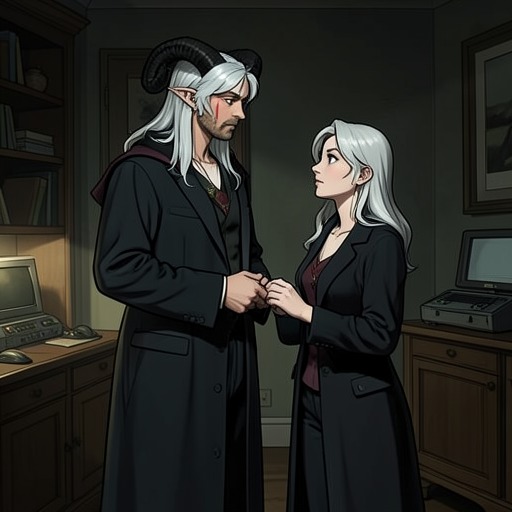
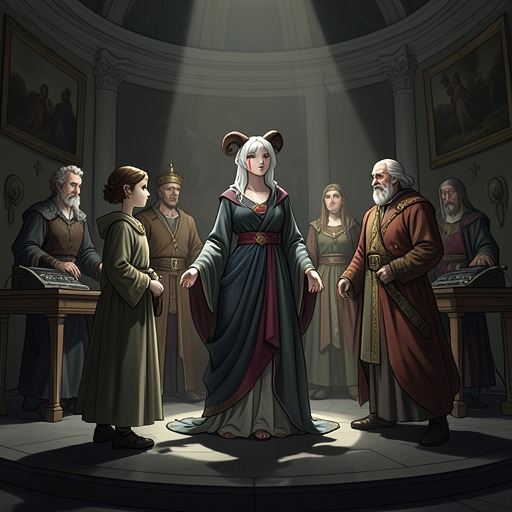
Vivi and Saffra
New Life as a Max Level ArchmageVivi and Saffra are joined by a relationship that changes both women’s position in the story: Saffra moves from a vulnerable adventurer seeking help into Vivi’s accepted apprentice and assistant, while Vivi, despite her overwhelming power and long absence from the changed world, finds someone she is willing to trust, protect, and teach. Their bond is not built on equality of strength. It is built on the more difficult recognition that immense power can still be used with restraint, and that a young adventurer’s compassion can be worth more than strict obedience.
Rescue and First Impressions
Saffra’s first decisive experience of Vivi is not comforting. After Vivi intervenes on her behalf, the demon mage approaches her with a presence so powerful that Saffra feels like an ant beneath a bear’s destructive path. Vivi could kill her accidentally through the secondary effects of an idle movement, and Saffra’s instincts register that danger before her judgment can soften it. The rescue therefore produces a complicated emotional response: Vivi is Saffra’s savior, yet she is also an apparently catastrophic force whose intentions remain difficult to read.
Vivi then changes the meaning of the encounter through a small, concrete act of care. She crouches beside Saffra, apologizes softly for not trusting her instincts, and removes the cloth from her mouth, her bindings, and even the metal collar around her neck with a vague gesture. The release is immediate and complete, but it does not erase Saffra’s fear. When Vivi raises her hands to show that she is not a threat, Saffra feels humiliated by the contrast between the demon’s restraint and her own helplessness, and bursts into tears. The scene establishes the central tension of their relationship: Vivi possesses terrifying superiority, while Saffra’s trust must be earned through conduct rather than demanded through power.
The Apprenticeship Proposal
During the Peace Day Festival, Saffra encounters Vivi again by coincidence. She has completed a successful mission and is following Vivi through the city, partly because curiosity has overcome her guilt and partly because Vivi’s drunken lack of vigilance makes her seem less threatening. Saffra has noticed Vivi’s distinctive figure in an alley after the aftermath of a spell, and the sight revives the question of who this woman really is. Although Saffra remains aware that Vivi is dangerous in a physical and magical sense, she concludes that the woman is not dangerous in the moral sense that matters.
That judgment leads to the relationship’s defining declaration. Saffra steps from around the alley’s corner, points at Vivi, and says, “I want you to teach me. I’m your apprentice now.” The declaration surprises Saffra as much as it shocks Vivi. Saffra immediately tries to protect herself with bluster and adds that she knows about Daisy and her cat, implying that she understands Vivi’s recent concern for the missing-pet task. Her boldness is partly a test and partly an attempt to make herself useful, but it also reveals a willingness to pursue connection directly rather than waiting for Vivi to offer it.
Vivi does not accept without qualification. She explains that her own business will leave little time for instruction and that she doubts she would make a good teacher. Nevertheless, she needs a trustworthy assistant, believes that Saffra is a young woman worth training, and considers her someone she can trust. She therefore agrees conditionally, asking whether Saffra understands the limitations and genuinely wants the arrangement. Saffra’s stunned silence and stutter expose how unexpected the acceptance is. The offer is especially startling because Vivi appears to be at least orichalcum rank, and possibly higher; Saffra cannot understand why someone of such stature would say yes to her. The apprenticeship begins, consequently, not as a formal reward for achievement but as Vivi’s judgment that Saffra’s character makes her worth investing in.
Care, Resources, and Mutual Trust
Vivi’s care for Saffra is expressed through material decisions as well as instruction. When Vivi buys comfortable transportation for herself, she also buys one for Saffra, treating the apprentice’s comfort as an obvious extension of her own. Saffra is horrified that Vivi has spent money on her, but Vivi dismisses the concern by stating that coin is not an issue. She then gives Saffra forty mithril as her share of the bounty, even though Vivi had considered handing over the entire amount and held back only because she expected Saffra to object. The exchange shows that Vivi does not want Saffra reduced to a dependent recipient: she protects her while also recognizing her right to compensation for her work.
The relationship is tested by Saffra’s use of a Phoenix Blood Elixir during the Convoy derailment and monster assault. Saffra assumes that Vivi should be angry because the relic-class potion had been intended for Saffra herself and was not hers to give away. Vivi instead asks whether Saffra derailed the convoy or harmed the people involved; when Saffra explains that the potion was used to help someone, Vivi says that this was acceptable. Jasper emphasizes the scale of the sacrifice by observing that most people would be furious over an artifact worth a small castle. Vivi’s response makes the ethical foundation of the apprenticeship explicit: she values lives above even extraordinarily expensive magical resources. Saffra’s fear of disappointing Vivi is answered not with punishment but with confirmation that compassionate action was the correct use of the gift.
Vivi also treats Saffra’s difficulties as responsibilities she is willing to share. When Tilly explains that something is wrong in Saffra’s circumstances, Vivi promises that she can deal with it and rejects the idea that her intervention should be understood merely as a favor. Instead, she thanks Tilly for providing the information. Tilly interprets Saffra’s discovery of Vivi as a rare break in a life that has given her little relief, and Vivi responds awkwardly to the earnest praise. The exchange reinforces that Vivi’s protection is not presented as a debt Saffra must repay; it is a deliberate commitment grounded in information, judgment, and concern.
Conflict Around Saffra’s Expulsion
The apprenticeship also draws Vivi into the institutional and political consequences of Saffra’s past. Vivi learns that the Caldimore family was responsible for Saffra’s expulsion from the Thaumaturgical Institute and that Saffra was allegedly accused of attacking Isabella Caldimore and other offenses. Vivi admits that she lacks proof and allows that Saffra might bear some guilt, but she suspects that most or all of the accusations were fabricated. Her position is protective without being blindly credulous: she does not claim certainty where she has none, yet she refuses to let the Caldimore family’s power settle the moral question by itself.
The consequences extend to a gold-rank adventurer who reacted angrily after learning what had happened to Saffra. He insulted Duke Caldimore, was imprisoned, and has remained in a cell for six months. Vivi wants him freed, even though Rafael warns that Duke Caldimore is politically difficult and may possess the legal advantage. Vivi had already checked on the prisoner and found that he was being treated well; only that fact prevented her from taking matters into her own hands. Her restraint is significant because it contrasts with the older, more impulsive version of herself that Rafael recalls. Saffra’s predicament therefore becomes a measure of Vivi’s development: she still intervenes fiercely for people under her protection, but she now attempts to distinguish justice from uncontrolled retaliation.
Significance and Trajectory
Saffra’s movement toward Vivi is a reversal of the usual mentor dynamic. She does not first receive a summons or formal recommendation; she follows the woman who saved her, studies the gap between terrifying appearance and moral behavior, and announces herself as an apprentice. Vivi, meanwhile, is not transformed into a gentle conventional teacher. She remains occupied, blunt about her limitations, and vastly beyond Saffra in power, but she recognizes the practical and ethical value of a trustworthy assistant. Their arrangement is therefore both intimate and functional: Saffra seeks knowledge and protection, while Vivi gains a reliable companion in a world that has changed during her absence.
The pair’s contrast is sharpened by the scale of Vivi’s identity. The history surrounding the Party of Heroes records that nearly all of its members perished when they defeated the seventh Cataclysm a century earlier, leaving only the Sorceress alive. Peace Day celebrates that victory, and the people of Prismarche revere the heroes who ended the Cataclysms. Later, Vivi’s power becomes so overwhelming that observers interpret her intervention as something godlike rather than merely the return of a legendary mage. Against this backdrop, Saffra’s apprenticeship is not simply a student choosing a powerful instructor. It is a young adventurer placing her future in the hands of a living legend, and a legend choosing to invest that power in one frightened, compassionate, and determined individual.
Their relationship consequently joins private attachment to the book’s larger moral question of what power is for. Vivi can teleport, overpower beings associated with Cataclysm-level danger, and treat vast sums of money as manageable resources, yet her most important choices concerning Saffra are modest and discriminating: removing a collar, buying a comfortable ride, dividing forty mithril, forgiving the use of a precious potion to save lives, listening to testimony, and promising to pursue a prisoner’s release. Saffra’s trust is not founded on the fantasy that Vivi is harmless. It rests on the tested belief that Vivi is dangerous only in the service of protection, and that her strength will not be used against those who place their faith in her.