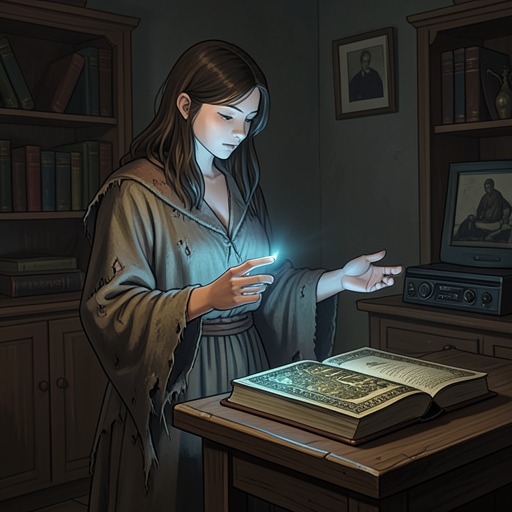
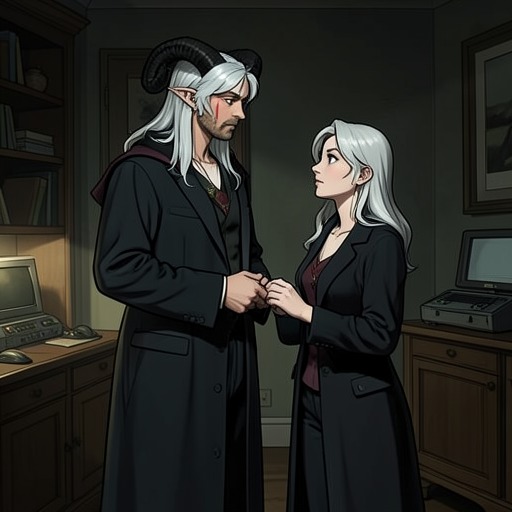
Vivi–Saffra apprenticeship
New Life as a Max Level ArchmageVivi–Saffra apprenticeship is one of the most consequential relationships in the narrative: what begins as Vivi’s provisional offer to teach Saffra becomes a bond shaped by mutual recognition, practical exchange, protection, and responsibility. Vivi sees in Saffra both a gifted, compassionate adventurer and a child who has been left to manage dangers beyond her years; Saffra, in turn, gains a powerful guide who treats her judgment seriously without allowing her recklessness to pass unchallenged.
Formation and Terms
Vivi did not originally intend to take an apprentice. After accepting Saffra’s request during the Peace Day Festival, she postponed the fuller discussion until the next morning, telling Saffra to enjoy the celebrations and meet her at the Adventurer’s Guild. The delay reflected Vivi’s uncertainty: a pseudo-apprentice could help her regain her bearings after decades of absence, but formal mentorship would impose responsibilities she normally avoided. Vivi also warned that she might not be a suitable teacher and that the arrangement might not constitute the full apprenticeship Saffra expected.
The decision nevertheless rested on more than convenience. Saffra was a fully fledged adventurer despite being about thirteen, apparently lacked dependable parents, and had already identified two disguised monsters when no one else in the Adventurer’s Guild recognized the danger. Her history suggested repeated exposure to terrible events, yet she continued to help others, first Allen and then Daisy. Vivi therefore judged that Saffra’s heart was in the right place. She explained her choice as a desire to teach someone like Saffra and admitted, in effect, that sympathy and protectiveness were involved. Vivi’s own experience of being alone from an early age gave the relationship an additional, unspoken point of identification.
The apprenticeship also has a formal mechanical dimension. Vivi explains that when a master accepts a lower-level apprentice with a sufficiently similar class, the apprentice receives Apprenticeship Status, a buff that increases experience gain; the larger the level gap, the stronger the benefit. Saffra’s alarm at Vivi’s unfamiliarity with this rule reveals that the arrangement is unusual from both sides: Saffra understands the institution more readily than the returned legend who has become her teacher, while Vivi must learn how the present world regulates a relationship she entered almost instinctively.
Teaching Through Protection and Provision
Vivi’s mentorship is expressed through concrete acts rather than a settled curriculum. She provides Saffra with a comfortable ride and gives her forty mithril as her half of a bounty, dismissing the cost because coin is not an issue for her. The gesture establishes a pattern in which Vivi’s considerable resources are used to enlarge Saffra’s freedom and security rather than to make the girl dependent through humiliation. Saffra’s shock at receiving the money also emphasizes the imbalance between Vivi’s wealth and Saffra’s circumstances.
Vivi’s planned support extends beyond spells and equipment. She tells Saffra that she will set aside time to help despite expecting to remain occupied, and promises to arrange other lessons through her contacts if she cannot teach everything herself. Her objective is not merely to improve Saffra’s combat ability; it is to ensure that the girl has reliable instruction and someone responsible for her welfare. Vivi recognizes that Saffra needs protection from repeating the kind of disaster she has already endured, even while acknowledging that the earlier catastrophe may not have been the first or second horrible experience in her life.
The relationship becomes ethically explicit when Saffra blames herself for events that were not clearly her fault. Vivi’s first rule from master to apprentice is that Saffra must not accept responsibility for consequences that do not belong to her. The rule is both instruction and care: Vivi refuses to turn Saffra’s willingness to help into a permanent burden of guilt. It also marks a contrast between Saffra’s instinctive self-sacrifice and the boundaries Vivi is trying to teach her.
That contrast is tested when Saffra risks herself during the convoy crisis. The protective spells Vivi placed on her ironically helped put her in danger, because they made Saffra capable of undertaking a hazardous task involving the convoy’s Aether Cannons. Vivi cannot simply condemn the decision: Saffra’s actions were crucial to the defense, and many people would have died without her intervention. Yet the incident confirms Vivi’s fear that Saffra is willing to risk her life at the slightest opportunity. The mentor’s private conclusion that her apprentice will be difficult captures the central problem of the bond: Saffra’s courage is also a destructive disregard for her own survival.
Reciprocity, Trust, and Moral Boundaries
Although Vivi possesses overwhelming power, the apprenticeship is not presented as one-way rescue. Vivi wants Saffra to become useful to her as a guide and helper while Vivi adjusts to a transformed world, and Saffra is eager to offer practical knowledge in return. When Saffra finds a way to help through ordinary common knowledge, she visibly brightens, suggesting that her need to contribute is as strong as her need for instruction. Vivi’s promise to teach therefore gives Saffra more than access to power: it gives her a recognized place beside someone who might otherwise appear unreachable.
Vivi’s generosity also establishes a form of generalized reciprocity rather than a strict commercial contract. She gives Saffra money, transport, magical protection, and future lessons, while Saffra repeatedly repays the relationship through courage and aid to others. When Saffra worries that Vivi will be angry because she used a relic-class potion intended for herself to help victims of the convoy disaster, Vivi rejects the assumption that an artifact’s price outweighs a life. She accepts the choice because Saffra used the potion to help someone, even though the potion was not hers to give away. The episode makes Vivi’s values legible: resources matter, but they remain subordinate to the preservation of life.
This ethic is reinforced when Tilly tells Vivi that Saffra deserves a break and is fortunate to have found her. Vivi responds awkwardly to the earnest praise, but she does not retreat from the responsibility. Instead, she promises that she can deal with the danger surrounding Saffra and asks Tilly to view her disclosure not as a favor owed to Vivi but as information for which Vivi is grateful. The exchange broadens the apprenticeship beyond private affection; Saffra’s welfare becomes a matter that Vivi actively investigates and manages.
Conflict with the Caldimores and the Expanding Role of the Mentor
Saffra’s past also draws Vivi into conflict with the Caldimore family. Vivi learns that the family was responsible for Saffra’s expulsion from the Thaumaturgical Institute after Saffra was allegedly accused of attacking Isabella Caldimore and committing other offenses. Vivi lacks proof, but suspects that many or all of the accusations were fabricated. The legal matter may have been settled through expulsion, yet its consequences continue through the imprisonment of a gold-rank adventurer who insulted Duke Caldimore after learning what happened to Saffra.
Vivi’s response shows how far the apprenticeship has moved beyond casual instruction. She wants the imprisoned adventurer freed and has already visited him to verify that he was being treated properly. She admits that, had the prisoner been mistreated, she might have taken matters into her own hands. Her intervention places Saffra’s protection within Vivi’s larger political and moral resistance to the Caldimores’ power. The mentor does not merely teach Saffra how to survive an unjust system; she begins challenging that system on Saffra’s behalf.
The political danger is heightened by the mismatch between Vivi’s restored identity and the public meaning of her power. Her defeat of a Greater Voidbeast is so effortless that observers are likely to interpret her not as the Sorceress but as a god descending to aid the battle. This power gives Vivi the means to shield Saffra, yet it also magnifies the consequences of every action taken in the apprentice’s defense. The apprenticeship thus links a young adventurer’s personal vulnerability to the return of a legendary figure whose presence can alter the balance of institutions and kingdoms.
Significance and Ongoing Trajectory
The relationship joins two forms of displacement. Saffra is young, underprotected, and forced into responsibilities associated with much older adventurers; Vivi has returned after a long absence to a city, faith, technology, and historical memory that have changed around her. The Temple of Prismarche displays Vivi and her former party as saints and heroes, while the city celebrates a century since the Party of Heroes defeated the seventh Cataclysm at the cost of nearly every member except the Sorceress. Within that world, Vivi is both a monument of the past and an active mentor in the present.
Their bond also revises the conventional image of the legendary master. Vivi is not a serene instructor who possesses complete knowledge of the age into which she has returned. She is uncertain about the apprenticeship’s formal status, unfamiliar with some contemporary systems, reluctant to accept responsibility, and still capable of spectacular mistakes, including an uncontrolled Grand Fireworks display. Her authority comes instead from judgment, resources, experience, and a willingness to acknowledge uncertainty while remaining present when Saffra needs help.
For Saffra, the apprenticeship offers recognition without requiring her to abandon her instinct to protect others. Vivi does not treat compassion as weakness; she tries to separate it from needless self-destruction. For Vivi, Saffra creates an obligation that cuts through her habitual avoidance of responsibility. The girl’s need becomes a reason to remain engaged with the world, and her courage gives Vivi a living connection to the future rather than only to the heroic past celebrated in Prismarche.
The apprenticeship therefore functions as both a protective relationship and a plot engine. Saffra’s risks compel Vivi to define rules, provide safeguards, investigate injustice, and decide what kind of teacher she can become. Vivi’s power, meanwhile, changes the scale of the dangers Saffra faces and makes their association politically consequential. The bond remains improvised and imperfect, but its decisive movement is clear: Vivi begins by agreeing to teach Saffra a few things, then gradually accepts the deeper work of keeping her alive, preserving her moral judgment, and giving her the chance to become more than a child repeatedly forced to survive alone.