Wardens' Guild
New Life as a Max Level ArchmageThe Wardens' Guild is presented as the most powerful guild in the Kingdoms, a formidable institution whose association with the Caldimore family makes even an insult to one of its lesser branches politically dangerous. Its importance is not only a matter of reputation: its guildhall, vault, accumulated wealth, and institutional name become central to the ritual that consumes its headquarters and opens a breach into the Other Side.
Identity and Political Weight
When Saffra discovers that Vivi does not recognize Barnaby Caldimore's name, she explains that the Caldimores run the most powerful guild in the Kingdoms. The guild is the Wardens. Saffra distinguishes Barnaby, whom she has never heard of, as probably belonging to a branch family, but stresses that his status as a count and his family affiliation still make disrespecting him dangerous. Her warning clarifies that the Guild's influence gives the Caldimore name force beyond any individual noble title.
Vivi asks which guild the Caldimores head, then compares the name with Vanguard, the guild she remembers from her previous life. The Wardens' name means nothing to her. The contrast marks a gap between the world she once knew and the political landscape she has returned to: the Wardens are powerful in the present, while Vanguard's condition and fate remain uncertain to Vivi. The Guild's strength is therefore established through another character's practical warning before its physical presence enters the story.
Hall, Vault, and Institutional Resources
The Wardens' Guild possesses a guildhall and a vault; the latter contains wealth substantial enough to matter in a high-stakes political bargain. The guildhall stands close to Vanguard's Guildhall, making the two organizations neighbors. This proximity later gives the Wardens' site a direct physical relationship to the catastrophe: Vivi senses the ritual's wrongness from within a hundred feet of Vanguard's premises and considers whether the nearness itself has intensified what she feels.
The Wardens' guildhall is more than a building in the final sequence. Its vault provides the ritual's location, while the institution's name and wealth provide its material and conceptual value. The evidence does not describe the Guild's internal rules or ordinary operations in detail, but it does establish officers of high rank, a treasury, a headquarters, and an identity powerful enough to be treated as a collective resource. Those elements—organization, property, and accumulated wealth—are precisely what make its destruction consequential.
The Caldimore Bargain and the Ritual
Damon Caldimore tells Rafael that the Wardens' name and all the wealth within the Guild are to serve as the primary sacrifice. This arrangement follows an earlier confrontation with the Fell Apostate, who objects that Damon is taking half measures and insists that the work matters above all. Damon refuses to spend his subordinates' lives indiscriminately, offering instead the Guild's name and wealth, as he had promised. The exchange exposes the institution's place in the bargain: the Wardens are not merely associated with Damon but are assets he is willing to commit to the ritual.
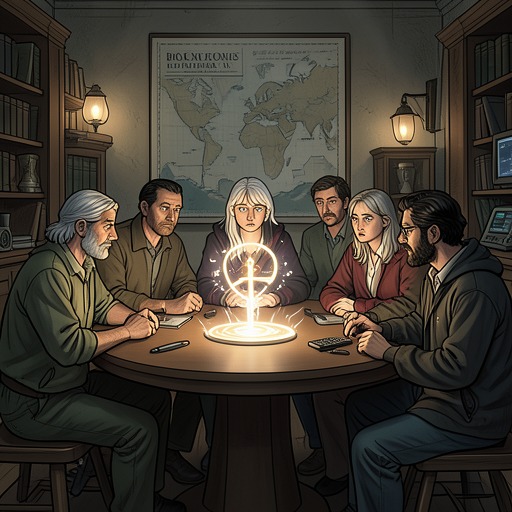
Rafael reasons that the Wardens' vault has been prepared as a staging ground for a ritual led by the Fell Apostate. He suspects that Damon intends to draw on the conceptual weight of possessing dominion over his own guild and sacrificing it. That explanation is Rafael's deduction, not a description of the ritual's complete mechanics. Damon's later account confirms the Guild's name and wealth as the primary sacrifice, while identifying the Fell Apostate as the designing mage. The Guild's institutional identity thus appears to carry force beyond the value of its material holdings: its destruction is meant to signify a ruler sacrificing what is under his authority.
Evacuation and Destruction
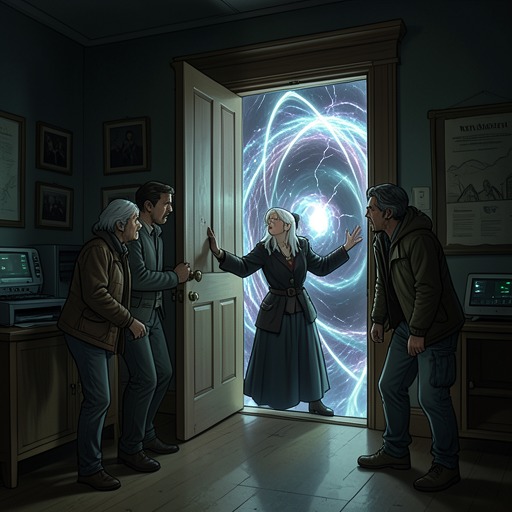
Before the catastrophe, Rafael reports that the Wardens have emptied their guildhall, including their highest officers. The sudden absence of its leadership is a warning that something has been set in motion, though Rafael initially phrases the ritual's purpose as a suspicion. Vivi and Saffra go to investigate. The ritual has taken place in the vault, and the scale of what follows rapidly exceeds the ordinary meaning of a guild's loss of property.
The Wardens' guildhall and the plot of land beneath it have sunk into a supernatural abyss. In their place is a pit of broken dimensional shards descending into darkness, with an opening into the Other Side at its bottom. The Guild's destruction is therefore inseparable from a breach in the world's boundary. The ritual's consequences extend beyond its intended sacrifice: the vanished headquarters becomes the visible wound through which unfamiliar monsters begin to emerge.
Consequences and Significance
Damon's account makes clear that the Guild's destruction was planned as part of a larger ritual rather than an incidental casualty. The Fell Apostate designed the process to reach beyond the dimensional veil; Damon supplies the Wardens' name and wealth, while the ritual also requires a soul as a breaching projectile. Isabella Caldimore meets that separate criterion. The Guild is consequently one part of a ritual whose costs include both an institution and a person, with its vault serving as the point of rupture.
For Rafael and Vivi, the Wardens' disappearance transforms an emerging political crisis into an immediate dimensional emergency. Rafael's inference links the emptied headquarters, Damon's cooperation, and the Fell Apostate's work; Vivi's investigation confirms the catastrophe on the ground. The Guild's role is sharply ironic: its reputation rests on power and institutional permanence, yet the resources that represent its authority are surrendered in a way that erases its own seat of power. Its name and wealth become instruments of the event, while its hall and land are swallowed by the breach they help bring about.