Almay
News of the WorldAlmay is a pale-haired, predatory opportunist who attempts to take Johanna Leonberger from Jefferson Kyle Kidd by purchase or force. His brief but consequential role exposes the market that surrounds the child’s vulnerability: Almay speaks of her as a commodity, and Kidd’s answer to that calculation comes in the form of actual money fired from a shotgun.
Identity and Introduction
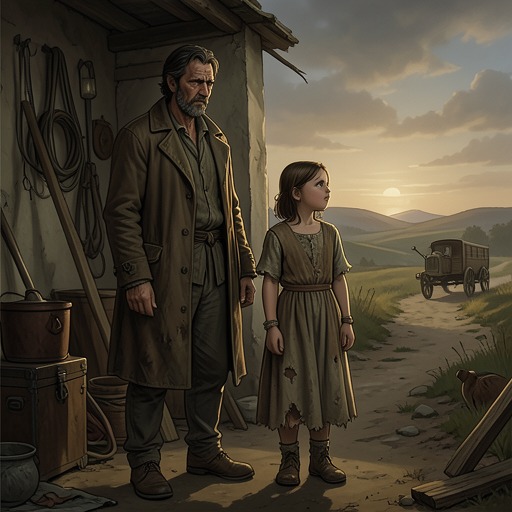
Almay first appears among the covert watchers observing Jefferson Kyle Kidd and Johanna leave. The girl’s new dress is splashed with Red River mud, and she is wild with dread; while some onlookers shake their heads, others watch with interest and greed. Almay is distinguished by pale hair, a blue-patterned neckerchief around his neck, and tobacco smoke drifting from his nose. The image places him among people who see the departing pair not simply as travelers, but as an opportunity.
He is accompanied by two Caddo people. The narrative describes these men as having left their tribal lands and accumulated unusual knowledge of how human beings behave under extreme duress. That detail gives the group’s observation an unsettling cast, but the evidence does not establish that Almay shares the companions’ history or knowledge. What becomes clear is that they are together, watching the road and the child.
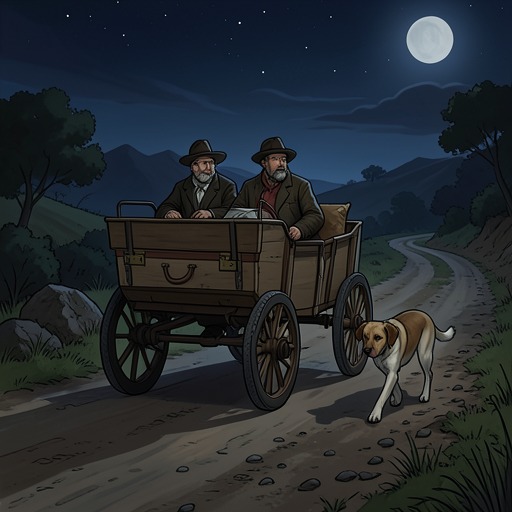
Almay later identifies himself to Kidd after the Captain’s reading at the Broadway Playhouse. He has followed Kidd from Wichita Falls and says he believes he saw him at Spanish Fort. His appearance after the reading is a deliberate approach: he waits until Kidd has finished, greeted the audience, and received his share of the evening’s money before raising the question of Johanna.
The Offer and Its Threat
Almay asks how much Kidd wants for the girl. Kidd’s response is immediate stillness: he stands expressionless, recognizing that someone does want her. Almay frames the proposal as business, but the circumstances make its coercion plain. He notes that the Army does not patrol the roads as it does near the Red River and says he could catch Kidd on the road and simply take Johanna. The offer is therefore backed by an explicit threat of abduction.
When Kidd asks for assurances that the girl will be treated well, Almay answers by contrasting his proposal with what he says the Indigenous people did to her. He adds that she will at least be paid for, then describes blond girls as premium merchandise. His language does not offer evidence of care; it makes the commercial value of Johanna the point. The contrast between a claim of fair dealing and the threat to seize a child exposes the self-serving terms of his supposed reasonableness.
Kidd does not openly refuse. He tells Almay to meet him the next morning at the Tyler Stage Roadhouse around seven so they can work out a price, explaining that he took in little money that night and needs funds. The explanation serves as a means to postpone the confrontation. As he speaks, Kidd is already calculating ammunition and considering whether Almay knows his route. Almay’s offer has made the journey itself dangerous, and Kidd’s apparent willingness to negotiate conceals his attention to the coming encounter.
The Confrontation
At a later meeting, Almay holds out a hat with a hole in it and points to the damage as evidence that Kidd had tried to hit him in the head. He calls the act serious malicious intent and insists they have talking to do. The hole gives the exchange a physical record of prior violence, while Almay’s demand to talk preserves his attempt to present himself as the reasonable party.
Kidd aims his twelve-gauge carefully, uncertain what the coins and extra-heavy powder charge will do. He targets the V of Almay’s open shirt collar and fires. The dimes leave the muzzle at six hundred feet per second; the blast and recoil nearly wrench Kidd’s shoulder, and the coins strike Almay’s forehead. As they turn edge-on in flight, they mark his head with hyphen-like wounds that begin to bleed. Almay falls backward, with Kidd seeing only the soles of his boots.
The weapon’s next use extends the violence beyond Almay. Kidd reloads with another dime-loaded shell and fires at the scrambling Caddo people. Coins ricochet through the ravine, strike a wounded man, chip another’s skull, and tear through shirtsleeves and hats. Almay’s fall is thus the opening blow in a wider, chaotic fight, not a reported resolution of the encounter. The narrative does not confirm his death.
Narrative Role and Significance
Almay’s attempt to buy Johanna makes the danger facing her explicit in a way that general unease cannot. The watching faces at the departure include interest and greed; Almay later supplies those looks with a concrete purpose. His blunt valuation of the girl turns the threat into a transaction, while his readiness to take her by force reveals how little separates that transaction from kidnapping.
The scene also gives money a double meaning. Almay treats Johanna’s value as a price to be negotiated, and Kidd answers with U.S. dimes made into ammunition. The coins do not resolve the moral conflict through a bargain; they violently interrupt it. Their bright, literal passage through the scene converts the language of payment into bodily consequence, while showing that Kidd’s effort to protect Johanna has moved from guarded negotiation to armed resistance.