American Indian Wars
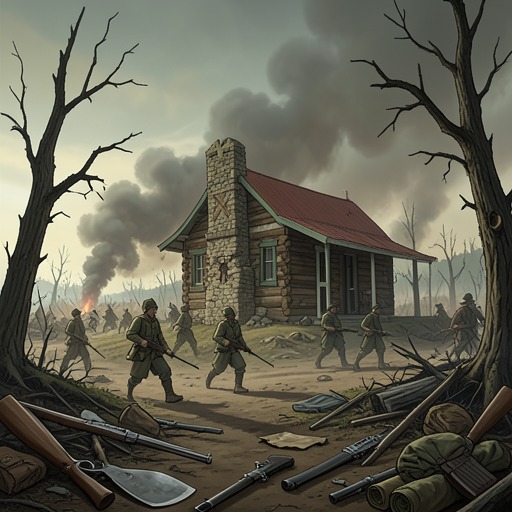
News of the WorldThe American Indian Wars in the novel are not confined to a single battle: they form an unsettled frontier condition in which raiding, military patrols, captivity, and disputed local authority govern movement across Texas. Their decisive ending is announced when Colonel Ranald Mackenzie drives the last Comanche and Kiowa holdouts to earth in Palo Duro Canyon; yet the story’s final reckoning preserves Indigenous lives and courage in stories rather than treating them as vanished with the fighting.
Frontier Conditions and Contested Authority
The danger of raiding shapes the route through the countryside. Near Lampasas, the travelers expect the hill country’s deep canyons, bluffs, and clear streams to offer more cover to Kiowa and Comanche parties. The landscape is not merely scenery: concealment and water make it attractive to raiders, and the travelers press on knowing that the threat may lie ahead.
The novel describes Comanche parties moving south from the Red River through the open, arid country around Lampasas. Dust raised in the open could be seen for miles, so they skirted towns and forts; farther south, the hill country offered water, concealment, and isolated farms, with no soldiers to stop them. In response, the Captain watches from rises, listens for signs of riders, and considers abandoning the wagon to escape. The routes and terrain determine both the raiders’ opportunities and the travelers’ precautions.
Military presence does not amount to stable government. A mounted infantry company of the United States Army appears on the road, while elsewhere in Erath County a self-appointed local group tells the Captain that no sheriff, judge, mayor, or commissioners remain: Davis’s men have displaced them, and no replacements have been sent. The men say that they have taken on the job themselves and make the Captain answerable to them. The episode places frontier violence beside political disorder, showing that the authority meant to govern the region is itself fractured.
Raiding, Captivity, and Resistance
The wars reach the travelers through the aftermath of a raid. Britt Johnson explains that the girl’s parents and little sister were killed, and that an Indian Agent has inferred who they were from the date she was taken. Wilhelm Leonberger and Anna Leonberger, her aunt and uncle, have supplied a paper authorizing her return to Castroville; a fifty-dollar gold piece has been sent to pay for her transport. Her captivity is thus bound to both family loss and the competing arrangements through which officials and relatives seek to move her across the frontier.
Violence also appears between armed groups, not only as an attack on settlers. During a gunfight with Caddo people, Cicada ignores the Captain’s order to get back. Barefoot among the red sandstone, she uses a stove-lid lifter to lever a broad slab loose; it rolls down the slope and strikes a concealed man. Her declaration that the Caddos will die and her later triumph chant make clear that she is acting from a remembered Indigenous identity, not simply occupying the role of a passive captive. The scene presents her agency within the danger while making the cost of the encounter unmistakable.
At the Red River, a flood brings another, quieter image of displacement. Cicada sees a party of Indigenous people on the far bank, among their horses, travois, and bundled tipi poles. She calls to them in Kiowa, but the rising water and its noise prevent them from hearing her. The scene joins the hazards of the terrain to the separation created by captivity: the people she longs to reach are visible, but the river divides them.
Declared End and Continuing Memory
The novel states that the Indian Wars ended after Colonel Ranald Mackenzie drove the last Comanche and Kiowa holdouts into Palo Duro Canyon. The announcement marks a change in the larger political landscape, but it does not erase the years of raiding, pursuit, and forced separation experienced along the travelers’ route. The Captain and Cicada continue across volatile Texas, collecting dimes, avoiding trouble, and reading news of a changing world to audiences along the way.
The closing account distinguishes a military ending from an end to memory. The bones of Kiowa warriors, it says, do not lie in the earth but in stories told and retold: stories of bravery and daring, of Britt Johnson and his men, and of Cicada, the blue-eyed girl taken from the Kiowa by the Indian Agent. By carrying those names and histories forward, the novel refuses to let the declaration of victory or closure stand as the whole account of the wars.