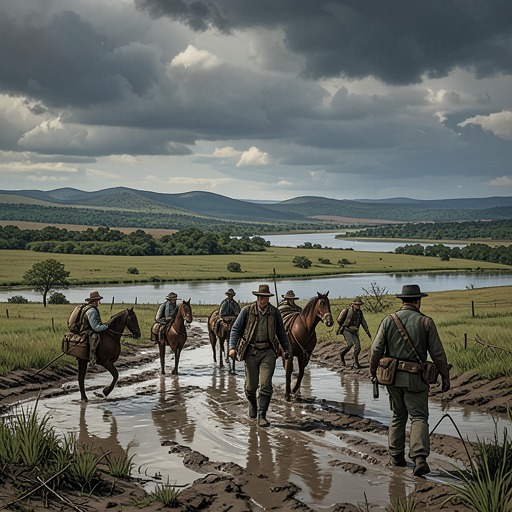
Brazos River crossing
News of the WorldThe Brazos River crossing is more than a point on the route taken by Jefferson Kyle Kidd and Johanna Leonberger. It is a shifting boundary that repeatedly turns travel into a test of judgment: the river is high, the expected ferry is absent, and the terrain around Carlyle Springs offers both cover and danger. Its crossings and banks shape the pair’s movement while exposing how little protection formal roads, ferries, or local authority can guarantee.
Setting and Terrain
At first light, Jefferson Kyle Kidd and Johanna are only about a mile from the Brazos. They follow a small road beside its north bank until they reach Carlyle Springs, where water flows from a red-sandstone bluff into a ravine and then into the river. The spring descends in clear streams, stepping from pool to pool. From the height above it, the road below can be watched through trees; a faint wagon track zigzags up the slope to a small, concealed flat among trees and sumac.
The ground offers cover, but reaching it is difficult. Jefferson turns Fancy, the mare, off the road and leads her uphill through agarita and young live oaks whose spikes tear at the wagon’s underside. The wagon jolts behind him, with Johanna and Pasha aboard, while wet vegetation soaks him to the knees. The refuge is therefore neither a convenient escape nor a secure fortress: it is a hard-won position above a route that remains visible from the rocks.
The ravine’s layered sandstone shapes the later confrontation. Water has worn the rock into irregular, hard, level plates, like steps descending toward the stream. Jefferson watches the road from above and sees only sections of it through the trees. The spring’s beauty and its tactical usefulness occupy the same place: clear water runs below a stone ledge that can conceal travelers, expose pursuers, and offer a defensible position.
Pursuit and the Fight at Carlyle Springs
The stop at Carlyle Springs takes place under the pressure of pursuit. Jefferson expects Almay and his Caddo companions to be following them on horseback, faster than the wagon. He strips away objects that might clink, including his gold watch, pennies, and penknife, and checks the chambers of his revolver before taking up watch. As daylight increases, he studies the road for movement and tries to judge how much of the wagon can be seen from below.
The concealment does not remove the danger. During the ensuing fight, a rifle round breaks stone in front of Jefferson, sending a shard into the area above his right eye. Blood runs down his face and his vision briefly fails. He considers whether he and Johanna can flee on Pasha, but Fancy is slow and prone to stumble; reaching distant smoke on the horizon is another possibility. Johanna has already helped resist the attackers by tipping a rock down onto one of them. When another shot strikes the stone, Jefferson realizes she has likely hit a man with a handgun. The defensive position depends on both of them, not on the Captain alone.
Almay advances up the ravine after judging that the shotgun’s dove shot is no longer a serious threat and assuming Jefferson has run out of revolver ammunition. He calls for Jefferson to put down the shotgun and proposes a conversation, while the distance between them closes. The spring’s carved stone steps become the path of approach: a place shaped by water over time is also a route by which the pursuer tries to reach them. The confrontation makes the bluff’s value temporary. It gives Jefferson and Johanna a position from which to resist, but cannot itself end the pursuit or guarantee their escape.
The River Crossing
The next day at noon, Jefferson and Johanna reach the Brazos ferry. The river unwinds in slow green coils; smoke from slash fires hangs low, at about a person’s head. But there is no ferry. Jefferson can see the landing on the opposite bank, roughly a hundred yards downstream, where the current would carry them. It appears to have a firm bottom, yet the river is high, and floodwater may have covered it with sand and silt or submerged tumbling trees that could turn in the current.
Once again, they must cross without a ferry. Jefferson looses Pasha, and Fancy plunges into the water. The mare struggles across the current and the travelers drift downstream; Johanna gathers her skirts, ready to jump. They make it to the far side. The crossing is successful, but the account preserves its uncertainty rather than presenting the river as a simple obstacle overcome: the landing may have changed, unseen debris may be below the surface, and the current determines where they emerge.
On the opposite bank, they reach the Lampasas Road and will miss Meridian. Jefferson accepts the altered route. He expects they will soon reach Durand, a larger place with more people and, he hopes, money in their pockets. The river crossing thus changes the itinerary as well as carrying them forward. Their passage depends on animals, timing, and adaptation, not on the transport infrastructure they had expected to use.
Routes, Borders, and Exposure
The Brazos setting belongs to a broader landscape of uncertain passage. The route brings Jefferson and Johanna alongside a river that has risen since the day before; elsewhere on their journey, high water has already made crossing difficult. Roads provide directions but do not ensure safety, and the absence of the ferry leaves them to make their own crossing. At Carlyle Springs, the road is something Jefferson watches for pursuers; at the ferry, it resumes as a route on the far bank.
The region is also described as a landscape crossed by competing powers. The United States Army appears on the road during the journey, while local authority in Erath County has collapsed: a man explains that there is no sheriff, judge of the peace, mayor, or county commission, and that the men who have taken on those functions hold travelers accountable themselves. Further south, Comanche raiders are described as moving from the Red River through open country and favoring the hill country’s concealment, water, and isolated farms. These details do not make the Brazos a formal boundary with a single governing meaning. Instead, the river and its approaches lie within a route where military presence, local coercion, raiding, and private travel overlap.
For Jefferson and Johanna, the river’s decisive significance is practical. The bluff grants temporary concealment but draws them into a fight; the ferry landing promises passage but is empty; the water must be crossed anyway. The Brazos is a threshold that repeatedly reveals the difference between a route as planned and a route as lived, with survival depending on adapting to what the landscape actually permits.