Buena Vista
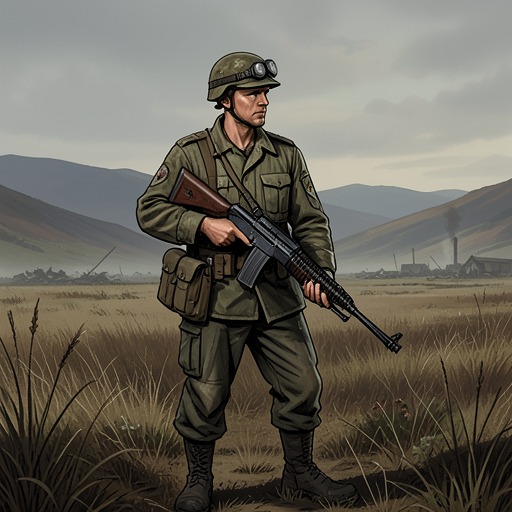
News of the WorldBuena Vista is presented as a high-mountain setting above Monterrey where Jefferson Kyle Kidd served with Zachary Taylor’s forces in February 1847. The place becomes significant through both combat and recollection: while the campaign tests the men under fire, a later campfire conversation turns the landscape into a setting for weighing one generation’s courage against another’s.
Mountain Campaign and Combat
Kidd’s account places him with Taylor’s forces at Buena Vista in the thin air of the mountains above Monterrey. The troops had been fired on repeatedly while moving up from the Rio Grande, though the shooters might have been Mexican Army sharpshooters or Apaches. During the fighting, Kidd used a Model 1830 Springfield flintlock, a weapon he knew from his upbringing. Lying in a wagon bed, he fired toward the gunsmoke, hoping to hit concealed snipers.
The passage gives the surrounding landscape a spare, exposed character: campfire smoke rises straight into still air, and the men gather beneath a cold, starry sky. The account offers no detailed map of the battlefield; instead, its emphasis falls on altitude, distance, and the soldiers’ uncertain view of the enemy.
A Campfire Conversation
At night, young men wanted to hear about the Battle of Horseshoe Bend. They were not asking only for a story of an earlier fight: they wanted to compare their own conduct with that of their forebears and judge whether their hardships and opponents measured up. Texas Rangers lounged against caissons and listened to Kidd, an older man they treated courteously despite their own apparent fearlessness and recklessness.
Kidd described the Creek and Choctaw fighters’ smoothbores and his Georgia militia company’s rifles and minie balls. He recalled that the company’s wagons sank hub-deep in sand on the way to Pensacola, and that after his captain was killed on the battle’s second day, he crawled out and dragged the man under cover, where he died. Kidd also described Andrew Jackson as fearless and fierce in combat. When the Rangers’ unspoken question turned to whether Kidd himself had been wounded, he disclosed that he had been shot in the hip without realizing it at the time; he thought a spoon fired from a smoothbore might have struck him.
Memory, Authority, and the Place
Buena Vista thus frames two layers of military experience: Kidd’s own service with Taylor’s forces and his retelling of an earlier battle to men seeking a measure for their present lives. The Rangers’ attention gives the older man a temporary authority grounded not in command but in what he has endured and remembers. Yet he admits that he tells them only what he can, or feels like telling, leaving the account selective rather than complete.
The scene closes on physical details rather than a verdict. Kidd pauses beside the fire, his trouser knees smoking from its heat and his hands stained with ink; the young Rangers wait silently beneath their hats. Their beards seem youthful, while their faces appear artificially aged. In this contrast, Buena Vista becomes more than a campaign location: it is where stories of past violence are tested against the present, and where the distance between experience and the desire to understand it remains visible.