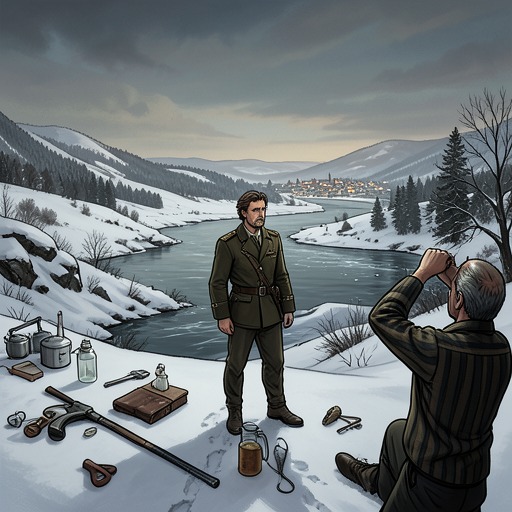
Captain Kidd's mission to return Johanna Leonberger
News of the WorldJefferson Kyle Kidd’s mission to return Johanna Leonberger begins as a charge of protection and becomes a promise that governs his journey south. After Britt Johnson tells him that Johanna’s parents were killed when the Kiowa captured her, Kidd takes responsibility for the girl and sets out toward her relatives. The evidence follows the mission through its preparations, its changing itinerary, and Kidd’s private recommitment after danger; it does not establish the journey’s final outcome.
The Charge and Its Stakes
Britt Johnson gives Kidd both a reason to take Johanna and a warning about what the task entails. He identifies her parents as Jan and Greta, says they were killed during her capture by the Kiowa, and explains that the gold coin he produces was sent by the family to the Agent. Its value is unusually conspicuous in a region where state finances have collapsed and both news and hard money are scarce. The coin is thus not merely payment: it connects the girl to the relatives seeking her and marks how precarious the surrounding economy has become.
Johanna is weary of being watched. As the men observe her, she slips between freight boxes and bales as if fainting and draws a thick blanket over her head. Britt says she has nowhere else to go that night and cautions Kidd to be careful with her. Kidd, in turn, cannot learn the name she uses in Kiowa. He decides to call her Johanna, though the name means nothing to her. Their journey begins, then, without shared language or trust established: he has accepted an obligation toward a child whose experience and identity he cannot yet fully reach.
Preparing to Leave
Kidd’s preparations reveal the practical scale of the undertaking. He packs newspapers for his readings, a razor and soap, and the equipment for loading his shotgun: powder, caps, wads, a shot box, and a spring-loaded charger. The Curative Waters wagon carries food and provisions, including tinned butter, dried beef, bacon, flour, and water bottles, alongside two sheepskins, medical supplies, a lantern and candles, and a small stove. He adds his portfolio of newspapers and a road map of Texas, which he rarely uses, as well as his riding boots, saddle, and blankets. He lifts Johanna into the wagon bed and makes a gesture instructing her to stay while he goes to find Britt.
The road plan is shaped by the river and by the weather. Britt directs Kidd east along the Red River to Spanish Fort, then southeast toward Weatherford and Dallas, warning that the Red River is still rising and advising him to get away from it quickly. From Dallas, Kidd can seek directions for the Meridian Road south. The route makes the mission a passage through a changing landscape rather than a direct delivery: first away from flood danger, then across North Texas and onward toward the country around San Antonio.
The Southbound Journey
The departure divides the travelers. Britt and his two wagons head south toward the lower Little Wichita, while Kidd and Johanna turn east toward Spanish Fort. The account projects their intended course through the Cross Timbers, then south through Dallas and eventually some four hundred miles farther, into the brush country around San Antonio. That destination is described as a region of alluvial rivers and live-oak valleys, far removed from the Red River border country where the mission began.
The separation is watched. People in doorways see an old man and a frightened ten-year-old girl leave together; some respond with disapproval, while other observers show interest and greed. A pale-haired man and two Caddo companions are among those watching. Their presence gives the departure an unsettled edge, but the immediate account does not say that they stop Kidd or alter his route.
The journey also exposes its ordinary vulnerabilities. Kidd has forgotten to find a blacksmith for a cracked tire rim. Rain has swollen the wheels and may have tightened the rim against the felloes, but he expects to need a repair in Dallas. His money is short after paying for the Masonic Hall and buying supplies and grain for the horses. Food, ammunition, and a carefully chosen road can keep the wagon moving, but they cannot remove the strain of distance, weather, and limited funds.
The Promise Under Pressure
The mission is not undertaken with easy confidence. After a violent episode in which Kidd and the fiddler drag Johanna back toward the wagon under fire, Kidd remains awake in the rainy darkness, counts his money, and thinks of the long roads still separating them from San Antonio and Castroville. Johanna sleeps. He aches in every joint and reflects that she has not cried once. The task feels imposed on him; he privately wonders whether accepting it was madness and fears senile decline. Yet he returns to the promise: he will get her back to her relatives, even if doing so means never cocking another gun.
That resolve does not instantly make the two companions close. Once they have left town, Johanna sits beside Kidd and sings to herself, moving one hand as if it were dancing. She has accepted that she cannot cross the Red River and rejoin her people, but her song and gestures show her continuing to act within the narrow freedom she has. Kidd’s responsibility is therefore more than transporting her south: he must continue in the face of her fear and separation without any assurance, in these scenes, that the white world awaiting her will feel like home. The mission’s decisive measure is the promise he keeps making real through the next mile of road.