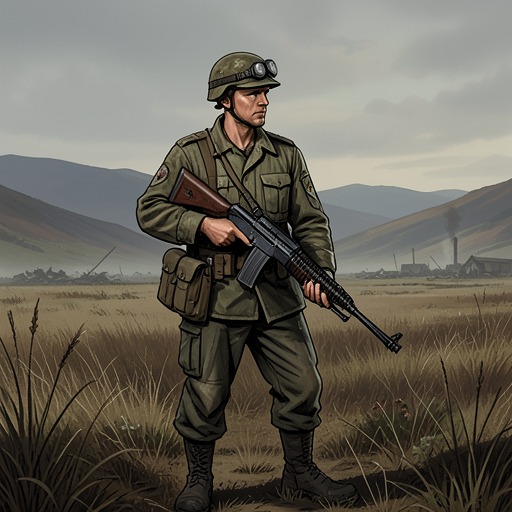
Captain Thompson
News of the WorldCaptain Thompson is the Georgia militiaman Jefferson Kyle Kidd helps elect and then tries to save under fire at the Battle of Horseshoe Bend. His brief appearance establishes both the danger of the battle and the bond formed when a young private crawls beyond cover for his wounded captain. Thompson dies despite Kidd’s rescue, an episode that returns years later as a defining memory Kidd tells to younger soldiers.
Identity and Election
Before the militia marched west to fight under Andrew Jackson, the men gathered in the Georgia hill country to prepare their supplies, arms, ammunition, personal kits, and horses. They also discovered that their force needed officers. The process was uncertain: two officers elected the previous year were no longer standing with them, and three had moved to Tennessee. The men were unsure what sergeants and corporals were for, and decided to do without those ranks. They nevertheless recognized the need for a captain, and Kidd, only sixteen, raised his hand to vote for Thompson.
The circumstances make Thompson’s authority practical rather than ceremonial. The militia was assembling a command structure as it prepared to leave, without much understanding of military roles or habits. Kidd’s vote is the only account of their personal connection before the battle; the narrative offers no portrait of Thompson’s life or character beyond his position as captain and what happens to him in combat. His importance emerges through the responsibility the men place in him and the peril Kidd accepts when that responsibility becomes personal.
The Battle and Rescue
On March 27, 1814, the Georgia militiamen were with Coffee’s forces south of the bend. They had dismantled a cabin and used its timbers to build a breastwork. Kidd lay beside two boys from his county, firing over the makeshift barrier. A large soap kettle had rolled out of the cabin’s fireplace; shots striking it made it ring loudly enough to obscure the sounds of the battle. Across the river, Creek and Choctaw fighters kept up accurate fire against the cabin and its defenders.
Thompson was out in front, crawling toward the shelter. Sherman Foster called to Kidd to identify the exposed man as Captain Thompson. The warning turns the captain’s position into an immediate test: Kidd could remain behind the barricade, or try to reach him through the fire. He set down his flintlock, wrapping its firing mechanism in his kerchief, removed his powder horn and measure strap, and shucked off his cartridge box. Then he crawled out toward Thompson. The decision strips away the equipment he would need to fight so that he can move more freely to retrieve his captain.
As Kidd reached for Thompson’s outstretched arm, bullets struck the sand around him. He seized the bloodied arm and torn shirt sleeve and dragged Thompson between two collapsed timbers, back into the shelter of the breastwork. The rescue carried them over the debris of the ruined cabin, including a broken mirror, spoons, and a calendar. Thompson’s boot heels caught the calendar, turning its pages over March, April, and May. The ordinary objects make the improvised shelter feel at once like a wrecked home and a place where the battle’s consequences cannot be held off.
Death and Its Aftermath
Once Thompson was under cover, Kidd found that he was dying. He had been struck in the V of his throat. Kidd turned him onto his back and searched for signs of life, confronting the uncertainty of whether life remained in a body he had just risked his own to retrieve. He opened Thompson’s military jacket and shirt and watched life drain away. The rescue succeeds in bringing the captain behind the barricade, but it cannot reverse the wound; Thompson dies soon afterward.
The battle also wounded Kidd, who had been hit on the outside of his right hip without initially realizing it. His injury was later bandaged and healed, but at the moment Thompson was brought back he had to look down to see the spreading blood on his own trousers. The contrast is sharp: Kidd’s wound proves survivable, while Thompson’s throat wound is fatal. The scene places the young soldier’s physical vulnerability beside the loss he has just witnessed, without suggesting that he understands the full meaning of either at once.
Memory and Narrative Significance
In February 1847, while with Zachary Taylor’s forces near Monterrey, Kidd recounts the Battle of Horseshoe Bend to young Texas Rangers. They want to compare their own hardships and courage with those of earlier fighters. Kidd describes the weapons, the difficult march, and Jackson’s fearlessness, then tells them that his captain was killed on the battle’s second day and that he crawled out and dragged him back under cover. The Rangers’ question about whether Kidd was wounded remains unasked, but he answers it: he was shot in the hip and did not know until later. He adds that the opposing fighters had run short of ammunition and were firing whatever they had in their smoothbores; he thinks a spoon may have struck him.
That later telling preserves Thompson not through an account of his life, but through the precise actions surrounding his death: crawling toward safety, Kidd laying aside his weapons, the bloodied arm, and the calendar pages dragged over by Thompson’s boots. The memory has also become a way for Kidd to speak to young men measuring their own courage against the past. Thompson’s role in that exchange is brief but consequential: his death is the event that gives Kidd’s account its personal cost, and the rescue is the experience through which the older man’s recollection of battle becomes more than a comparison of weapons or endurance.