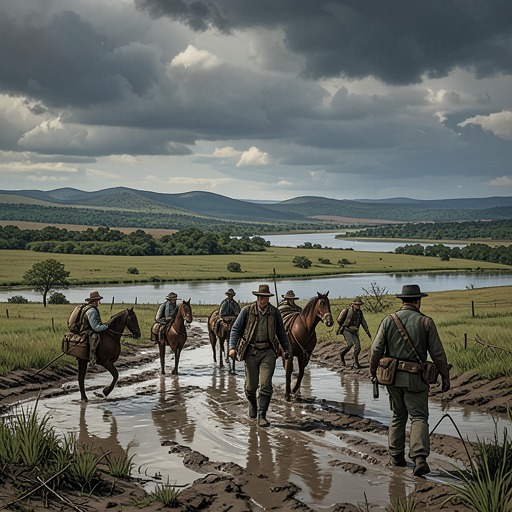
Carlyle Springs
News of the WorldCarlyle Springs is a spring and ravine beside the Brazos River crossing, remembered by Jefferson Kyle Kidd as a place of shelter and transformed into a battlefield. Its red sandstone bluff, narrow approaches, and broken stone steps shape both the attempt to hide from pursuit and the ensuing fight with Almay and his Caddo companions.
Setting and Approach
At first light, Jefferson Kyle Kidd and Cicada are only about a mile from the Brazos when their route brings them to a small road running along its north bank. Kidd recognizes Carlyle Springs. Water flows from a red sandstone bluff into a ravine and then to the river, sparkling as it jumps from pool to pool. The spring is not merely a landmark: its ravine offers a way off the exposed road, while a faint wagon track zigzagging up the slope suggests a route to higher ground.
Kidd turns Fancy from the road and climbs. After roughly a hundred yards, the track becomes too difficult to follow from the wagon seat; he dismounts and leads the mare through agarita and spiky young live oaks. The brush catches at the wagon’s underside, and the climb leaves Kidd soaked to the knees. Cicada and Pasha jolt and scramble behind him as he struggles to get the wagon under cover. The arduous ascent makes the refuge costly to reach, but it takes them above the road and out of immediate view.
A Concealed Vantage
At the top, Kidd finds the only flat place where the wagon can stop. Trees and sumac thickets provide concealment, while nearby stumps indicate that someone has cut fence posts there. A layered stack of red sandstone, thick and crenellated like a defensive wall, gives him a view down to the road. The place combines a hiding spot with a lookout: he can watch the route without returning to the exposed ground below.
The wagon’s concealment remains uncertain. Kidd guesses that someone on the road might see its top boards, but he does not climb down to check; on foot, he could be caught with a long, difficult ascent back to the wagon. Instead, he lies prone and watches two visible stretches of the red dirt road, whose twin tracks are divided by mullein and Indian grass. As daylight increases, a possible glimpse of a horse’s tail makes him climb onto the wagon seat for a better view. The spring’s height and cover help him observe pursuit, but they do not make the party secure.
The morning’s conditions sharpen that uncertainty. The temperature is perhaps fifty degrees, and a thin sun shines over widely separated, tree-covered ridges. Smoke rises from the cedar hills three or four miles away, possibly from someone burning slash or stubble; it is a distant sign, not an assured destination or aid. Kidd believes Almay may have begun searching after failing to find him at the Tyler Stage Roadhouse, and worries that mounted pursuers can travel faster. At Carlyle Springs, every soundless stretch of road becomes a test of whether concealment has bought enough time.
The Ravine as a Battlefield
The terrain that hides the wagon also channels the confrontation. When rifle fire breaks stone near Kidd, chips strike him above the right eye and temporarily blind that eye; the wound bleeds, but he remains focused on preventing Cicada from falling into the attackers’ hands. He considers escape on Pasha, with Fancy following, or trying to reach the smoke on the horizon. These are difficult options: Fancy is slow, has a misaligned front leg, and is prone to stumble. The spring’s ravine has become both cover and a trap from which escape must be carefully judged.
Water continues to chatter down the ravine as the fighting proceeds. Almay uses the terrain to approach, advancing over hard, pale layers of sandstone where the water has worn the red strata down into irregular steps. The stone plates offer a route through the ravine, but also expose his progress to Kidd’s position. Almay walks forward in knee-high boots, hat in hand, confident that he understands the shotgun’s range and its light dove shot. He also believes Kidd has exhausted his revolver ammunition. His offer to have his men empty their magazines and talk is, in Kidd’s judgment, a delay that allows the Caddo companions to creep closer.
Kidd answers the advance with a concealed difference in firepower. He carefully aims his twelve-gauge shotgun at Almay’s open shirt collar and fires a shell loaded with U.S. dimes. The overloaded blast drives the stock hard against Kidd’s shoulder; the coins strike Almay in the forehead, and he falls backward down the slope. Kidd immediately reloads with another dime-loaded shell and fires toward the scrambling attackers. Coins ricochet through the ravine, strike a wounded man, clip live-oak branches, and chip stone; a further shot hits the Caddo fighter at the rear. The spring’s stepped rock, thickets, and narrow ravine turn the shots into a chaotic exchange at close range.
Narrative Significance
Carlyle Springs changes function as the scene unfolds. Its height and vegetation initially promise concealment, while the spring itself offers a vivid, almost tranquil course of water through red stone. Yet the same ravine funnels pursuers toward the hidden wagon and forces Kidd to defend the ground rather than simply disappear from it. Cicada’s brief return to the immediate domestic task of preparing food, followed by her attention to the attackers, places care and danger within the same refuge.
The location also determines the fight’s distinctive material terms. The stone protects and wounds: it provides the defensive vantage, then fragments under rifle fire, cutting Kidd above the eye. The ravine’s water-worn steps become Almay’s approach, while the shotgun’s dimes turn the narrow landscape into a corridor of ricocheting metal. Carlyle Springs is therefore not a passive backdrop to the encounter. Its topography creates the temporary advantage on which Kidd relies, shapes the attackers’ advance, and makes the spring-side refuge the site where concealment gives way to open resistance.