Cicada
News of the WorldCicada, identified by the authorities as Johanna Leonberger, is a child whose four years among the Kiowa have made return more complicated than physical rescue. Captured at six from near Castroville, she has been raised within a family and culture she still longs for even as others try to restore her to her German relatives. Her names, silences, language-learning, and decisive actions show a continuing Kiowa identity that cannot be erased by the journey home.
Identity and Background
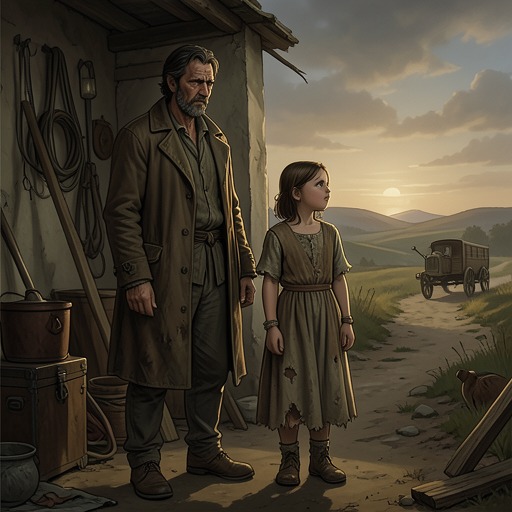
Britt Johnson reports that Cicada was captured four years earlier, when she was six, and that Agent Hammond believes she is about ten. She has already tried to jump from the wagon twice on the journey from Fort Sill. At the livery stable, she sits on a bale of Army shirts beneath a lantern, watching each movement around her with bright, glassy eyes and a still head. The adults regard her as strange and potentially dangerous; Britt, despite his strength, watches her cautiously. Their uncertainty contrasts with the clear identity she holds within herself.
Cicada knows herself through her Kiowa name and family. In her thoughts, she names her father as Turning Water and her mother as Three Spotted, and says that she wants to go home. Her words remain internal: the Kiowa language, with its tonal music, lives in her head, unheard by the people around her. The gap between what she knows and what others can hear is central to her predicament. The agent’s identification gives the adults a name and a destination, but it does not convey the family and belonging she means when she thinks of home.
Her Kiowa name, Ay-ti-Podle, means Cicada, whose song signifies that fruit is ripening nearby. She gestures toward Pasha as she explains the name, briefly including the horse in her happiness. Earlier, when Captain Kidd tries to teach her the name Johanna, she answers with Chohenna; when he names himself Captain, she offers her approximation, Kep-dun. These exchanges show both the distance between their languages and her willingness to test the sounds passing between them.
Names, Language, and the Attempted Return
Captain Kidd tries to make the return intelligible through names. He points to her and patiently repeats Johanna, while she leans forward and holds the roan mare’s back band, the horse’s warmth and scent among the few familiar things in the upheaval. She raises both palms, apparently treating the requested name as something potentially dangerous, and calls on a guardian spirit whose signs—a pair of down puffs in her hair and a golden eagle feather—have been taken from her. The naming lesson is therefore no neutral exercise: the adults’ effort to restore her former identity meets a child who has already lost objects and practices that connected her to her Kiowa life.
When Captain Kidd tries German, calling her aunt and uncle by their family terms, she recognizes the words for Anna Leonberger and Wilhelm Leonberger. Her brief affirmation is followed by visible difficulty: she looks at her stained hands, opens and closes them, and seems unable to resolve what recognition means. The passage makes comprehension different from belonging. She can recognize the names of relatives without being able simply to resume the life those names represent.
On the road, Captain Kidd points out Pasha, the horse’s nose, and bacon. Cicada supplies approximate English words for horse, nose, and bacon, then practices commands for standing and sitting. The word Opa, meaning grandfather in German, seems to connect with something in her mind; she becomes interested in the puzzle of another language, its words and grammars. She then tries out phrases and counts from one to ten in English. Captain Kidd has begun a Kiowa dictionary, but the language’s many specific tones puzzle him, and he sets the effort aside. The asymmetry is telling: she is acquiring the language needed for the world she is entering, while his attempt to record hers falters at the point where its sound carries distinctions his writing cannot easily capture.
Loyalty, Danger, and Agency
At the Red River, a flood brings Cicada’s longing into the open. She stands on red stone with her skirts soaked and heavy, clutching her china-headed doll, while a Kiowa party moves along the far bank. She calls to them in Kiowa, but the rising river drowns her voice. The people she sees are traveling with horses, tipi poles, and drenched children on travois; she calls for her mother, father, siblings, and the life of movement across the Plains. Her appeal is not an abstract preference for the past. She is trying to reach people she still understands as her own, even when the distance and flood make communication impossible.
Cicada’s attachment to that life also appears in action. During a gunfight with the Caddo people, she ignores Captain Kidd’s order to get back and moves barefoot among the red sandstone, using a stove-lid lifter to lever at a flat slab. With her skirts tucked up into her belt, she moves through the rocks while warning that the attackers will die. This is not her first gunfight. She tips the slab downhill; it breaks against a boulder and strikes a concealed man, bringing him out of hiding. Her competence is practical and immediate, not merely a recollection of the culture from which she has been taken.
After the attackers flee, Cicada rises, lifts her face to the sun, and sings a Kiowa triumph and scalping chant. Its words declare that the enemies have fled and been sent to the otherworld. The Caddo people hear the chant as they descend toward the Brazos River and do not stop even to fill their canteens. The scene reverses the adults’ first impression of a strange, passive child: Cicada is an active participant whose knowledge, judgment, and cultural expression affect what happens around her.
A Life Between Worlds
As the journey continues, Cicada learns English gradually. She speaks it with a clipped accent and difficulty with the letter R, while her questions remain direct and sometimes embarrassing to those around her. In towns, she sits sternly in front of the paint can collecting payment during Captain Kidd’s newspaper readings. At Nacogdoches, Spanish-speaking listeners call her La Cautiva, another name imposed by people who see her as a captive. Her collected coins also register the distance between her experiences: it takes a long time before she regards them as legal tender rather than ammunition.
The wandering life suits her better than the values of settled white society. She watches new towns and people pass from beneath the wagon canopy, across country that shifts from shaded springs to waterless stretches. She does not learn to prize fashionable dresses or bank accounts. The Kiowa pride in doing without—making use of what is at hand and enduring without food, water, or shelter—remains a measure of life for her. The narrative stresses that her gestures and expressions are not those of white people and will not become so. Her return journey may change what she can say and where she travels, but it does not simply replace the standards by which she understands the world.
Memory and Narrative Significance
The book’s later remembrance keeps Cicada connected to the Kiowa even as it describes her as the little blue-eyed girl taken from them by the Indian Agent. The Kiowa warriors, the account observes, survive in stories told and retold: their bravery, the deaths of Britt Johnson and his men, and the loss of Three Spotted’s child. This retrospective framing resists treating Cicada’s removal as an uncomplicated recovery. The name Johanna points toward the relatives to whom she is being returned; Cicada and Ay-ti-Podle preserve the relationships and meanings that the return cannot undo.
Her story is therefore shaped by a persistent mismatch between naming and recognition. Officials identify her, relatives can be named in German, and Captain Kidd helps her acquire English, but none of these acts makes her earlier belonging disappear. The remembered Kiowa words, the attempted call across the flooded Red River, the chant after the fight, and her changing understanding of coins all mark a person adapting without becoming a blank slate. Cicada’s importance lies in that unresolved continuity: she can learn the language and routines of a new life while remaining, in memory and action, a child of the people from whom she was taken.