Curative Waters wagon
News of the WorldThe Curative Waters wagon is a green excursion vehicle that becomes the material center of Jefferson Kyle Kidd and Cicada’s journey: transport for their supplies, shelter for their meals, and a conspicuous marker that attracts attention and danger. Its painted promise of mineral waters belongs to another, unknown journey, but the wagon’s new work carries Cicada toward her relatives and ultimately carries Jefferson Kyle Kidd away from them again.
Acquisition and Appearance
Jefferson Kyle Kidd buys the spring wagon from a livery stable with Spanish coin, and the purchase is described as fortunate. It is not an ordinary freight wagon but an excursion vehicle painted dark, glossy green, with gold lettering on its sides reading “Curative Waters East Mineral Springs Texas.” The label identifies its former association with mineral-water excursions, though Jefferson Kyle Kidd has no idea how it traveled from near Houston to the small town on the Red River. The route that brought it there—and whatever story the wagon might have carried before his purchase—remains unknown.
Its design is jaunty and sociable: two rows of seats run lengthwise in the bed so passengers can sit facing one another. Poles hold a canopy, and side curtains can be stretched around the vehicle. These offer only poor protection in hard weather, but they give Jefferson Kyle Kidd what shelter he can manage. The wagon is therefore useful without being secure or comfortable. Its form suggests an outing among passengers, while its later use is shaped by the more pressing needs of travel and care.
The vehicle’s sign preserves that contrast. “Curative Waters” announces a destination and a promise of restoration, but the wagon itself does not explain its own past, and its new passengers travel through conditions the canopy and curtains cannot fully keep out. The old lettering remains while the purpose changes: a commercial excursion wagon becomes the means by which Jefferson Kyle Kidd carries a child across Texas.
A Traveling Household
Before setting out, Jefferson Kyle Kidd packs the wagon with the tools and provisions of a life on the road. He loads his shotgun, tinned butter, dried beef, bacon, two sheepskins, medical supplies, flour, water bottles, a candle lantern and candles, and a small stove. He also brings his newspapers and portfolio, a Texas road map that he rarely uses, his riding boots, saddle, and blankets. The inventory joins practical necessities with the work and habits he already carries: the papers remain his livelihood, while food, water, and bedding make continued travel possible.
He lifts Cicada into the wagon bed and makes a gesture for her to stay. The vehicle is not merely a means of conveyance; it is the space in which their shared journey is organized, with the child’s place established among the provisions and equipment. Its long seats, intended for passengers to face one another, now frame a smaller, more provisional domestic arrangement.
That arrangement becomes visible under the bur oaks during a drizzle. The leaves overhead, combined with the canopy and stretched curtains, keep the wagon dry enough. Cicada has made cornbread, bacon, and coffee and sits cross-legged between the long seats with supper spread before her. Jefferson Kyle Kidd, Simon, and Doris Dillon hurry through the rain to join her. In the lantern light, the wagon’s gold lettering shines above this improvised meal. The scene gathers shelter, food, and companionship inside a vehicle whose protection remains limited: the wagon can provide a temporary household, but only within the weather and circumstances of the road.
The stove also makes the wagon’s domestic use vulnerable to mishap. In one episode, the small stove erupts amid a clatter of broken pipe and scattered coals; the skillet lid flies away, and bacon and coffee are thrown into the air. The cooking equipment packed as part of the wagon’s provisions is not a quiet convenience but a source of sudden disruption. The scene makes the vehicle’s interior feel contingent: meals depend on portable gear that can fail, and the travelers must live with the practical risks of making a home on the move.
Visibility and Danger on the Road
The wagon’s distinctive paint and lettering repeatedly make it recognizable. That visibility matters when Jefferson Kyle Kidd assesses the danger of an approaching threat: he believes the other man wants to take the girl and horses and burn the wagon, and he identifies “Curative Waters” as the reason it is too recognizable. The sign that once named a commercial destination now works against concealment. The wagon is useful precisely because it carries the travelers’ world with them, but its marked identity makes that world easier to locate.
Later, at a broom and stave mill, the same mixture of practical use and exposure is on display. Blankets hang on lines, harnesses are thrown over the wagon’s sides, and black beans and bacon simmer on the tiny stove. The man at the mill regards both the gold lettering and the bullet holes with serious doubt. The wagon bears signs of danger alongside the evidence of routine domestic work; its weathered, marked presence draws scrutiny even as it holds the equipment for another meal and departure.
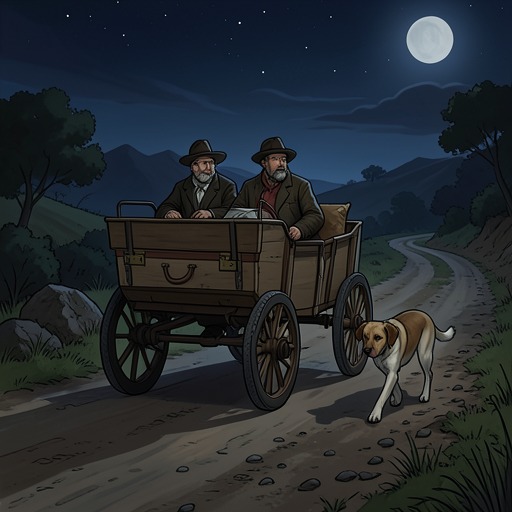
The travelers’ handling of the wagon is often direct and hurried. When Jefferson Kyle Kidd prepares to leave, he harnesses the roan mare, backs her into the shafts, settles the collar, hooks up the trace chains, and turns the wagon outward. He throws in the portfolio and bag of coins, wraps the remains of supper in the frying pan, and puts his formal reading clothes over his arm. The wagon’s bed receives both the tools of his work and the leftovers of the household. At the stave mill, after the rain has nearly passed, he backs Fancy between the shafts and harnesses her. The gold letters shine in the moonlight, still announcing the vehicle even as its occupants prepare to move on.
Return and Reversal
When Jefferson Kyle Kidd reaches the Leonberger family, the green excursion wagon gathers a public audience. After he and Cicada’s names are heard from the hotel owner, people come around it to stare. They have heard that Cicada was redeemed for German coin silver, a report connected to Bianca Babb’s grandfather, who had brought his granddaughter back from Indian Territory. The wagon becomes the visible point around which secondhand news, curiosity, and the actual return converge.
Jefferson Kyle Kidd identifies himself to the family and says that he has returned their niece, explaining that Indian Agent Samuel Hammond ransomed her at Fort Sill, Indian Territory. In this moment the wagon has delivered its passenger to the stated destination of the journey. Its function as a vehicle of return, however, does not settle Cicada’s place among her relatives or end her connection with Jefferson Kyle Kidd. When he puts an arm around her and throws the halters into the road, he turns the Curative Waters wagon north again. He says that if anyone objects, they will be met with coin-loaded ammunition.
The final turn gives the wagon a new direction after the return it was meant to accomplish. Earlier, Jefferson Kyle Kidd acquired it as a lucky, imperfect solution to the need for transport; its seats and curtains then made room for travel, meals, and temporary shelter. Its conspicuous lettering also exposed the travelers to notice and helped make it a target. Now the same vehicle carries Jefferson Kyle Kidd and Cicada away from the reunion, so the wagon’s path reverses without erasing what it has carried. The painted promise of curative waters remains fixed on its sides, while its meaning in the story comes from the changing lives gathered beneath its canopy.