Erath County
News of the WorldErath County enters the novel as a jurisdiction without functioning local government, where political exclusion and improvised authority shape the road taken by Jefferson Kyle Kidd and Johanna Leonberger. Its significance lies less in a detailed portrait of the county than in a brief, revealing encounter: the men who control entry admit that no sheriff or other local officials remain, yet insist that travelers answer to them.
Political and geographic setting
The county lies along the pair’s overland route through Texas. The narrative places their passage amid a wider landscape of unsettled authority and danger. Comanche raiders were said to come south from the Red River, crossing the open country around Lampasas before moving into the hill country, where water, concealment, isolated farms, and the prospect of loot drew them. The account establishes this as a regional threat, not as a specific raid in Erath County.
The journey itself is precarious. Kidd is escorting Johanna toward her relatives in Castroville after bringing her out of Indian Territory and across the flooded Red River; the family had sent a fifty-dollar gold piece to pay for her transport. By the time the travelers approach Erath County, the journey is also economically strained: after the violence at Carlyle Springs, Kidd knows that reading the news in Durand may bring further trouble, but they have shot themselves into poverty and still have a long way to go.
The claim to control entry
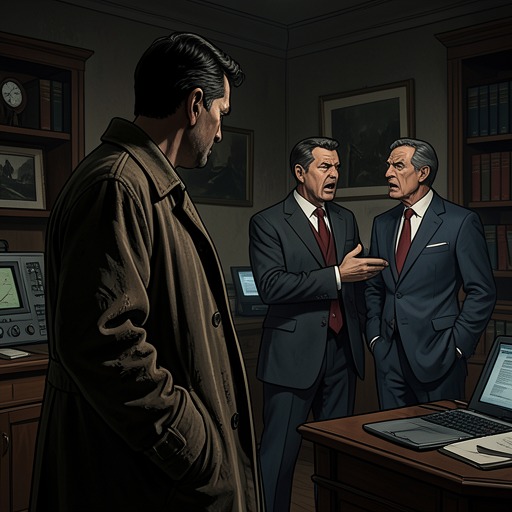
The men who stop Kidd ask whom he voted for and whether he supported Governor Davis or Hamilton. One declares that no one who voted for Davis is getting into Erath County. Kidd challenges the group’s standing, asking whether this is an official decision by the local administration. The answer is that there is no local administration: no sheriff, justice of the peace, mayor, or commissioners.
The black-bearded spokesman explains that Davis’s men and the United States Army removed officials who had served under the Confederacy, and that no replacements were sent. The group, he says, has taken on the job itself and holds travelers accountable to its authority. The encounter thus gives political dispossession a concrete form: a vacuum left by competing powers is occupied by local men who enforce a partisan test at the county boundary.
Passage, cost, and narrative significance
Kidd answers that the vote is secret and invokes his service at Horseshoe Bend and Resaca de la Palma, insisting that he fought for political rights rather than dictatorship. His appeal to principle does not dissolve the danger or restore formal government. Instead, after a pause, the men ask for a half-dollar. The nominally political checkpoint ends in a payment that allows the journey to continue.
The episode also exposes Kidd’s limited choices. He considers selling the wagon and proceeding on horseback, but his weakened back and painful hip joints make long rides increasingly difficult. Erath County is therefore not merely a point on the route: it is a place where partisan control, absent institutions, and the travelers’ material vulnerability converge. The men’s casual collection of money makes their authority at once coercive and makeshift, while the county’s missing officials leave no recognized local body to which Kidd can appeal.