Georgia
News of the WorldGeorgia is the formative landscape in Jefferson Kyle Kidd’s life, a place he leaves more than once but never entirely escapes. Its hill-country habits remain in his voice, its militia provides his first military service, and its wartime roads become the setting for years spent carrying messages. Later, Georgia returns through the lives of his children and the remains of a family farm, making the state both an origin and a measure of the distance between his Texas life and his Eastern family.
Hill-Country Origins
Kidd grew up in the Georgia hill country, and the narrator presents that upbringing as something more lasting than a place of birth. He spoke and thought in the manner of the region throughout his life; its habits and intonations stayed with him even after he settled far away. Georgia is therefore present in his later character not simply as remembered scenery but as an enduring pattern of speech and perception.
The state also appears as a place where responsibility shaped his choices before he could pursue the future he wanted. Kidd wished to go west to the Spanish settlements, but his widowed mother and younger sisters depended on him. He postponed departure, and twice deliberated so long about marriage that the young women he had courted returned his letters and married other men. By the time he finished an apprenticeship as a printer in Macon, his mother had died and both sisters had married. Only then, after the upheavals surrounding the Alamo and San Jacinto, did he leave for Texas. The move west was not a simple escape from Georgia: it came after the family obligations that had held him there were over.
Militia Service and the Road Through Georgia
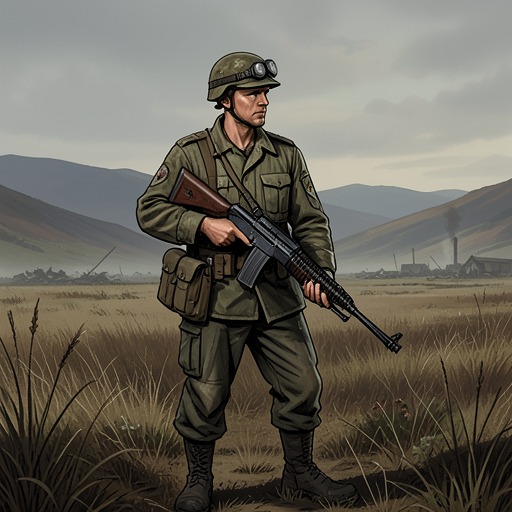
Kidd’s first military experience began when he was sixteen, serving as a private in the Georgia militia during the War of 1812. Before the unit departed, its members assembled supplies, arms, ammunition, personal kits, and horses in the Georgia hill country. They then confronted the practical need to elect officers. Some previously elected officers were absent or had moved to Tennessee; the men were uncertain about military ranks and chose not to appoint sergeants or corporals. In this makeshift setting, Kidd raised his hand to support a man named Thompson for captain.
The militia traveled west to fight at the Battle of Horseshoe Bend in Alabama under Andrew Jackson. The battle itself thus belongs to Alabama, not Georgia, but Georgia is where Kidd’s military life takes shape. On March 27, 1814, he was wounded in the outside of his right hip while fighting with the Georgia men south of the bend. They had pulled down the timbers of a cabin to make breastworks. As Kidd and two other young men fired from behind them, rounds struck a large soap kettle that had rolled from the fireplace, ringing it like a bell and making it difficult to hear Captain Thompson as he crawled toward cover. The remembered scene binds the young private’s first experience of combat to the rough organization and shared danger of his Georgia company.
His service continued into a period of carrying messages across Georgia and Alabama. Kidd traveled on foot and on small Florida horses called Tackies, keeping the information in a leather budget as he dodged artillery and musket fire. He recalled two years of directed flight as a time when he seemed to have found the task for which he was meant, though he also knew that such a fortunate, extraordinary period could not last. One episode left him hidden in a large empty ash hopper beside a cabin. He woke to find a farmyard full of British soldiers and stayed concealed until the hot middle of the day, when they had left. Had they found him, they would have killed him. Georgia’s wartime landscape is rendered through these narrow escapes: a route to be crossed, a place to hide, and a dangerous passage for a man carrying news.
Family Life in the Postwar State
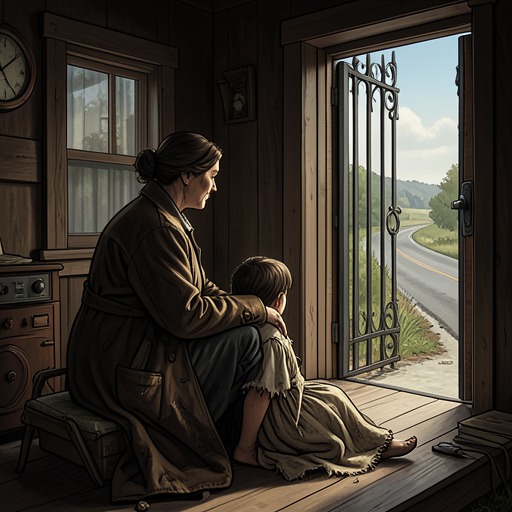
Georgia reappears in Kidd’s later life through the effects of war on his family. His younger daughter Olympia lived with Elizabeth and Emory in the remains of their farm at New Hope Church, Georgia. The description of the farm as a remnant gives the family’s circumstances a material weight: the household had not returned to an intact prewar life. Kidd’s letter considers the difficulties facing Emory, who had lost an arm, and argues that he might pursue typesetting or accounting once he learned to use his left hand. The state is thus associated not only with Kidd’s own youthful service but with the long aftermath borne by the next generation.
Olympia’s husband, Mason, had been killed at Adairsville during Johnston’s retreat toward Atlanta. He was shot from the tower of the Bardsley mansion and fell three stories. Kidd remembers him as a strikingly large man and as a foil to Olympia, whom he describes as performing helplessness and refinement. His account of her inability to pull a turnip without weeping is affectionate only in part; he also admits privately that his youngest daughter was a bore. These judgments reveal a family relationship complicated by grief, irritation, and distance. Mason’s death explains why Olympia is living with Elizabeth and Emory, while Kidd’s recollection preserves the force of a loss that reshaped the household.
Georgia as a Point of Distance
From Texas, Kidd urges his Eastern family to consider joining him, presenting Texas as preferable to the ruined and devastated states in the East. His proposal is practical as well as personal: he hopes to have his daughters, son-in-law, and grandsons near him again, and he points them toward land connected with their late mother. The claim is uncertain, with old records and questions of registration to investigate, but his letter turns inherited property into a possible route toward reunion. Georgia is not named as the only place his family might leave; rather, the state’s postwar farm and its residents make the larger distance between East and Texas tangible.
As a narrative location, Georgia gathers several stages of Kidd’s life without becoming a continuous present-day setting. The story reaches it through recollection: the young militiaman learning the demands of command, the courier slipping across wartime country, and the father receiving news of a damaged farm and a bereaved daughter. The state’s recurring appearances also mark the cost of movement. Kidd eventually fulfills his wish to travel west, but the departure does not erase the Georgia ties formed by duty, military service, and family loss. In his later life, Georgia remains the place from which he came and the place toward which his letters still reach.