Jefferson Kyle Kidd
News of the WorldJefferson Kyle Kidd is a former printer turned itinerant newspaper reader, an elderly veteran whose rounds through postwar Texas make him a bearer of public news and, ultimately, a protector of Johanna Leonberger. His authority rests less on wealth or institutional power than on his voice, his papers, and the steadiness with which he keeps moving. The work that begins as a way to survive becomes a form of responsibility: after bringing Johanna to her relatives, he cannot leave her there when their treatment makes clear that she is not safe.
Identity and Background
Born in 1798, Jefferson Kyle Kidd has lived through several wars and is nearly seventy-two during the events set in 1870. He once worked as a printer, but war took his press and the economic collapse of the Confederacy damaged the world in which he had built his livelihood. His losses were financial as well as professional: after debts and the demand that he invest in Confederate bonds, his deposits and bank stocks were gone by 1866. He sold his printing business, paid what he could, and took to the road.
Widowed after Maria Luisa died the year before, Kidd describes his departure from settled life through the image of a balloon freed from its anchor rope. The comparison conveys a genuine release, but not a secure or purposeful freedom: he rises into chance, dependent on whatever work and welcome a town will offer. By then, his most valued possessions are his gold hunting watch, his horse Pasha, and his reading voice. The voice is especially important. It is both a practical asset and the means by which he brings distant events into rooms where people have few other ways to encounter them.
The Reader on the Road
In the winter of 1870, Kidd arrives in Wichita Falls, Texas, and prepares to read from the Boston Morning Journal. He puts up posters, changes into his reading clothes in a stable, and begins despite the hard rain outside. His appearance is marked by white hair, a clean-shaven face, and a still-tall frame; a revolver sits at his back, though he has rarely used it and has never much liked it. The scene joins the remnants of an older life to the modest labor of the present: the armed veteran stands at a lectern with a newspaper.
His reading is not simply a recitation. Reporting that the Fifteenth Amendment has been ratified on February 3, 1870, he explains that it extends the vote to qualified men without regard to race, color, or previous condition of servitude. He then looks up at an audience whose muttering he will not let pass unchallenged. His response is direct and sharp; he insists that the crowd listen rather than retreat into disapproval. In the same session he reads a report that the polar exploration ship Hansa has been crushed and sunk in pack ice off Greenland, with no survivors mentioned. The shift from a new constitutional amendment to a distant shipwreck shows the breadth of his chosen work: the public reading brings political change and uncertain news of disaster into one shared space.
The notices advertising his readings promise a compendium drawn from major journals of what the poster calls the civilized world. Yet Kidd's selections are shaped by circumstance and judgment. In Durand, hoping to restore his finances without being shot, he chooses more soothing articles and leaves out subjects likely to provoke the local audience, including military occupation and the Peace Policy. His work therefore involves more than carrying newspapers intact from town to town. He weighs what can be read safely, what a particular audience might hear, and how to keep earning a living in a country strained by political conflict.
War, Loss, and Memory
Kidd's military past begins when he is sixteen. With the Georgia militia during the War of 1812, he votes for Thompson to be captain before the men set out for the Battle of Horseshoe Bend. The improvised election captures the distance between the idea of military order and the inexperienced group expected to create it: the men lack a settled understanding of ranks and basic forms of discipline. Kidd, a Georgia hill-country boy whose speech and habits remain with him for life, enters this history as an ordinary private rather than a figure already shaped for command.
At the battle on March 27, 1814, a shot tears into the outside of his right hip. He does not initially realize he has been hit. Near a cabin's timber breastworks, he lies beside two boys from his county and fires while rounds strike a displaced soap kettle, ringing it like a bell. The battle survives in his memory not as a clean sequence of maneuvers but as a confusion of pain, noise, and men exposed under fire. Later conflicts also return to him in sleep. After fighting on the Brazos and in Durand, he dreams of an armed figure rising from the Leon River, and wakes reaching for the coat around his revolver.
These episodes are part of a recurring pattern: conflict follows him beyond the event itself. His dreams draw on Resaca, the Tallapoosa, and the house-to-house fighting in Monterrey. Maria Luisa once knew how to wake him by speaking softly and repeating his name and an endearment until he emerged from the dream. Now she is gone, and he must quiet himself alone, release his grip on the coat, and lie back down. The narrative places this private aftermath beside Kidd's reflections on children who have endured capture and violence, suggesting that what is suffered in childhood can remain powerful even when it is unseen and unacknowledged.
Johanna and the Decision to Return
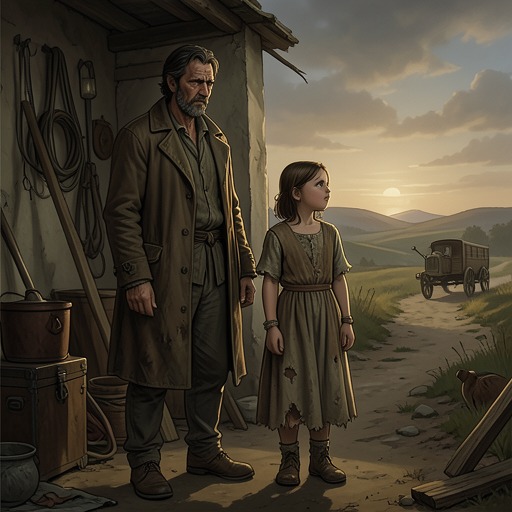
Kidd's bond with Johanna changes the meaning of his journey. He recognizes that, in the hostile world surrounding her, she has no one else but him. After delivering her to the Leonberger farm, he watches her meet the German-speaking relatives she has been returned to; his task, he initially believes, is to hand over the papers and leave. The effort costs him. He stands exhausted and in pain, and says he has brought her all the way from Wichita Falls on the Red River.
The reunion does not become a safe homecoming. When Kidd sees the dark red stripes left by a dog whip across Johanna's hands and forearms, his anger nearly stops him from acting. Instead, he tells her it is time to go, steps down from the wagon, and lets her cross the fence and run to him. She calls him grandfather and says she will go with him. Kidd puts his arm around her, throws the halters into the road, and turns the Curative Waters wagon north. His warning that anyone who objects will be shot full of ten-cent pieces recalls the violence they have already survived, but here the threat serves to protect the child rather than to claim authority over her.
Their life together becomes visible in small, repeated acts of care. On the road, Kidd patiently guides Johanna's hand as she prints letters with a carpenter's pencil on the back of one of his handbills. She learns to read and write while he continues his work as the man who reads the news. The relationship is not merely that of rescuer and rescued: Johanna calls him her curative water, while he later calls her his dearest little warrior. Their words and gestures give the journey a lasting intimacy that neither the return to her relatives nor the demands of adulthood can erase.
Farewell and Later Years
When Johanna is ready to leave with John Calley, she puts her arms around Kidd's neck and promises that they will visit often. She begins to sob; Kidd shuts his eyes and hopes not to cry himself. He gives her his gold watch, connecting the possession he had counted among his finest to the person who has become central to his life. He tells her that time seems to have moved quickly and that, after years of worry and delight in her company, it is time to give her away. The gesture makes separation an act of love rather than a repudiation of their shared life.
Johanna and John Calley marry, and she joins him on a cattle drive to Sedalia, Missouri, in a light four-wheeled buggy. They continue together into the next century and live to see an airplane land in Uvalde. Kidd, meanwhile, drifts into very old age and works again on a Kiowa dictionary until his eyesight makes it difficult to continue. He often remembers Johanna's cry at the Great Brazos River Ten-Cent Shoot-Out: she was only ten, but he remembers the cry as a genuine war cry. The memory holds together the two sides of his experience with her—his fear for a child exposed to violence and his recognition of her courage. His final years do not undo the losses that shaped him, but they are no longer defined only by drifting: he has carried news, protected Johanna, and helped her reach a life she can love.