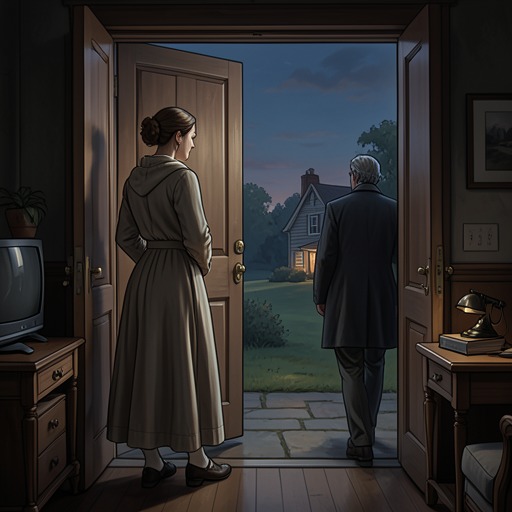
Johanna Leonberger and Anna Leonberger
News of the WorldJohanna Leonberger and Anna Leonberger are joined by family ties but separated by their understanding of what Johanna needs after captivity. When the ten-year-old returns to the Leonberger farm, Anna responds not with the gradual reassurance Jefferson Kyle Kidd believes the child requires, but with commands to rise, work, and learn the household’s ways. Johanna’s eventual flight back to Kidd makes the distinction stark: kinship brings her to Anna’s door, but it does not make that household feel like home.
Kinship and the Return
Johanna’s arrival at the farm begins with a small recognition. On hearing German, she looks toward the farmhouse and outbuildings and whispers the family words for aunt and uncle. The response is not an embrace described as mutual recognition. Dogs bark around the arrivals; the household stands watching; and Johanna, after looking toward the farm, becomes blank again. Her relatives receive her as a returned niece, but the scene presents return as a threshold rather than a settled reunion.
Kidd introduces himself and explains that Johanna was ransomed at Fort Sill. He hands the family the papers, then stands exhausted and in pain while Johanna crosses the driver’s seat and climbs down beside him. The documents establish how she has been returned; they cannot establish what kind of relationship she and Anna will now have. Johanna’s brief German recognition gives way to the difficulty of living among relatives whose home, language, and expectations are familiar in name but no longer familiar to her.
Anna’s Expectations and Johanna’s Refusal
Inside the house, Anna tells Johanna to get up. The girl looks at her seriously, then turns away. Anna’s command makes visible the gap between her expectation of ordinary household behavior and Johanna’s condition. The child sits on the floor with her skirts gathered around her, bare feet and loosened hair showing the disarray of the journey. To Johanna, the house itself is strange: its pictures, carpet, dishes, glass windows, and curtains belong to a way of life she does not understand. Anna’s demand asks for compliance before that estrangement has been addressed.
Anna asks whether Johanna thinks she is Indian and orders her to rise again; Johanna ignores her. Kidd explains that the girl identifies as Kiowa and is only ten, and asks that her circumstances be taken into account. Anna’s answer is that the child must be corrected strongly. That exchange makes their conflict more than a disagreement over manners. Anna regards correction and work as the means by which Johanna should be brought into the household; Kidd sees a traumatized child who needs quiet, peace, gradual adjustment, and reassurance after changing guardians three times.
The contrast extends to the meaning of household membership. Johanna sings softly to herself in Kiowa while the adults discuss whether she can learn their ways. Anna considers the practical demands of the farm and says Johanna is not too small to do her share. Her position is consistent with a home organized around labor and discipline, but it leaves little room for the child’s attachment to another language or identity. Johanna’s refusal to rise is one of the few actions the scene gives her; it registers a boundary even when she cannot make her needs understood to Anna.
Family History and the Limits of Care
Anna is presented as precise in gesture and tightly guarded in expression. When she looks at Johanna, she presses her lips together and turns her attention to her shoes. She also recounts the violence suffered by the family: her little sister was killed, and the men who pursued the attackers rode their horses to death without catching them. The account places Anna’s sternness within a history of bereavement and failed pursuit, but the text does not say that this history excuses her treatment of Johanna. Instead, the family’s grief and the child’s needs occupy the same house without bringing them into understanding.
The practical and legal conditions surrounding the reunion further complicate the claim of kinship. Johanna’s relatives have no adoption papers, and the messenger tells Kidd that adopting her would make them legally responsible for her support and, according to custom, for providing a dowry. They had not adopted their nephew either. These details distinguish receiving a blood relative from accepting the obligations of adoption. They also make the household’s welcome uncertain: Johanna has been brought to her family, but there is no formal commitment that secures her continuing care.
The Second Departure
Kidd leaves the farm after recognizing that the adults’ expectations will not change simply because he has explained Johanna’s condition. That night he returns to see her alone in a field, sent out after dark to fetch horses. She carries heavy halters and a wooden bucket of shelled corn, struggles over uneven ground, and calls to the horses softly in Kiowa. Dark stripes mark her forearms and hands from a dog whip. The narrative does not identify who wielded it, so the scene cannot assign that act to Anna; it does show the conditions Johanna faces in the household where Anna is one of her guardians.
When Kidd calls, Johanna drops the bucket, vaults the fence, and runs to him. She calls him grandfather and says she will go with him, crying as she repeats her decision. Kidd puts an arm around her, throws the halters into the road, and turns the Curative Waters wagon north. Her choice does not erase the family relationship with Anna, but it gives the attempted reunion its decisive outcome: the child prefers the companion who has protected her to the relatives who have received her as a worker to be corrected.
Significance of the Relationship
Anna and Johanna’s relationship reveals that biological return is not the same as emotional or cultural restoration. Anna addresses the child as someone who must resume work and learn the household’s customs; Johanna remains attached to Kiowa speech and rejects even simple commands. Their conflict is conveyed through ordinary gestures—the order to stand, the turned gaze, the ignored instruction, the burdened walk to the horses—rather than through a negotiated reconciliation. The farm offers family connection in name, but Johanna’s experience there makes that connection insufficient to keep her.
The episode also contrasts formal kinship with care as practiced. The family’s lack of adoption papers leaves support and dowry obligations unassumed, while Kidd’s response becomes concrete when he returns at night and takes Johanna away. Anna is not given a later reconciliation with her niece; the relationship’s last decisive movement is Johanna’s departure. The result is an unresolved family bond, shaped by bereavement, cultural dislocation, labor, and the difference between claiming a child as kin and making her feel safe.