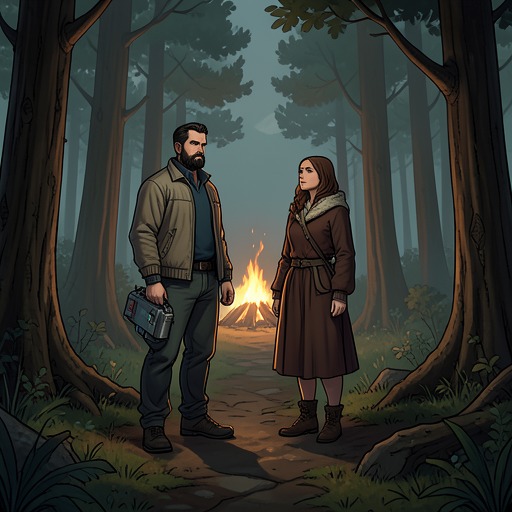
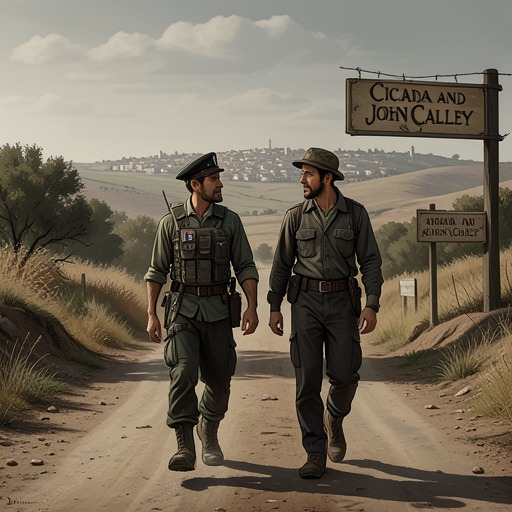
Johanna Leonberger and John Calley
News of the WorldJohanna Leonberger and John Calley’s relationship joins a tentative courtship to a long life on the road. John first approaches Johanna in San Antonio, Texas, as a visitor to Jefferson Kyle Kidd; she does not remember him, though he remembers her as the ragged, wary ten-year-old he met years earlier. Their marriage, celebrated in the Betancort house, takes Johanna from a strained attempt to fit into her relatives’ household toward a life she can love, while making her departure from Jefferson Kyle Kidd an unmistakable loss for them both.
Reunion in San Antonio
By the time John rides into San Antonio, Texas, Johanna and Jefferson Kyle Kidd have come to live with Elizabeth and Emory and their children. Johanna is trying to pass as a white girl: she joins other girls on river excursions and at dancing lessons, rides sidesaddle, and carefully manages her knife, fork, and coffee spoon at dinner. Yet she watches Mexican women and girls washing and playing in the water with envy. The effort to adopt the expected manners has not made her feel at home, and Jefferson Kyle Kidd, helpless before her unhappiness, sits in silence over his flan.
John arrives carrying his own memory of Johanna. He recalls the ten-year-old in the spring wagon, her hair in ragged braids and her manner like a wild animal’s, and remembers that she once slapped taffy from his hands. The girl who opens the door now has braided yellow hair, freckles, and clean, carefully tended nails. She introduces herself as Johanna Kidd, but does not recognize him. The contrast makes the meeting uneven: John brings a vivid past with him, while Johanna receives him as a travel-stained stranger.
He explains that he has come to pay his respects to Jefferson Kyle Kidd and claims that cattle brought him to town. After their conversation in the patio, John asks to visit again. He returns with newspapers for Jefferson Kyle Kidd and a small arrangement of dried roses for Johanna. His attentions connect the older man’s world of news and print with a personal effort to become familiar to the young woman. Johanna invites him to call her Johanna, a small but deliberate easing of the formality between them.
Courtship through music and visits
The relationship advances through repeated visits rather than an immediate declaration. At Elizabeth’s piano, John plays Come to the Bower and The Yellow Rose of Texas. He does not look up as he plays, waiting to see whether Johanna will come to him. She eventually stands at his shoulder; when he moves along the bench, she hesitates, then sits beside him. For the first time, she smiles at him. He teaches her the songs note by note, making music their shared activity and giving their growing ease a concrete form.
The afternoon has the ordinary sounds of the city around it: a milkman calling as he passes with his gray horse, a voice calling for Timotea, and the wind rising by the river. John sings in a rough, off-key voice, loses the lyrics, and finally sits looking at Johanna. Jefferson Kyle Kidd watches from a tall window as old Spanish houses are demolished and new brick buildings rise around the Plaza de las Islas. His view holds the courtship within a city changing around them, even as Johanna and John make a quieter change of their own.
When John must leave at sunset, Johanna stands in the doorway holding his hat in both hands. She invites him to dinner, speaking carefully in the accent she has acquired. The gesture reverses the reserve of their first meeting: the girl who had not recognized him now asks him to return. The visits, newspapers, roses, music, and invitation establish a gradual passage from polite hospitality to mutual closeness without suggesting that Johanna’s deeper cultural estrangement has simply disappeared.
Marriage and the parting from Jefferson Kyle Kidd
John makes his living gathering wild cattle around Frio Town, south of San Antonio, in the lawless brush country of the Nueces Strip. The work is dangerous, dependent on alertness and skill with a gun, but successful drives can yield a small fortune. He hires experienced hands, brands the cattle he gathers with a road brand, and becomes established after two trips north. This hard-won livelihood forms the practical background to the life Johanna joins when they marry.
The wedding takes place in January at the Betancort house, following the Southern custom of marrying in the bride’s home. John waits downstairs in a stiff black cutaway and striped ascot beside an Episcopal minister from St. Joseph’s. Upstairs, Johanna sits on the bed with Jefferson Kyle Kidd, her hands shaking. She sits close to him as though seeking protection from the unknown future. The scene makes the wedding more than a passage into marriage: it is also a threshold between the relationship that has sheltered her and the new household she is about to enter.
At eleven, Elizabeth calls up to ask whether Johanna is ready. Before going downstairs, Johanna embraces Jefferson Kyle Kidd and promises that she and John will visit often. She calls him her curative water and begins to sob. He shuts his eyes, trying not to cry, calls her his dearest little warrior, and presses Kidd’s gold pocket watch into her hand. He reflects that time has swept ahead through the years in which he worried about her and delighted in her company, and that now he must give her away. His gift makes the moment’s separation tangible: the watch that measures time passes from the man who raised and protected her to the woman leaving him to marry.
A life on the cattle roads
After the wedding Johanna accompanies John on his next cattle drive, traveling all the way to Sedalia, Missouri, in a light four-wheel buggy. The narrative says plainly that it is a life she can love. She and John ride the cattle country of Texas together into the next century, making their marriage a continuing partnership rather than a brief ending to the courtship. They live to see an airplane land in Uvalde, standing with their two grown children as it strikes the Texas earth and its pilot walks away from the wreckage.
The relationship’s final shape is therefore measured in shared journeys and years, not only in the wedding scene. Johanna moves from the stiff performances of her San Antonio household into a life on the cattle roads with John; Jefferson Kyle Kidd, meanwhile, grows old and continues working on his Kiowa dictionary until his sight fails. He often remembers Johanna’s cry at the Great Brazos River Ten-Cent Shoot-Out, when she was ten. That memory and the wedding farewell frame John and Johanna’s future beside the lasting bond between Johanna and the man who had cared for her: marriage gives her a life of her own, but does not erase the love or grief involved in leaving.