John Calley
News of the WorldJohn Calley’s arc moves from a roadside apology to a precarious cattle business and marriage to Johanna Leonberger. He is introduced not as an established gentleman or rancher but as a man connected to the people who took Jefferson Kyle Kidd’s money. His effort to make amends, and to be regarded as more than the company he keeps, becomes the beginning of a consequential relationship with Kidd. Later, Calley makes his living in a region where lawlessness and physical risk are part of the work, and returns to San Antonio to court and marry Johanna.
Introduction and the roadside apology
Calley first comes into focus after the disturbance at the mercantile store in Durand. As rain falls and men continue arguing in the street, Kidd kneels to collect coins. Calley, recognizable as the short-black-bearded man who had stopped him on the road, offers help. Kidd acknowledges the indignity of having to gather the money himself, and Calley draws up an unbroken chair so the exhausted older man can sit while he picks up the coins.
As he returns the money to the can, Calley admits that he and his companions should not have taken it earlier that day and says he regrets doing so. Kidd observes that Calley has fallen in with bad company. Calley identifies that company as his cousins and brother. The exchange makes his family tie to the roadside taking explicit, while also separating his own conduct from theirs: he does not deny what happened, and he takes practical action to repair it.
Respect, class, and the search for work
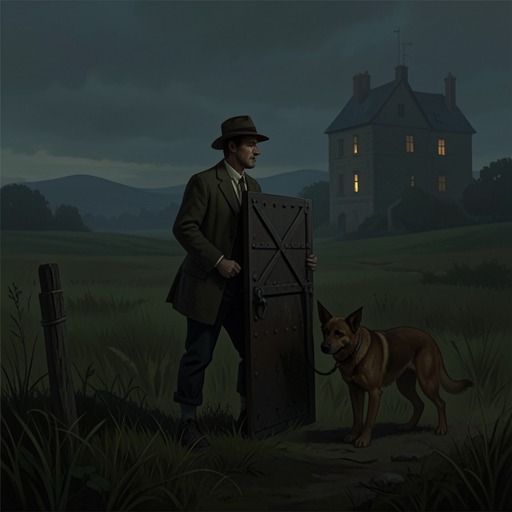
Calley’s appearance at the store changes the older man’s impression of him. He is now in pressed dark trousers, a cutaway coat, a clean white shirt with a high collar, and a cravat. The clothes are frayed, but carefully kept; his boots are good, and his dark beard has been trimmed. While handling the coins, he remarks on the unstable legal situation, including land titles, and Kidd recognizes that Calley has dressed in his best to show that he is not a filthy, ignorant brigand but a serious man of gentle upbringing who wants Kidd’s respect.
That desire matters because Kidd has urged him to abandon his wayward relatives and their illegal activities. Calley replies that what counts as illegal seems to change from week to week. When Kidd asks whether he is considering reading law, Calley rejects the suggestion and says he is looking for honest work. His response does not erase the earlier taking of money; instead, the scene sets his stated intention against his compromised circumstances. He wants a respectable livelihood, but lives in a period when, as he points out, even the legal status of land is uncertain.
A livelihood in the Nueces Strip
Calley eventually decides to remain in South Texas and gather wild cattle around Frio Town, south of San Antonio, in the notorious Nueces Strip. The work offers a chance to make a small fortune, but the region is described as devoid of law and suited neither to the careless nor the fainthearted. Success depends on staying alert, being able to shoot, and sleeping lightly enough to survive the danger. The account gives the business no romantic ease: the cattle are wild, the country is unsafe, and a man must live long enough to profit from the effort.
Calley hires men suited to those conditions, including Ben Kinchlowe, who speaks both English and Spanish and is skilled with cattle and revolvers. Calley brands the cattle he gathers with a road brand and drives them north. After two trips he is described as a made man. The change is concrete: the man who had said he was looking for honest work has found a demanding enterprise that can provide wealth, but only through alertness, armed competence, and repeated journeys through dangerous country.
Courtship and marriage
Calley’s memory of Kidd’s public call for silence and reason in the Durand mercantile store endures. He later rides into San Antonio and visits Kidd at the Betancort house. At the doorway, a maid answers suspiciously; behind her stands a slender, freckled, blue-eyed girl of about fifteen, with thick yellow hair braided in a crown. The scene presents Calley’s visit through the household’s guarded threshold and Johanna’s uncertain first response. When he finally leaves at sunset, she stands at the door holding his hat in both hands and carefully invites him to dinner. Her halting words make the invitation an effort as well as a courtesy.
Calley and Johanna marry in January at the Betancort house, following the Southern custom of holding the wedding in the bride’s home. Calley waits in a stiff black cutaway and striped ascot with an Episcopal minister from St. Joseph’s. Before they are called downstairs, Johanna sits on the bed beside Kidd, her hands shaking; she stays close to him as if seeking protection from an unknown future. Her fear is explicit in the scene, while Calley’s formal clothing and presence mark the transition to marriage without making the future seem settled. Johanna addresses Kidd as Kontah, and tears stand unshed in her eyes.
Narrative significance
Calley’s importance lies in the contrast between the beginnings of his story and its later commitments. He is first associated with an act of exploitation carried out by his family group, but he apologizes, returns the money, and asks to be judged as a serious man. His search for respectable work does not lead to a safe or orderly world: he makes his fortune in a lawless cattle country where survival depends on vigilance and skill. The later marriage links that self-made life to Johanna’s difficult return to a household and culture in which she remains unsure of her place. Their wedding is therefore a union, but not a simple resolution; the scene closes on her apprehension, with Kidd beside her and the future still unknown.