Mexico
News of the WorldMexico enters the novel not as a single setting but as a borderland of military routes, contested information, and remembered battles. For Jefferson Kyle Kidd, service in the Mexican-American War joined his work as a printer to the physical risks of the campaign, while his encounters with soldiers on Mexican soil helped form his later understanding of what stories might do for their listeners.
A Destination and a Theater of War
After the Alamo and San Jacinto, Jefferson Kyle Kidd left for Texas. By the time of the war with Mexico, he was nearly fifty and had established a life in San Antonio, where he ran a print shop and had a wife and two daughters. The conflict drew him from that civilian life into the organization of military communications.
The novel places several of his wartime experiences in and around Mexico. He served with Zachary Taylor’s forces at Resaca de la Palma and Buena Vista; the latter lay in the high mountains above Monterrey. The campaign’s geography also reaches back to the Rio Grande, from which the soldiers had been shot at during their advance. Mexico is therefore rendered through movement and exposure: a country approached along military routes and encountered through the hazards of the front.
Printing and Carrying Military News
Taylor’s forces needed Jefferson Kyle Kidd to organize communications. He was given a small hand press to print orders of the day, and he wrote up Taylor’s orders for delivery by Captain Walker of the Texas Rangers. Walker’s horsemen carried messages between Port Isabel on the Gulf and the army encampment north of Matamoros, on the Rio Grande. The printed order and the mounted courier formed a working chain: information had to be made legible, reproduced, and carried across distance before it could guide the forces.
His appointment also depended on his practical needs as a communications organizer. Taylor made him a brevet captain in the Second Division so that he could arrange couriers and obtain paper, ink, and horses. His service in the War of 1812 helped recommend him for the rank; afterward he was known as Captain Kidd. In this account, Mexico’s war is not only a sequence of battles but also a test of the material systems that move orders—presses, supplies, and riders.
Resaca de la Palma and Buena Vista
At Resaca de la Palma, an artillery ball from the Mexican side passed through the staff tent and shattered a table only three feet from Jefferson Kyle Kidd. Lamp oil sprang into transparent dots across the canvas. A major was struck by a table splinter through the neck, complained that his collar was too tight, and fainted; against the odds, he survived. The near miss makes the work of transmitting information inseparable from the immediate violence surrounding it.
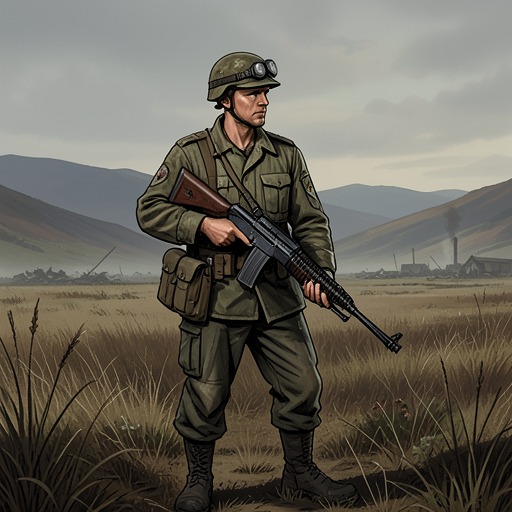
At Buena Vista, in February 1847, Jefferson Kyle Kidd was handed a Model 1830 Springfield flintlock. Familiar with the weapon from his upbringing, he lay in a wagon bed and fired toward gunsmoke, hoping that he brought down at least one hidden sniper. The campaign had already exposed the troops to shots from Mexican sharpshooters or Apaches, and the uncertainty itself was part of the danger.
The young men around him wanted to compare their own ordeal with earlier fighting. As the Texas Rangers listened by the campfire, Jefferson Kyle Kidd told them what he could about the Battle of Horseshoe Bend: the weapons used by the Creek and the Choctaw, the Georgia militia’s rifles and minie balls, the wagons sunk hub-deep in sand on the way to Pensacola, and the captain who was killed on the second day. When the men sought advice, he urged them to care for one another, since a person might be hit without knowing it, as might the soldier beside him. Mexico thus becomes the setting for an exchange between generations of fighters, in which battlefield recollection serves a practical purpose as well as a human one.
The Mexican Army and the Meaning of Telling
The soldiers’ opponent was José Mariano Martín Buenaventura Ignacio Nepomuceno García de Arista Nuez, described as a committed republican at odds with his own general staff. Jefferson Kyle Kidd understood the Mexican Army as divided by entrenched aristocrats and generals with liberal theories. He also recalled the contrast between its stiffly European, formal manner and the barefoot mestizo privates, who were still made to wear neck stocks. These details complicate the soldiers’ view of the enemy: the opposing army was not a faceless force, but an institution divided by internal political tensions and unequal conditions.
After one of these conversations, alone beside the dying mesquite fire, Jefferson Kyle Kidd considered using intelligence reports and the general press to give people reliable knowledge of distant events. He hoped that fuller understanding might dissuade people from taking up arms. That belief lasted for years, but his idea of his work changed: information alone was not enough. He came to see that listeners also needed tales of the remote and mysterious, carried to them as if they were hard news. His wartime experience in Mexico helps establish the double nature of his vocation—first a courier of orders and information, later a teller who hopes that news and stories can carry listeners, briefly, toward a healing place.