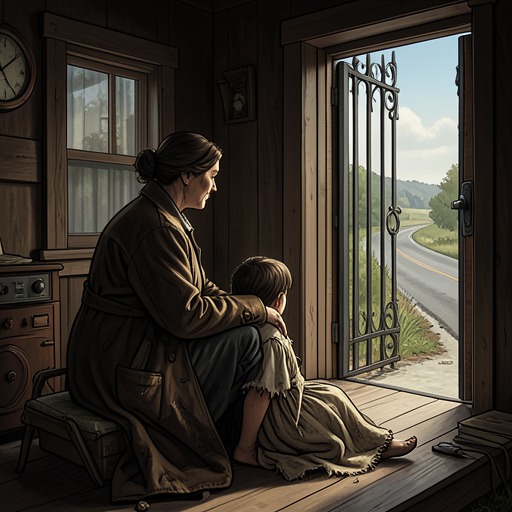
Mrs. Gannet
News of the WorldMrs. Gannet is a widowed livery-stable keeper in Dallas, Texas, whose brief but consequential hospitality gives Jefferson Kyle Kidd and Johanna Leonberger shelter during a dangerous journey. Her welcome is practical rather than ceremonial: she offers to look after Johanna, arrange clothes for both travelers, and help Kidd prepare to leave. The risks she warns him about are not distant abstractions; a raid has already taken her husband. That history gives her care a gravity the travelers’ hurried stop might otherwise conceal.
Identity and Circumstances
Mrs. Gannet runs the stable herself, a fact that surprises Kidd as he arrives worn and stained with Red River sludge. She appears trim and youthful, with leaf-colored hazel eyes and a good smile; her bonnet is pushed back, its strings hanging over her shoulders. The description is filtered through Kidd’s attention, which registers both her competence and her appearance. She is introduced at work, emerging from the feed-storage room with three empty flowered feed sacks, not waiting passively for the travelers to arrive.
Her widowhood is tied directly to the violence surrounding the journey. A year before Kidd’s visit, her husband was found in pieces along the Weatherford road, stripped of his clothes. Kidd knows this history as he hears her warn that raids have spread through the country. Her experience gives her warning a personal basis, even as she still has to manage the stable and decide what help she can offer a stranger.
Shelter and Practical Care
When Mrs. Gannet sees Johanna watching from beneath the red wool covering, she looks to Kidd for an explanation. He tells her they are traveling toward San Antonio, and she immediately stresses how far away it is and how dangerous the roads have become. She asks whether they should wait for a convoy. Kidd answers that he is armed with a sidearm and shotgun, but asks if Johanna can remain with her while he searches for newspapers and a hotel in Dallas, Texas.
Mrs. Gannet agrees to look after the girl and offers Kidd the chance to change in the feed room. She proposes sending his traveling clothes to Mrs. Carnahan and asking whether Mrs. Carnahan has a secondhand dress for Johanna, along with other necessary garments. Kidd recognizes that Johanna needs a change of clothing, and Mrs. Gannet turns that need into a concrete arrangement. When he thanks her and says he will settle up when they leave the next day, the exchange establishes her generosity as deliberate assistance, not simply a stable transaction.
Johanna is frightened enough to reach out from her covering for Kidd’s hand, apparently fearing that she is about to be handed to another stranger. Mrs. Gannet’s offer of care therefore meets a child’s immediate vulnerability as well as the practical demands of the journey. Later, she tells Kidd that Johanna has found some comfort among the horses and that the two of them are learning the animals’ names. Kidd is relieved. The stable becomes, for a short interval, a place where Johanna can attend to something familiar and manageable while her guardian makes arrangements.
The Night Departure
The travelers’ stay ends abruptly. In the middle of the night, Kidd hurries from his hotel room to Mrs. Gannet’s door and tells her they have to leave that night. She has been roused quickly: her lamp has just been lit, and she appears in a forest-green wrapper over a long nightgown, her dark brown hair loose down her back. Behind her, Johanna is already sitting upright in bed, fully awake, with both feet planted on the floor.
Before climbing onto the wagon’s footplate, Kidd removes his hat and thanks Mrs. Gannet. She is furious and shocked at what Almay has said, although the account does not specify the words that provoked her reaction. Her anger is visible in her eyes as she holds a lantern. Kidd is immediately struck by this animated force in her; the farewell is not only a hurried exchange of thanks but a moment in which her anger sharpens his attention to her.
Farewell and Narrative Significance
Kidd takes Mrs. Gannet’s hand, described as short and strong, with a silver bangle set with sparkling red gems at her wrist. He asks whether he may have the honor of calling on her when he returns and suggests picnics on the banks of the Trinity. Mrs. Gannet does not treat the proposed future meeting as certain: she replies that he must first return, then tells him to take care. Her answer holds the warmth of the encounter beside the real uncertainty of the road ahead.
Mrs. Gannet’s role is brief, but her kindness has specific consequences. She gives Johanna a safer pause among the horses, helps address the travelers’ need for clean clothing, and offers Kidd assistance when he is exhausted and exposed to danger. Her own bereavement also places that hospitality in a world where violence has already entered her household. The narrative presents her largely through Kidd’s gaze, including his notice of her dress, hair, and smile, but it also gives her decisive actions and judgments: she runs the stable, recognizes the danger, tends to Johanna, and responds forcefully when she hears what Almay has said. Her last words do not promise a reunion; they make return itself the condition on which any future can depend.