News and Stories as a Healing Transmission
News of the WorldNews and Stories as a Healing Transmission names the purpose Jefferson Kyle Kidd gradually discovers in his public readings: distant information can orient people to a wider world, while tales of remote places can briefly carry them away from immediate worry. The two forms work together. News supplies the authority of fact; story opens a space for imaginative relief. His readings do not erase hardship, but offer listeners a short interval in which attention can move elsewhere.
From Information to a Larger Purpose
Late one evening, alone beside a dying mesquite fire, Jefferson Kyle Kidd considers taking on the work of distributing important facts gathered from intelligence reports and the general press. Reports about struggles at the highest levels of the Mexican Army suggest to him that knowledge might have practical consequences: if people understood the world more fully, perhaps they would be less inclined to take up arms. For a time, he imagines becoming an aggregator of distant information whose work might help make the world more peaceful.
That conviction lasts from the age of forty-nine to sixty-five. The span matters because the later idea does not simply discard the earlier one. Information remains central, but he comes to think it is not, by itself, what people need. They also need accounts of the remote and mysterious, presented in a form that sounds like hard information. The blend gives listeners both the sense of learning about the world and the freedom to travel beyond their immediate circumstances in imagination.
The Reader as a Messenger
Jefferson Kyle Kidd pictures himself as a runner who does not move: in his smeared printing apron, he carries reports and stories to people gathered to hear him. The paradox makes his task legible. He stays at the lectern, but the news has crossed great distances before it reaches him, and his voice conveys those distances to a local audience. He is not merely reporting events; he is mediating between faraway places and people whose daily concerns can make the wider world seem remote.
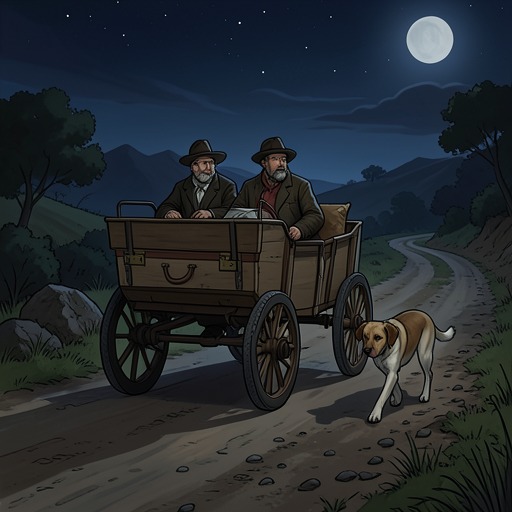
The Curative Waters wagon gives this idea a physical counterpart. He buys the dark green excursion wagon with Spanish coin at a livery stable, lucky to obtain it. Its gold lettering identifies it as a vehicle for mineral-water excursions, and he cannot account for how it traveled from near Houston to a small town on the Red River. Its own journey will remain unknown. The wagon has two rows of seats facing across its bed, poles for a canopy, and side curtains that offer little protection against hard weather. It is at once useful transport and a reminder that an object, like a report, can arrive from elsewhere with a history no one can fully recover. The curative waters named on its sides also echo the refuge Jefferson Kyle Kidd hopes his readings can provide.
How the Readings Carry Their Audience
At Spanish Fort, Jefferson Kyle Kidd follows a deliberate arrangement: several paragraphs of hard news, then accounts of dreamlike places far away. In one reading, he draws on the London Daily News for a report on the Franco-Prussian War, including the French defeat at Wissembourg. He then moves through accounts of Dr. Schliemann’s search for Troy in Turkey and telegraph wires laid from Britain to India, an advance that seems almost otherworldly to his listeners. He finishes with the account of the Hansa crushed in pack ice during an attempt on the North Pole and the rescue of its survivors by a whaler. The sequence crosses war, archaeology, technology, and peril at sea, making the distant world feel at once factual and strange.
His performance gives this material a public form. He reads carefully and precisely, using round, gold-rimmed glasses, and sets his small gold hunting watch beside the podium to time the reading. A lantern throws light across his face. People contribute dimes, five-cent and two-cent pieces, pennies, and sometimes quarters to a paint can; when someone gives a quarter, listeners make their own change. The coin sounds register an exchange, but the crowd’s attention is the larger measure of the reading’s reach. People leave saloons and other establishments, hurry from firelit homes, or leave cattle bedded beside the flooding Red River to listen.
The audience’s response also shows how information can create a temporary community. Listeners in North Texas are jointly astonished that news from France has reached their town, though they do not know the route it traveled or who carried it. The reading makes that invisible journey present without pretending to explain every link in it. They hear reports from elsewhere together, then follow Jefferson Kyle Kidd into settings and subjects that enlarge the evening beyond local concerns.
A Temporary Refuge, Not an Escape from Reality
When he steps down from the lectern, people stand, some following him to offer thanks and compliments. A woman with bright cheeks thanks him after the reading; Jefferson Kyle Kidd wonders whether he has taken her away from worry and preoccupation for a short while. He understands this relief as a brief change in what occupies the mind, not as a cure for the conditions that produced the worry. His image of listeners drifting toward curative waters gives the moment its measure: temporary respite is meaningful precisely because it is temporary.
A man wearing a silver shamrock badge from Hancock’s Second Artillery Corps, Union, receives a firm handshake. Jefferson Kyle Kidd recognizes that surviving Gettysburg warrants congratulations regardless of which side a person supported. He imagines that the reading may have escorted the man’s thoughts toward distant places: crisp ice mountains, falling chimney pots, and tropical volcanoes. The effect joins personal recognition to imaginative travel. The reader acknowledges a listener’s history while offering an attention that can turn, for a time, toward another landscape.
The concept therefore rests on a movement between witness and transport. Reports carry facts across oceans and continents; the reader makes them available to a gathered public; tales carry that public into places beyond its immediate worries. Jefferson Kyle Kidd once hoped that knowledge might prevent people from taking up arms. His later understanding is more modest and more intimate: information and story may give listeners a healing interval in which to attend to a wider world. Like the wagon whose route to the Red River remains untold, the transmission itself contains gaps, but its arrival can still matter.