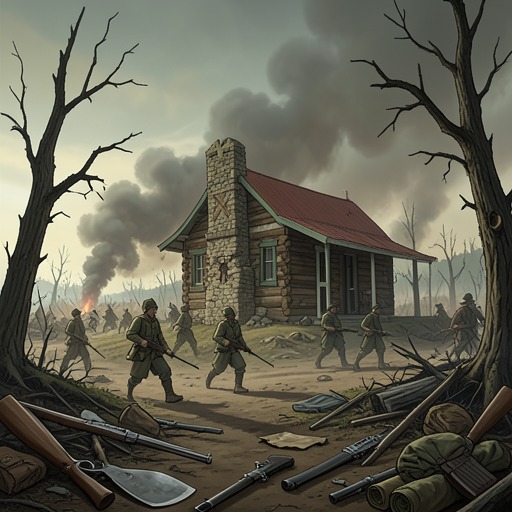
North Texas
News of the WorldNorth Texas is less a bounded destination than a precarious landscape of passage in the novel: a country crossed by travelers and troops, exposed to raiding, and marked by deaths that outlast the journeys themselves. As Jefferson Kyle Kidd and Cicada move through Texas, the region connects the practical business of travel with the unsettled contests over safety and authority that define the postwar setting.
Geography and routes
The narrative places North Texas within a larger network of roads and destinations rather than describing it through fixed borders. Jefferson Kyle Kidd and Cicada travel north from San Antonio toward Wichita Falls, Bowie, and Fort Belknap, sometimes moving in convoy with freighters or the Army. Their journey makes the region part of a working route: a place reached by wagon and traversed amid the ordinary demands of distance, supplies, and company on the road.
The wider itinerary also gives this northern passage a varied geographic context. The travelers cross country that includes the hill country, the coast, and waterless stretches between Kerrville, the Llano, and the Concho; later they pass through Wichita Falls and Spanish Fort. These contrasts matter to the experience of movement. The road is not an abstract line on a map but a succession of places where shelter, water, other travelers, or danger may alter the day’s journey.
A contested frontier
The northern routes lead through a landscape in which military movement and civilian travel overlap without guaranteeing security. On one leg of the journey, a major explains that cavalry is being transferred from San Antonio to Fort Sill and warns Jefferson Kyle Kidd that raiders are active in the hill country. His answer—asking why the Army does not do something about them—meets the officer’s reply that he is under orders and cannot simply go where he chooses. The exchange exposes a gap between the presence of soldiers and their ability to protect people across the country they traverse.
The region’s dangers are connected to the geography north of the settled towns. The novel describes Comanche raiders coming down from the Red River across open, arid country around Lampasas, where dust raised by their movement could be seen for miles. They skirted towns and forts; farther south, the hill country offered concealment, water, and isolated farms, as well as opportunities for fighting and loot beyond the soldiers’ reach. This account makes terrain consequential: open country can reveal movement, while broken and wooded ground can shelter it.
Violence and local memory
North Texas is also fixed in the narrative by a specific death. In 1871, Britt Johnson, Paint Crawford, and Dennis Cureton were killed by the Comanche on a freighting trip near Graham. They were caught on the only open stretch between Graham and Indian Mound Mountain, then buried where they fell. The account emphasizes both the exposed location of the attack and the permanence of its aftermath: their gravestone still stands there.
That event gives the region a human history beyond the travelers’ immediate fears. During their journey, raiders are a warned-of possibility and the country is something to cross cautiously. The later report of the killings turns that general danger into a particular loss, naming the men and the place where they died. North Texas is therefore not only a route through which the story moves; it is also ground where the consequences of violence remain legible.
Narrative significance
The novel’s account of North Texas gathers together the tensions of a mobile, unsettled world. A wagon carrying newspapers and a rescued child shares roads with freighters and cavalry, while neither military orders nor the passing of travelers makes isolated stretches safe. The contrast between the Army’s visible movement and the officer’s inability to act freely gives the frontier’s insecurity a concrete institutional dimension.
The region’s significance also emerges through recurrence and distance. Jefferson Kyle Kidd and Cicada pass through a volatile Texas, collecting money and evading trouble, while the story’s later recollection of Britt Johnson’s death makes clear that danger was not merely an episode in their travels. North Texas links the immediate work of getting from place to place with a broader landscape of raids, constrained protection, and remembered loss.