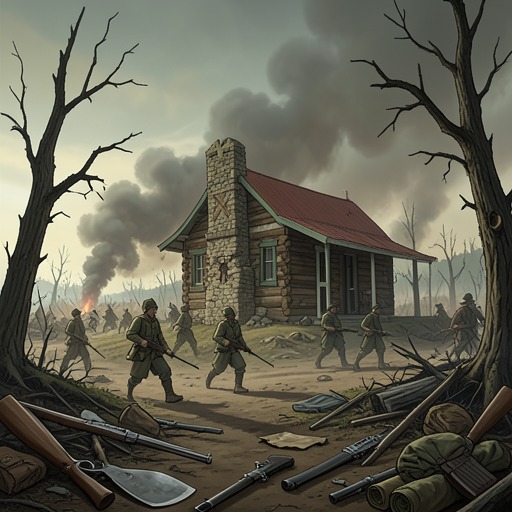
Palo Duro Canyon battle
News of the WorldThe Palo Duro Canyon battle is presented retrospectively as the campaign that ended the Indian Wars: Colonel Ranald Mackenzie drove the last Comanche and Kiowa holdouts to earth in Palo Duro Canyon. The account gives the outcome, not a blow-by-blow of the fighting, and places that conclusion against a landscape where Indigenous people and their histories continue beyond the announcement of military defeat.
A Compressed Account
The narrative reduces the battle to a single decisive statement. It names Mackenzie, identifies the Comanche and Kiowa as the remaining holdouts, and locates the campaign in Palo Duro Canyon. It does not describe the opposing forces, the battle’s tactics, or its duration, so the event is defined by its stated result rather than a dramatized combat scene.
Outcome and Its Immediate Frame
Mackenzie’s drive into the canyon is said to have brought the Indian Wars to an end. The declaration appears as Jefferson Kyle Kidd and Johanna travel through volatile Texas, collecting dimes, evading trouble, and reading news of a changing world. Their movement continues at a reasonable pace; the end of the wars does not make the surrounding land safe or settled in their experience.
Memory Beyond the Campaign
The book’s later coda shifts from military outcomes to the persistence of memory. It says that Kiowa warriors’ bones did not lie in the earth but in stories told and retold, preserving their bravery and daring. That remembrance is not presented as a specific account of the Palo Duro Canyon battle; rather, it complicates the campaign’s claim of finality by showing Indigenous lives and histories continuing in narration after the wars are declared over.